

Wayground
Quadratic Forms - Printable Mathematics Worksheets - Wayground

Quadratic Forms

16 questions

11th - 11th Grade

Mathematics

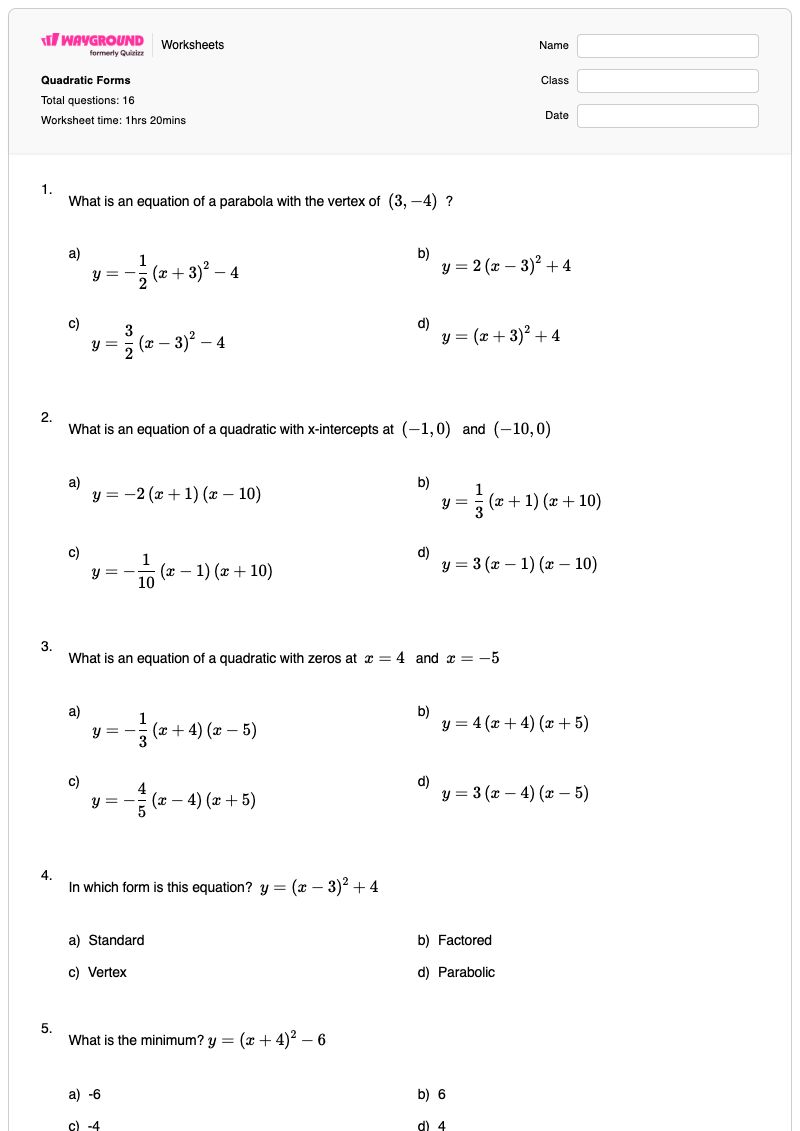
Quadratic Forms is a Grade 11 mathematics worksheet with 16 multiple-choice questions on reading and using the three common forms of a quadratic equation. Students identify standard, factored, and vertex form; determine vertices, minima, y-intercepts, zeros, and f(0); and select equations that match given features such as a vertex or x-intercepts. Several items require students to connect an equation’s structure with the graph information it reveals, including recognizing vertex coordinates from vertex form and zeros from factored form. This free printable worksheet is designed for algebra instruction, guided practice, independent work, or a quick formative assessment. Its answer key supports efficient review of sign conventions, coordinate interpretation, and the relationship between equation form and quadratic features. The multiple-choice format lets teachers quickly identify whether students need reinforcement with equation classification, evaluating functions, or interpreting key features.

Worksheet settings

Font size

S
M
L
XL
Worksheets

Quadratic Forms

Total questions: 16

Name
Class
Date
1.

What is an equation of a parabola with the vertex of  (3,−4)\left(3,-4\right)  ?

a)

 y=−12(x+3)2−4y=-\frac{1}{2}\left(x+3\right)^2-4  

b)

 y=2(x−3)2+4y=2\left(x-3\right)^2+4  

c)

 y=32(x−3)2−4y=\frac{3}{2}\left(x-3\right)^2-4  

d)

 y=(x+3)2+4y=\left(x+3\right)^2+4  

2.

What is an equation of a quadratic with x-intercepts at  (−1,0)\left(-1,0\right)   and  (−10,0)\left(-10,0\right)  

a)

 y=−2(x+1)(x−10)y=-2\left(x+1\right)\left(x-10\right)  

b)

 y=13(x+1)(x+10)y=\frac{1}{3}\left(x+1\right)\left(x+10\right)  

c)

 y=−110(x−1)(x+10)y=-\frac{1}{10}\left(x-1\right)\left(x+10\right)  

d)

 y=3(x−1)(x−10)y=3\left(x-1\right)\left(x-10\right)  

3.

What is an equation of a quadratic with zeros at  x=4x=4   and  x=−5x=-5  

a)

 y=−13(x+4)(x−5)y=-\frac{1}{3}\left(x+4\right)\left(x-5\right)  

b)

 y=4(x+4)(x+5)y=4\left(x+4\right)\left(x+5\right)  

c)

 y=−45(x−4)(x+5)y=-\frac{4}{5}\left(x-4\right)\left(x+5\right)  

d)

 y=3(x−4)(x−5)y=3\left(x-4\right)\left(x-5\right)  

4.

In which form is this equation?  y=(x−3)2+4y=(x-3)^2+4  

a)

Standard

b)

Factored

c)

Vertex

d)

Parabolic

5.

What is the minimum? y=(x+4)2−6y=(x+4)^2-6  

a)

-6

b)

6

c)

-4

d)

4

6.

What's the y-intercept?  y=2x2+6x+7y=2x^2+6x+7  

a)

(0, -7)

b)

(7, 0)

c)

(0, 7)

d)

(-7, 0)

7.

In which form is this equation?  y=(x−3)(x+8)y=(x-3)(x+8)  

a)

Standard

b)

Factored

c)

Vertex

d)

Parabolic

8.

What is f(0) 
 f(x)=2x2+4x+6f(x)=2x^2+4x+6  

a)

-4

b)

4

c)

-6

d)

6

9.

What is the vertex of
 f(x)=2(x−5)2+12f(x)=2(x-5)^2+12  

a)

(-5, -12)

b)

(5,-12)

c)

(5, 12)

d)

(-5, 12)

10.

What's the y-intercept? y=2x2+6x+7y=2x^2+6x+7  

a)

(0, -7)

b)

(7, 0)

c)

(0, 7)

d)

(-7, 0)

11.

Which form is this in?  y=3x2−7x+2y=3x^2-7x+2  

a)

Intercept

b)

Standard

c)

vertex

d)

Cubic

12.

Where is the vertex of this quadratic?

 y=(x−1)2+7y=\left(x-1\right)^2+7  

a)

(1, 7)

b)

(-1, 7)

c)

(7, 1) 

d)

(0, 7) 

13.

Which of the following correctly shows the vertex of this graph

a)

f(x) = (x -5)2 + 1

b)

f(x) = (x - 1)2 - 5

c)

f(x) = (x + 1)2 - 5

d)

f(x) = (x + 5)2 +1

14.

Which of the following is correctly paired with the feature it reveals

a)

 f(x) = (x−3)(x+5)f\left(x\right)\ =\ \left(x-3\right)\left(x+5\right)  has zeros at  x = −3x\ =\ -3  and  x = 5x\ =\ 5  

b)

 f(x) = x2−2x − 15f\left(x\right)\ =\ x^2-2x\ -\ 15  has zeros at  x = −15x\ =\ -15  

c)

 f(x) = x2−2x−15f\left(x\right)\ =\ x^2-2x-15  has vertex at  (2, −15)\left(2,\ -15\right)  

d)

 f(x) =(x−1)2−16f\left(x\right)\ =\left(x-1\right)^2-16  has vertex at  (1,−16)\left(1,-16\right)  

15.

Which of the following is correctly paired with the feature it reveals

a)

f(x) = (x −6)(x+4)f\left(x\right)\ =\ \left(x\ -6\right)\left(x+4\right) has zeros at x=6x=6 and x=−4x=-4

b)

f(x)=x2−2x+24f\left(x\right)=x^2-2x+24 has f(0)=−24f\left(0\right)=-24

c)

f(x) = (x−1)2−23f\left(x\right)\ =\ \left(x-1\right)^2-23 has vertex (1, 23)\left(1,\ 23\right)

d)

f(x)=(x−1)2−23f\left(x\right)=\left(x-1\right)^2-23 has f(0)=−23f\left(0\right)=-23

16.

Which of the following correctly shows f(0)

a)

f(x)=x−5f\left(x\right)=x-5

b)

f(x)=x2+3x+5f\left(x\right)=x^2+3x+5

c)

f(x)=x2+3x−5f\left(x\right)=x^2+3x-5

d)

f(x)=x2+3x+1f\left(x\right)=x^2+3x+1

Answer Key

Quadratic Forms

Total questions: 16

1.
c)

 y=32(x−3)2−4y=\frac{3}{2}\left(x-3\right)^2-4  

2.
b)

 y=13(x+1)(x+10)y=\frac{1}{3}\left(x+1\right)\left(x+10\right)  

3.
c)

 y=−45(x−4)(x+5)y=-\frac{4}{5}\left(x-4\right)\left(x+5\right)  

4.
c)

Vertex

5.
a)

-6

6.
c)

(0, 7)

7.
b)

Factored

8.
d)

6

9.
c)

(5, 12)

10.
c)

(0, 7)

11.
b)

Standard

12.
a)

(1, 7)

13.
b)

f(x) = (x - 1)2 - 5

14.
d)

 f(x) =(x−1)2−16f\left(x\right)\ =\left(x-1\right)^2-16  has vertex at  (1,−16)\left(1,-16\right)  

15.
a)

f(x) = (x −6)(x+4)f\left(x\right)\ =\ \left(x\ -6\right)\left(x+4\right) has zeros at x=6x=6 and x=−4x=-4

16.
c)

f(x)=x2+3x−5f\left(x\right)=x^2+3x-5

FAQs

What does the Quadratic Forms worksheet cover?

This Grade 11 worksheet uses 16 multiple-choice questions to assess how students interpret standard, factored, and vertex forms of quadratic equations. Students identify vertices, minima, y-intercepts, zeros, and f(0), then match equations with the graph features those forms reveal.

How can I use this worksheet to teach quadratic forms?

Introduce one equation form at a time and ask students to explain what information its structure makes easiest to find before assigning the multiple-choice items. Use the vertex-form questions to discuss vertex coordinates and minimum values, the factored-form questions to connect factors with zeros, and the standard-form questions to evaluate f(0) and identify the y-intercept.

What mistakes should I watch for when students complete this worksheet?

Watch for sign reversals when students read the vertex from expressions such as (x − 5)² + 12 or identify zeros from factors such as (x + 1)(x + 10). Students may also confuse a point’s coordinates, mistake the constant term for the y-intercept without writing the point as (0, b), or confuse standard, factored, and vertex form.

How do I assign and grade this Quadratic Forms worksheet?

The worksheet is available as a printable PDF and as a digital quiz on Wayground, and it includes a complete answer key. For printable submissions, you can scan student work with the Wayground for Teachers app to support grading and review.

How does this worksheet help students choose the most useful quadratic form?

The classification and feature-matching questions require students to connect an equation’s form with the information it exposes. By comparing standard, factored, and vertex expressions, students build fluency in deciding whether to look for a y-intercept, zeros, a vertex, or a minimum directly from the equation.

Where can I find more worksheets like this on Wayground?

Wayground offers a comprehensive collection of free printable worksheets and practice problems across all subjects, with downloadable PDFs and answer keys to help students master essential skills and concepts. Browse more resources at https://wayground.com/en-us/worksheets.