
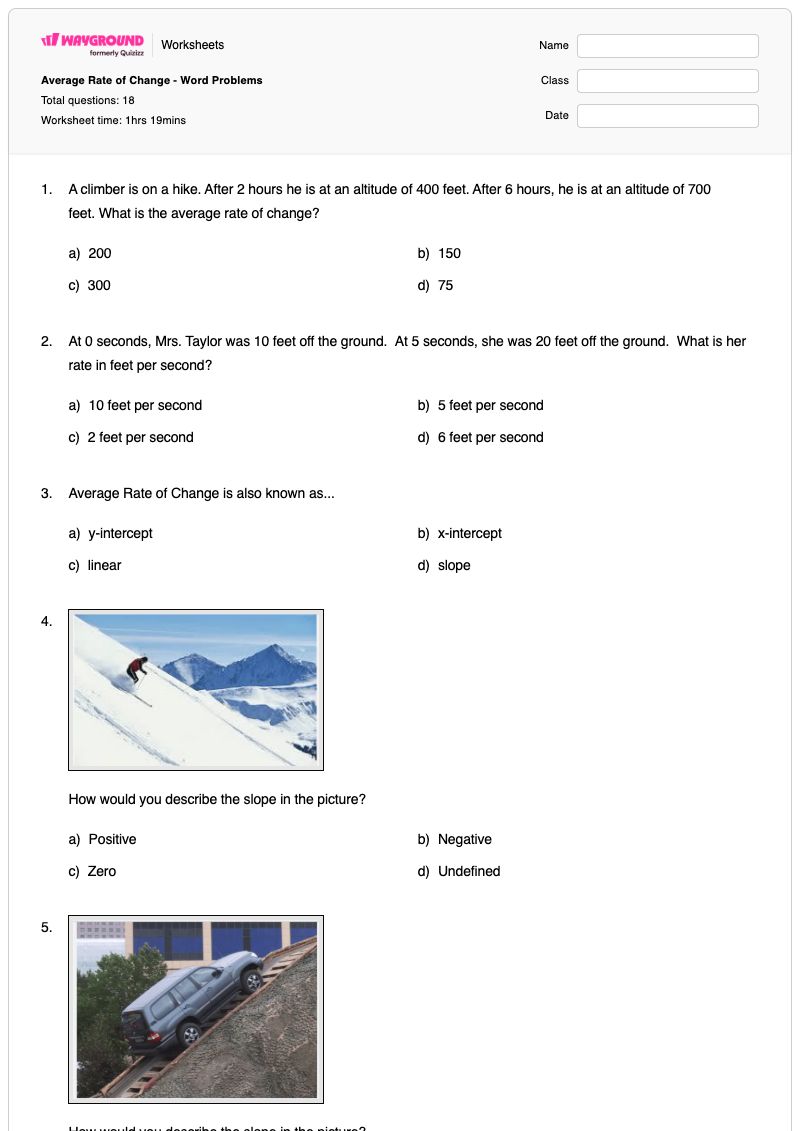

Average Rate of Change - Word Problems is a free printable mathematics worksheet for Grades 9–11 that develops students’ ability to calculate and interpret average rate of change, slope, and unit rates. Across 18 questions—15 multiple choice and 3 multiple select—students work with real-world situations involving hiking altitude, motion, rocket distance, snowfall, height, travel, typing, customers, and fuel costs. They also interpret graphs, tables, intervals, and visual representations to identify positive, negative, zero, or undefined slope and compare rates.
The worksheet helps students connect average rate of change to slope, choose appropriate units such as feet per second or inches per day, and decide when to find a unit rate alone or find and apply it to a new quantity. It is suitable for guided practice, independent review, or formative assessment in an algebra or functions unit. The worksheet is available as a free printable PDF and includes a complete answer key for efficient checking and instruction.
Worksheet settings
Font size
S
M
L
XL
Worksheets
Average Rate of Change - Word Problems
Total questions: 18
Name
Class
Date
1.
A climber is on a hike. After 2 hours he is at an altitude of 400 feet. After 6 hours, he is at an altitude of 700 feet. What is the average rate of change?
a)
200
b)
150
c)
300
d)
75
2.
At 0 seconds, Mrs. Taylor was 10 feet off the ground. At 5 seconds, she was 20 feet off the ground. What is her rate in feet per second?
a)
10 feet per second
b)
5 feet per second
c)
2 feet per second
d)
6 feet per second
3.
Average Rate of Change is also known as...
a)
y-intercept
b)
x-intercept
c)
linear
d)
slope
4.
How would you describe the slope in the picture?
a)
Positive
b)
Negative
c)
Zero
d)
Undefined
5.
How would you describe the slope in the picture?
a)
Positive
b)
Negative
c)
Zero
d)
Undefined
6.
A rocket is 1.5 miles above the Earth in 20 seconds and is 8 miles above the Earth in 2 minutes. What is the rocket's rate of change in miles per second?
a)
0.065 mps
b)
0.361 mps
c)
3.892 mps
d)
4.145 mps
7.
The Jamison family kept a log of the distance they traveled during a trip, as represented by the graph below. During which interval was their average speed the greatest?
a)
the first hour to the second hour
b)
the second hour to the fourth hour
c)
the sixth hour to the eighth hour
d)
the eighth hour to the tenth hour
8.
The table below shows the snowfall in a north-eastern city in inches for the first week in January.
Find the average rate of change in the number of inches of snowfall from January 8 to January 11.
a)
2/3 in/day
b)
2 in./day
c)
3 in./day
d)
6 in./day
9.
Find the average rate of change of Pete's height from 3 years old to 5 years old.
a)
2 inches per year
b)
8 inches per year
c)
2 years
d)
4 inches per year
10.
What is Mrs. Gordon's rate from 0 to 2 seconds?
a)
2.5 feet per second
b)
.4 feet per second
c)
5 feet per second
d)
.2 feet per second
11.
Which of the following intervals has the largest average rate of change?
a)
[13,14]
b)
[13, 17]
c)
[16, 17]
d)
[16, 19]
12.
A store sees 120 customers in 8 hours. How many customers will there be in an hour? Select all that apply in solving this question.
a)
Only find unit rate
b)
Find AND use the unit rate
c)
15 customers
d)
1/15 customers
13.
If Justin can type 408 words in 4 minutes, how many words can he type in 7 minutes? How can one approach this question?
a)
Only find unit rate
b)
Finding AND use the unit rate
14.
I paid $15.00 for 6 gallons of gasoline. What was the price per gallon? What approach can one use to solve this problem?
a)
Only find unit rate
b)
Finding AND use the unit rate
15.
A jet travels 530 miles in two hours. At this rate, how far can the jet travel in 11 hours? Select all that apply.
a)
2530
b)
265 miles
c)
2,915 miles
d)
2530x11
16.
Will spent $3.75 for 3 pounds of granola. What is the price of one pound of granola? Select all that apply.
a)
3.75×3
b)
33.75
c)
$11.25
d)
$1.25
17.
Which is the better deal buying?
Oreos$2.98 for 15 oz
OR
Chips Ahoy$2.50 for 14 oz
a)
Oreos at $2.98 for 15 oz
b)
Chips Ahoy at $2.50 for 14 oz
18.
You can buy 3 apples for $1.20. What is the price of 10 apples? How do you approach this question?
a)
Only find unit rate
b)
Finding AND use the unit rate
Answer Key
Average Rate of Change - Word Problems
Total questions: 18
1.
d) 75
2.
c) 2 feet per second
3.
d) slope
4.
b) Negative
5.
a) Positive
6.
a)
0.065 mps
7.
a)
the first hour to the second hour
8.
a)
2/3 in/day
9.
d) 4 inches per year
10.
a) 2.5 feet per second
11.
d) [16, 19]
12.
a) Only find unit rate, c)
15 customers
13.
b) Finding AND use the unit rate
14.
a) Only find unit rate
15.
c)
2,915 miles
, d)
2530x11
16.
b)
33.75
, d)
$1.25
17.
b)
Chips Ahoy at $2.50 for 14 oz
18.
b) Finding AND use the unit rate
140 %
Browse by subjects
Browse by grades
Browse by format
FAQs
What does this average rate of change word-problem worksheet cover?
This Grade 9–11 mathematics worksheet uses 18 questions, including multiple-choice and multiple-select items, to practice calculating average rate of change from word problems, graphs, tables, and intervals. Students find rates such as feet per second, miles per second, inches per day, and inches per year; classify slope as positive, negative, zero, or undefined; compare intervals; and determine when to find and apply a unit rate.
How can I use this worksheet to teach average rate of change?
Introduce average rate of change as the change in the dependent quantity divided by the change in the independent quantity, then model one context such as altitude over time with units. Have students annotate the starting and ending values before solving the worksheet’s hiking, rocket, snowfall, and height problems. Afterward, discuss how the graph and interval items show that slope describes the rate and how the unit-rate questions require either finding a rate or finding and using it.
What mistakes should I watch for when students complete this worksheet?
Students may divide by the ending time instead of the elapsed time, as in the hiking and rocket problems, or subtract values in the wrong order and lose the correct sign of the slope. They may also report a numerical answer without units, confuse average rate of change with an intercept, or choose “only find unit rate” when a problem requires applying the rate to a new time or distance. In graph and interval items, check that they compare the steepness or calculated rate over the specified interval rather than the overall endpoint values.
How do I assign and grade this average rate of change worksheet?
You can assign this worksheet as a printable PDF or as a digital quiz on Wayground. It includes a complete answer key, and printable submissions can be graded by scanning student work with the Wayground for Teachers app. The printable format can also support schools that are reducing screen time while students practice calculating and interpreting rates.
How can I differentiate this worksheet for my students?
Use the worksheet’s Advanced Settings to adjust font spacing or choose a larger font size so the multi-step word problems, graph prompts, and rate calculations are easier to read. You can also select a dyslexia-friendly font or translate the worksheet into another language when those options support access to the mathematical directions and units.
Where can I find more worksheets like this on Wayground?
Wayground offers a comprehensive collection of free printable worksheets and practice problems across all subjects, with downloadable PDFs and answer keys to support mastery of essential skills and concepts. Browse more resources at https://wayground.com/en-us/worksheets.