

Rate of Change from a Table targets Grade 7–8 mathematics through 15 multiple-choice questions. Students calculate rate of change and unit rate from tables, equations, and contextual quantities, including whole numbers, decimals, and fractions. They also identify proportional relationships and select equations such as y = kx that match a table or rate.
The worksheet builds fluency with dividing y by x, interpreting the resulting units, and recognizing when a constant ratio indicates proportionality. Items connect tables and equations to servings, earnings, prices, and measurement rates, making the worksheet useful for guided practice, independent review, or a formative check. It is a free printable worksheet with a complete answer key for teachers supporting students from Grade 7 into Grade 8.
Worksheet settings
Font size
S
M
L
XL
Worksheets
Rate of Change from a Table
Total questions: 15
Name
Class
Date
1.
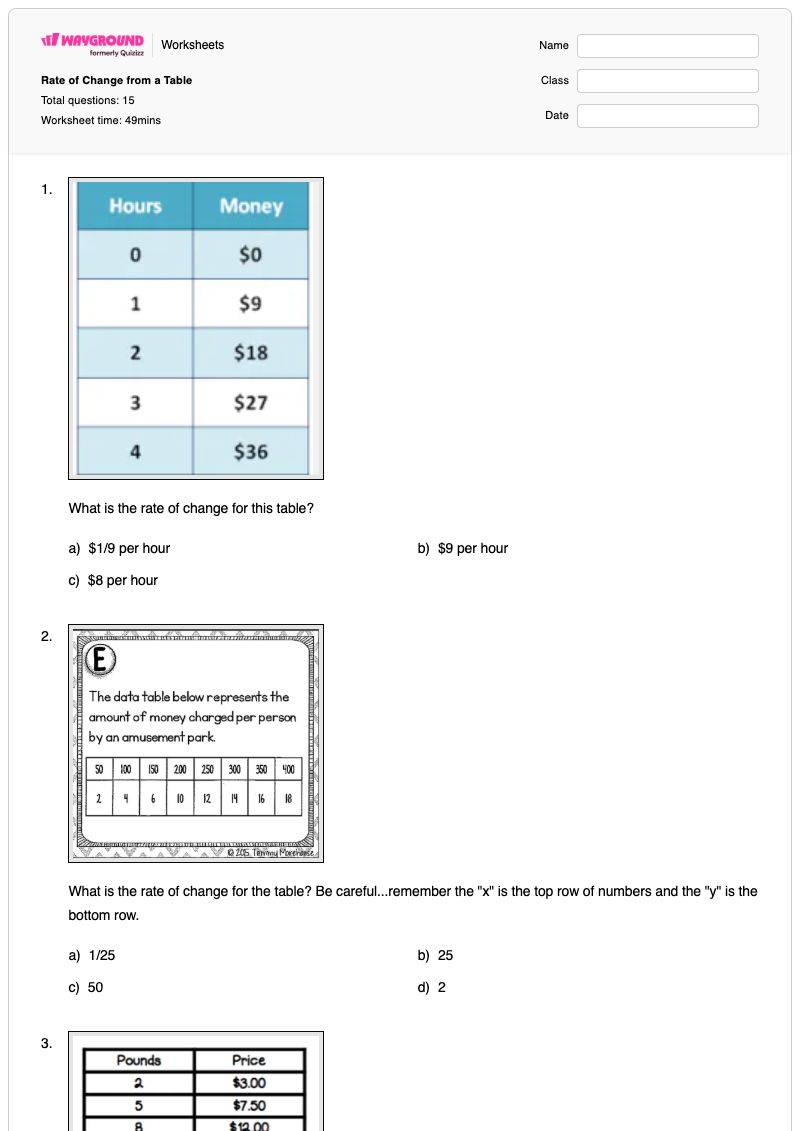
What is the rate of change for this table?
a)
$1/9 per hour
b)
$9 per hour
c)
$8 per hour
2.
What is the rate of change for the table? Be careful...remember the "x" is the top row of numbers and the "y" is the bottom row.
a)
1/25
b)
25
c)
50
d)
2
3.
Identify the rate of change. Use a calculator if you need to.
a)
2 dollars per pound
b)
3 dollars per pound
c)
$1.50 per pound
d)
67 cents per poound
e)
none (not proportional)
4.
What is the rate of change of the relationship represented by the table above?
a)
75 dollars per adult
b)
0.013 dollars per adult
c)
1/75 dollars per adult
d)
None of the above
5.
Does the table show a proportional relationship? If so, what is the equation?
a)
Yes, y = 6x
b)
No, this is not proportional
c)
Yes, y = 12x
6.
What characteristic do you look for in the table in order to decide whether the relationship is proportional?
a)
The amount earned divided by the number of days is constant for each pair of values in the table.
b)
The amount of days that are worked go up to 5.
c)
The amount earned multiplied by the number of days is constant for each pair of values in the table.
7.
Write an equation using the rate of change.
a)
y = 5x
b)
y = 4x
c)
y = 8x
8.
The table shows a proportional relationship. Select the equation to match the table.
a)
y = 1x
b)
y = 18x
c)
y = 6x
d)
y = y
9.
Identify the rate of change from this equation: y=32x
a)
32
b)
2
c)
3
d)
23
10.
Find the rate of change if there are 624 calories in 3 servings.
a)
1,872 calories per serving
b)
208 calories per serving
c)
624 calories per serving
d)
621 calories per serving
11.
Alycia earned $20.40 in 3 hours. What is her unit rate in dollars per hour? Use a calculator if necessary.
a)
$7 per hour
b)
$6 per hour
c)
$6.80 per hour
d)
$17.40 per hour
12.
Ben drinks tea at a relatively quick rate. He drinks 1/2 liter of tea every 2/3 of an hour. How much tea does Ben drink per hour? Hint: The process is the same whether you have nice whole numbers to deal with or fractions to deal with. Think about this and use a calculator if necessary.
a)
1 and 1/3 of an hour per liter
b)
3/4 of a liter per hour
c)
1 and 1/3 liter per hour
d)
3/4 of an hour per liter
13.
Is this table proportional or non-proportional? a.k.a. ....are all the rates of change equal?
a)
Proportional
b)
Non-Proportional
14.
If Justin ordered 5 ice cream bars for $12.25, how much was each ice cream bar?
a)
$1.45
b)
$4.00
c)
$7.25
d)
$2.45
15.
In the equation y = 14x, what is the rate of change?
a)
y
b)
x
c)
14
Answer Key
Rate of Change from a Table
Total questions: 15
1.
b)
$9 per hour
2.
a)
1/25
3.
c)
$1.50 per pound
4.
a)
75 dollars per adult
5.
a)
Yes, y = 6x
6.
a)
The amount earned divided by the number of days is constant for each pair of values in the table.
7.
b)
y = 4x
8.
a)
y = 1x
9.
a)
32
10.
b)
208 calories per serving
11.
c)
$6.80 per hour
12.
b)
3/4 of a liter per hour
13.
a)
Proportional
14.
d)
$2.45
15.
c)
14
140 %
Browse by subjects
Browse by grades
Browse by format
FAQs
What does the Rate of Change from a Table worksheet cover?
This worksheet uses 15 multiple-choice questions to help students calculate rate of change or unit rate from tables, equations, and real-world situations. Students divide the y-value by the x-value, interpret units such as dollars per hour or calories per serving, determine whether a table is proportional, and match proportional relationships with equations such as y = 6x.
How can I use this worksheet to teach rate of change from a table?
First model finding y ÷ x from one table and explain why the quotient represents the rate of change, including its units. Then use the worksheet’s equation and context items to have students connect the constant ratio to y = kx, and pause on decimal or fraction examples to discuss how unit rates are calculated when the numbers are not whole numbers.
What mistakes should I watch for when students complete this worksheet?
Students may reverse the ratio and calculate x ÷ y instead of y ÷ x, especially when the choices include reciprocal values such as 1/25 and 25. Watch for students who multiply instead of divide, ignore the stated units, or choose a proportional equation without checking that the same y ÷ x value holds across the table; fraction items may also lead them to confuse liters per hour with hours per liter.
How do I assign and grade this worksheet?
This rate-of-change worksheet is available as a printable PDF and as a digital quiz on Wayground, and it includes a complete answer key. You can grade printable submissions by scanning student work with the Wayground for Teachers app, while the digital quiz supports online completion and grading.
How can I differentiate this rate-of-change worksheet for my students?
Use the worksheet’s Advanced Settings to adjust font spacing or font size so the tables, equations, and multiple-choice options are easier to read. You can also apply a dyslexia-friendly font or translate the worksheet into another language when those options support access to the rate-of-change and proportional-relationship items.
Where can I find more worksheets like this on Wayground?
Wayground offers a comprehensive collection of free printable worksheets and practice problems across subjects, with downloadable PDFs and answer keys to help students master essential skills and concepts. Browse more resources at https://wayground.com/en-us/worksheets.