

Wayground
Proportional Relationships: Ratio Tables - Printable Mathematics Worksheets year 7 - Wayground

Proportional Relationships: Ratio Tables

14 questions

7th - 7th Grade

Mathematics

Proportional Relationships: Ratio Tables is a Grade 7 mathematics worksheet that helps students use equivalent ratios to solve real-world problems. The 14 questions include 10 multiple-choice items and 4 fill-in-the-blank items involving pet populations, classroom materials, recipes, maps, scale drawings, and proportional predictions. Students determine missing quantities, convert between model and actual measurements, find totals from part-to-part ratios, and simplify fractions. This free printable worksheet gives students varied practice applying proportional reasoning rather than relying on one repeated problem type. It is useful for introducing or reviewing ratio tables, checking whether students can identify the correct scale factor, and assessing accuracy with both selected-response and numerical answers. A complete answer key is included so teachers can review the proportional relationships and fraction-simplification items efficiently.

Worksheet settings

Font size

S
M
L
XL
WaygroundWorksheets

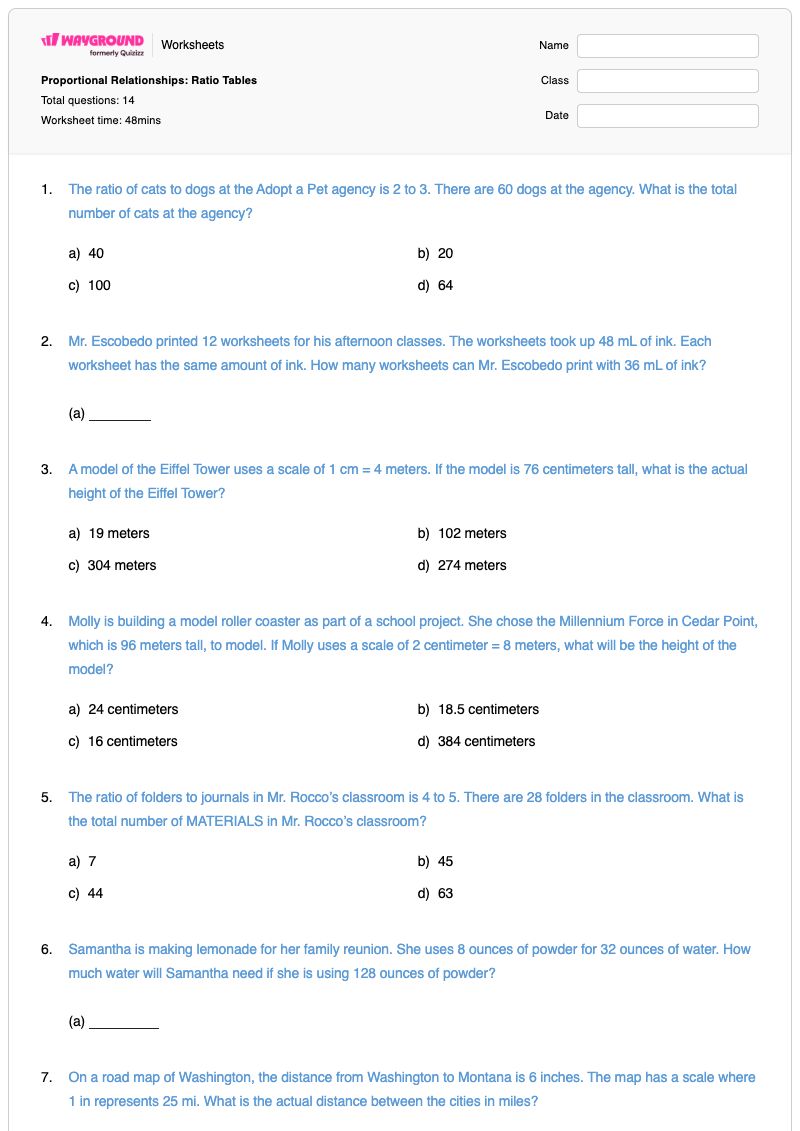
Proportional Relationships: Ratio Tables

Total questions: 14

Name
Class
Date
1.

The ratio of cats to dogs at the Adopt a Pet agency is 2 to 3. There are 60 dogs at the agency. What is the total number of cats at the agency?

a)

40

b)

20

c)

100

d)

64

2.

Mr. Escobedo printed 12 worksheets for his afternoon classes. The worksheets took up 48 mL of ink. Each worksheet has the same amount of ink. How many worksheets can Mr. Escobedo print with 36 mL of ink?

(a)  

3.

A model of the Eiffel Tower uses a scale of 1 cm = 4 meters. If the model is 76 centimeters tall, what is the actual height of the Eiffel Tower?

a)

19 meters

b)

102 meters

c)

304 meters

d)

274 meters

4.

Molly is building a model roller coaster as part of a school project. She chose the Millennium Force in Cedar Point, which is 96 meters tall, to model. If Molly uses a scale of 2 centimeter = 8 meters, what will be the height of the model?

a)

24 centimeters

b)

18.5 centimeters

c)

16 centimeters

d)

384 centimeters

5.

The ratio of folders to journals in Mr. Rocco’s classroom is 4 to 5. There are 28 folders in the classroom. What is the total number of MATERIALS in Mr. Rocco’s classroom?

a)

7

b)

45

c)

44

d)

63

6.

Samantha is making lemonade for her family reunion. She uses 8 ounces of powder for 32 ounces of water. How much water will Samantha need if she is using 128 ounces of powder?

(a)  

7.

On a road map of Washington, the distance from Washington to Montana is 6 inches. The map has a scale where 1 in represents 25 mi. What is the actual distance between the cities in miles?

(a)  

8.

In one forest in England, a species of Moths appears in different forms. One form is black and the other form is gray. The ratio of black moths to gray moths is 2 : 7. If there are a total of 49 gray moths in the forest, how many black moths are in the forest?

a)

14 Black Moths

b)

68 Black Moths

c)

42 Black Moths

d)

7 Black Moths

9.

There are 30 students in one of Mr. Baker’s music classes. In this class 12 students play the trumpet. If Mr. Baker has a total of 150 students, what is a reasonable prediction for the total number of students that play the trumpet?

(a)  

10.

Simplify the fraction 315\frac{3}{15}  

a)

15\frac{1}{5}  

b)

45\frac{4}{5}  

c)

13\frac{1}{3}  

d)

25\frac{2}{5}  

11.

Simplify the fraction 824\frac{8}{24}  

a)

15\frac{1}{5}  

b)

45\frac{4}{5}  

c)

13\frac{1}{3}  

d)

25\frac{2}{5}  

12.

Simplify the fraction 2025\frac{20}{25}  

a)

15\frac{1}{5}  

b)

45\frac{4}{5}  

c)

13\frac{1}{3}  

d)

25\frac{2}{5}  

13.

Simplify the fraction 1248\frac{12}{48}  

a)

15\frac{1}{5}  

b)

45\frac{4}{5}  

c)

13\frac{1}{3}  

d)

14\frac{1}{4}  

14.

Simplify the fraction 615\frac{6}{15}  

a)

15\frac{1}{5}  

b)

45\frac{4}{5}  

c)

25\frac{2}{5}  

d)

14\frac{1}{4}  

WaygroundAnswer Key

Proportional Relationships: Ratio Tables

Total questions: 14

1.
a)

40

2.
9
3.
c)

304 meters

4.
a)

24 centimeters

5.
d)

63

6.
512
7.
150
8.
a)

14 Black Moths

9.
60
10.
a)

15\frac{1}{5}  

11.
c)

13\frac{1}{3}  

12.
b)

45\frac{4}{5}  

13.
d)

14\frac{1}{4}  

14.
c)

25\frac{2}{5}  

FAQs

What does this proportional relationships worksheet cover?

This Grade 7 worksheet covers solving proportional relationship problems with equivalent ratios, scale factors, and ratio tables. Across 14 items, students find missing values in contexts such as cat-to-dog populations, lemonade mixtures, maps, scale models, classroom materials, and proportional predictions, then complete five multiple-choice fraction-simplification questions.

How can I use this worksheet to teach ratio tables and proportional relationships?

Use the contextual problems to model how one known ratio pair generates equivalent pairs by multiplying or dividing both terms by the same factor. Before students work independently, demonstrate how the 1 centimeter = 4 meters Eiffel Tower scale converts model length to actual length, then ask students to explain why the roller-coaster scale requires a different factor. Finish by having students justify whether their answers represent a part, a total, or a prediction.

What mistakes should I watch for on this ratio tables worksheet?

Watch for students reversing the order of a ratio, such as treating cats-to-dogs as dogs-to-cats, or using the wrong quantity as the starting value. In the scale-model and map items, students may multiply when they should divide or confuse model measurements with actual measurements; in the folders-and-journals problem, they may report the number of journals instead of the total materials. Check the fraction-simplification items for answers that reduce only one factor or stop before the fraction is in simplest form.

How do I assign and grade this proportional relationships worksheet?

This worksheet is available as a printable PDF and as a digital quiz on Wayground, so you can assign the ratio-table, scale, prediction, and fraction-simplification practice in the format that fits your lesson. It includes a complete answer key, and printable submissions can be graded by scanning student work with the Wayground for Teachers app. The printable option can also support schools that are reducing screen time.

How can I differentiate this ratio tables worksheet for my students?

In the worksheet’s Advanced Settings, adjust font spacing or choose a larger font size so the multi-step ratio, scale, and fraction items are easier to read and annotate. You can also enable a dyslexia-friendly font or translate the worksheet into another language while keeping its multiple-choice and fill-in-the-blank format.

Where can I find more worksheets like this on Wayground?

Wayground offers a comprehensive collection of free printable worksheets and practice problems across all subjects, with downloadable PDFs and answer keys to help students master essential skills and concepts. Browse more resources at https://wayground.com/en-us/worksheets.