

Wayground
Ch. 6 Review - Area Under a Curve - Printable Mathematics Worksheets year 10 - Wayground

Ch. 6 Review - Area Under a Curve

25 questions

9th - 12th Grade

Mathematics

Ch. 6 Review - Area Under a Curve is a Grade 9–12 mathematics worksheet that reviews integral evaluation and graph-based area reasoning. Students work through 25 questions—24 multiple-choice items and one fill-in-the-blank item—covering definite integrals, relationships between integrals and derivatives, signed areas of regions, shaded-area formulas, and comparisons of integral values. The review also asks students to interpret Riemann sums, including the number of subintervals and whether left, right, or midpoint values are used. Additional items connect a function’s definition to relative maxima and intervals of concavity, helping students apply calculus ideas beyond computation. This free printable worksheet with an answer key can support independent practice, chapter review, or a teacher-led check of students’ understanding of area under a curve and related graphical concepts.

Worksheet settings

Font size

S
M
L
XL
Worksheets

Ch. 6 Review - Area Under a Curve

Total questions: 25

Name
Class
Date
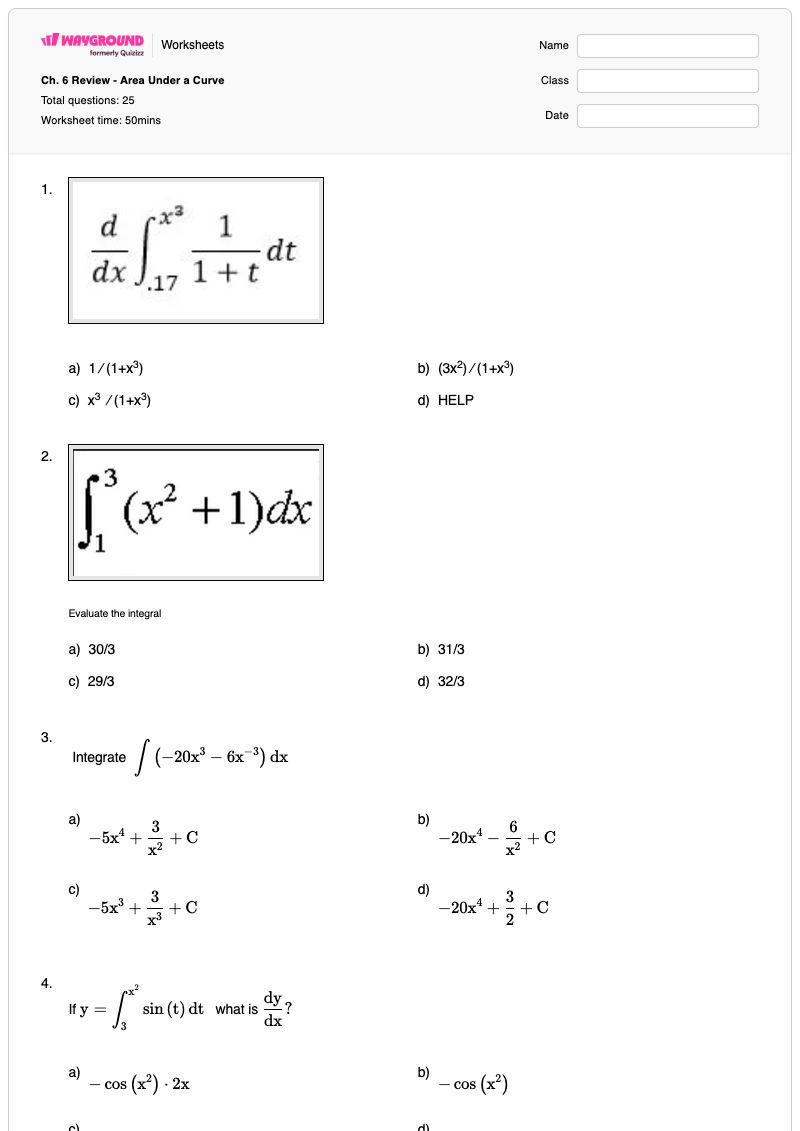
1.
a)
1 ⁄ (1+x3) 
b)
(3x2) ⁄ (1+x3) 
c)
x3  ⁄ (1+x3) 
d)
HELP
2.
Evaluate the integral
a)
30/3
b)
31/3
c)
29/3
d)
32/3
3.

 Integrate  ∫(−20x3−6x−3)dx\int\left(-20x^3-6x^{-3}\right)dx  

a)

−5x4+3x2+C-5x^4+\frac{3}{x^2}+C  

b)

−20x4−6x2+C-20x^4-\frac{6}{x^2}+C  

c)

−5x3+3x3+C-5x^3+\frac{3}{x^3}+C  

d)

−20x4+32+C-20x^4+\frac{3}{2}+C  

4.

If y=∫3x2sin⁡(t)dty=\int_3^{x^2}\sin\left(t\right)dt   what is dydx?\frac{dy}{dx}?  

a)

−cos⁡(x2)⋅2x-\cos\left(x^2\right)\cdot2x  

b)

−cos⁡(x2)-\cos\left(x^2\right)  

c)

sin⁡(x2)⋅2x\sin\left(x^2\right)\cdot2x  

d)

sin⁡(x2)\sin\left(x^2\right)  

5.

Let F(x)=∫x2x4tdtF\left(x\right)=\int_{x^2}^{x^4}\sqrt[]{t}dt . Find F'(x).

a)

x2x^2

b)

x2−xx^2-x

c)

4x5−2x24x^5-2x^2

d)

4x6−2x24x^6-2x^2

6.

Let F(x)=∫−4xsin⁡(x)(1t)dtF\left(x\right)=\int_{-4x}^{\sin\left(x\right)}\left(\frac{1}{t}\right)dt . Find F'(x).

a)

1sin⁡(x)+14x\frac{1}{\sin\left(x\right)}+\frac{1}{4x}

b)

1cos⁡(x)+14\frac{1}{\cos\left(x\right)}+\frac{1}{4}

c)

cot⁡(x)−1x\cot\left(x\right)-\frac{1}{x}

d)

1sin⁡(x)⋅cos⁡(x)+14x\frac{1}{\sin\left(x\right)}\cdot\cos\left(x\right)+\frac{1}{4x}

7.

Using the areas of each region given
∫adf(x)=\int_a^df\left(x\right)=  

a)

6

b)

20

c)

2

d)

24

8.

Which integral has the largest value?

a)

∫abf(x)dx\int_a^bf\left(x\right)dx

b)

∫bcf(x)dx\int_b^cf\left(x\right)dx

c)

∫acf(x)dx\int_a^cf\left(x\right)dx

d)

∫adf(x)dx\int_a^df\left(x\right)dx

9.

Evaluate

(a)  

10.

The formula to find the area of the shaded region is

a)

−∫0A y dx+∫AB y dx-\int_0^A\ y\ dx+\int_A^B\ y\ dx

b)

−∫0B y dx-\int_0^B\ y\ dx

c)

∫0B y dx\int_0^B\ y\ dx

d)

∫0A y dx−∫AB y dx\int_0^A\ y\ dx-\int_A^B\ y\ dx

11.

The formula to find the area of the shaded region is

a)

∫0π4 y dx\int_0^{\frac{\pi}{4}}\ y\ dx

b)

(2×π4)−∫0π4 y dy\left(2\times\frac{\pi}{4}\right)-\int_0^{\frac{\pi}{4}}\ y\ dy

c)

∫02 x dy\int_0^2\ x\ dy

d)

(2×π4)−∫02 x dy\left(2\times\frac{\pi}{4}\right)-\int_0^2\ x\ dy

12.
a)
Average Value
b)
Net Area
c)
Total Area
d)
Average Rate of Change
13.

  ∫axn dx =\int_{ }^{ }ax^n\ dx\ =  

a)

axn+1n+1\frac{ax^{n+1}}{n+1}  

b)

axn−1n−1+ c\frac{ax^{n-1}}{n-1}+\ c  

c)

axn+1n+ c\frac{ax^{n+1}}{n}+\ c  

d)

axn+1n+1+ c\frac{ax^{n+1}}{n+1}+\ c  

14.

∫−15f(x) dx\int_{-1}^5f\left(x\right)\ dx   is

a)

Positive

b)

Negative

c)

0

d)

Cannot be determined

15.

What is the value of∑k=13k2k+1What\ is\ the\ value\ of\sum_{k=1}^3\frac{k^2}{k+1}  

a)

4912\frac{49}{12}  

b)

4712\frac{47}{12}  

c)

116\frac{11}{6}  

d)

4312\frac{43}{12}  

16.

Let g be the function defined by g(x)=∫5xf(t)dtg\left(x\right)=\int_5^xf\left(t\right)dt  . At which x value does g(x) have a relative maximum?

a)

-2

b)

2

c)

6

d)

10

e)

12

17.

Let g be the function defined by g(x)=∫5xf(t)dtg\left(x\right)=\int_5^xf\left(t\right)dt  . What is the longest interval that g(x) is concave down?

a)

(-6 , 12)

b)

(-4 , -2)

c)

(0 , 2)

d)

(4 , 8)

e)

(10 ,12)

18.

Let  F(x)=∫0xf(t)dtF\left(x\right)=\int_0^xf\left(t\right)dt  , where the graph of  f(x)f\left(x\right)  above consists of lines and a semi-circle. Determine  F(4)F\left(4\right) . 

a)

π\pi  

b)

2π2\pi  

c)

3π3\pi  

d)

4π4\pi  

19.
a)
0
b)
2
c)
4
d)
6
20.

What statement best describes the Riemann Sum?

a)

4 intervals, with heights using middle values

b)

4 intervals, with heights using left values

c)

5 intervals, with heights using middle values

d)

5 intervals, with heights using right values

21.
For a function that is strictly decreasing, a right hand Riemann Sum is which of the following:
a)
Overestimate
b)
Underestimate
c)
Exact Solution
d)
Unable to Determine
22.
Is this LRAM, RRAM, or MRAM?
a)
LRAM
b)
RRAM
c)
MRAM
23.

Approximate the integral using the Trapezoidal Rule

a)

A) 43

b)

B) 35

c)

C) 33

d)

D) 36.5

24.

The correct formula for Trapezoidal Rule  of the definite integral  ∫abydx\int_a^bydx  , where  y=f(x)y=f\left(x\right)   is

a)

b−an[y0+yn+2(y1+y2+...+yn−1)]\frac{b-a}{n}\left[y_0+y_n+2\left(y_1+y_2+...+y_{n-1}\right)\right]  

b)

b−a2n[y0+yn+y1+y2+...+yn−1]\frac{b-a}{2n}\left[y_0+y_n+y_1+y_2+...+y_{n-1}\right]  

c)

b−a2n[y0+yn+2(y1+y2+...yn−1)]\frac{b-a}{2n}\left[y_0+y_n+2\left(y_1+y_2+...y_{n-1}\right)\right]  

d)

b−an[y0+yn+(y1+y2+...+yn−1)]\frac{b-a}{n}\left[y_0+y_n+\left(y_1+y_2+...+y_{n-1}\right)\right]  

25.

Which of the following statements is true about Simpson's Rule?

a)

Simpson's Rule using trapezoids to estimate area.

b)

Simpson's Rule is only accurate for linear functions.

c)

Simpson's Rule is more accurate than the Trapezoidal Rule

d)

Simpson's Rule can only be used to approximate integrals with an odd number of intervals.

Answer Key

Ch. 6 Review - Area Under a Curve

Total questions: 25

1.
b) (3x2) ⁄ (1+x3) 
2.
d) 32/3
3.
a)

−5x4+3x2+C-5x^4+\frac{3}{x^2}+C  

4.
c)

sin⁡(x2)⋅2x\sin\left(x^2\right)\cdot2x  

5.
c)

4x5−2x24x^5-2x^2

6.
c)

cot⁡(x)−1x\cot\left(x\right)-\frac{1}{x}

7.
a)

6

8.
b)

∫bcf(x)dx\int_b^cf\left(x\right)dx

9.
6
10.
a)

−∫0A y dx+∫AB y dx-\int_0^A\ y\ dx+\int_A^B\ y\ dx

11.
b)

(2×π4)−∫0π4 y dy\left(2\times\frac{\pi}{4}\right)-\int_0^{\frac{\pi}{4}}\ y\ dy

12.
a) Average Value
13.
d)

axn+1n+1+ c\frac{ax^{n+1}}{n+1}+\ c  

14.
a)

Positive

15.
a)

4912\frac{49}{12}  

16.
c)

6

17.
d)

(4 , 8)

18.
b)

2π2\pi  

19.
a) 0
20.
a)

4 intervals, with heights using middle values

21.
b) Underestimate
22.
b) RRAM
23.
d)

D) 36.5

24.
c)

b−a2n[y0+yn+2(y1+y2+...yn−1)]\frac{b-a}{2n}\left[y_0+y_n+2\left(y_1+y_2+...y_{n-1}\right)\right]  

25.
c)

Simpson's Rule is more accurate than the Trapezoidal Rule

FAQs

What does the Ch. 6 Review - Area Under a Curve worksheet cover?

This worksheet reviews how to evaluate definite integrals and interpret them as signed areas, including areas represented by separate graph regions and shaded-region formulas. Its 25 items also ask students to analyze Riemann sums, identify relative maxima, and determine intervals of concavity, using mostly multiple-choice questions plus one fill-in-the-blank integral evaluation.

How can I use this worksheet to teach area under a curve?

Begin by modeling how regions above and below an axis affect the value of a definite integral, then use the worksheet’s graph-based area questions to have students explain whether they are finding signed area or total geometric area. Follow with the integral-evaluation and Riemann-sum items, asking students to justify the number of subintervals and whether the heights use left, right, or midpoint values. Finish with the relative-maximum and concavity questions as a check that students can connect integral and graph interpretations.

What mistakes should I watch for when students complete this area-under-a-curve review?

Students may treat every integral as a positive geometric area instead of accounting for regions below the axis, or select a shaded-area formula without identifying the relevant boundaries. In the Riemann-sum items, watch for confusion between the number of intervals and the number of sample points, especially when distinguishing midpoint values from left or right values. Students may also confuse a relative maximum with an interval of concavity when interpreting the graph-based function questions.

How do I assign and grade this area-under-a-curve worksheet?

You can assign Ch. 6 Review - Area Under a Curve as a printable PDF or as a digital quiz on Wayground. The worksheet includes a complete answer key for checking the 24 multiple-choice responses and the fill-in-the-blank item. For printable submissions, scan student work with the Wayground for Teachers app to help grade responses efficiently.

How can I differentiate this area-under-a-curve worksheet for my students?

Use the worksheet’s Advanced Settings to adjust font spacing or choose a larger font size so integral expressions, answer choices, and graph-based prompts are easier to read. You can also enable a dyslexia-friendly font or translate the worksheet into another language when those changes will help students access the integral, Riemann-sum, and shaded-area questions.

Where can I find more worksheets like this on Wayground?

Wayground offers a broad collection of free printable worksheets and practice problems across subjects, with downloadable PDFs and answer keys to support essential skills and concepts. Browse more resources at https://wayground.com/en-us/worksheets.