

Wayground
Science Safety - Printable Science Worksheets year 5 - Wayground

Science Safety

20 questions

4th - 5th Grade

Science

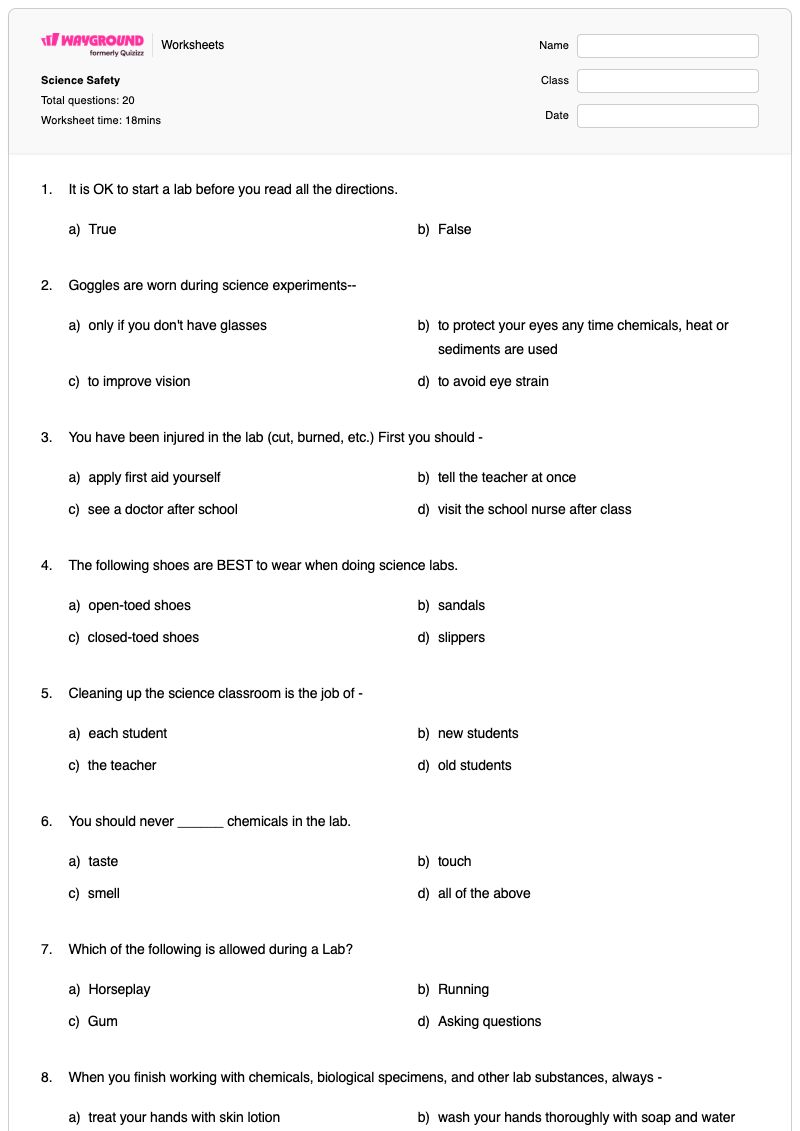
Science Safety is a free printable worksheet for students in Grades 4–5 that builds essential laboratory safety knowledge through 20 multiple-choice questions. Students identify when to read procedures, wear goggles and closed-toed shoes, avoid food and contact with chemicals, wash their hands, and report injuries to the teacher. They also recognize permitted lab behavior, safety equipment such as an eyewash station and fire extinguisher, glove-safety symbols, and the meaning of PASS: Pull, Aim, Squeeze, Sweep. The questions use true-or-false and multiple-choice answer choices to check whether students can select safe actions in common laboratory situations. Use this worksheet to introduce science lab expectations, reinforce procedures before an experiment, or assess readiness for hands-on work. The complete answer key supports quick review and grading. Teachers can download and print the worksheet for individual practice, partner discussion, or a whole-class safety check.

Worksheet settings

Font size

S
M
L
XL
Worksheets

Science Safety

Total questions: 20

Name
Class
Date
1.
It is OK to start a lab before you read all the directions.
a)
True
b)
False
2.
Goggles are worn during science experiments--
a)
only if you don't have glasses
b)
to protect your eyes any time chemicals, heat or sediments are used
c)
to improve vision
d)
to avoid eye strain
3.
You have been injured in the lab (cut, burned, etc.) First you should -
a)
apply first aid yourself
b)
tell the teacher at once
c)
see a doctor after school
d)
visit the school nurse after class
4.
The following shoes are BEST to wear when doing science labs.
a)
open-toed shoes
b)
sandals
c)
closed-toed shoes
d)
slippers
5.
Cleaning up the science classroom is the job of -
a)
each student
b)
new students
c)
the teacher
d)
old students
6.
You should never ______ chemicals in the lab. 
a)
taste
b)
touch
c)
smell
d)
all of the above
7.
Which of the following is allowed during a Lab?
a)
Horseplay
b)
Running
c)
Gum
d)
Asking questions
8.
When you finish working with chemicals, biological specimens, and other lab substances, always -
a)
treat your hands with skin lotion
b)
wash your hands thoroughly with soap and water
c)
wipe your hands on a towel
d)
wipe your hands on your clothes
9.
Never touch the eyewash or shower station unless it is a true emergency. 
a)
True
b)
False
10.
Part of lab safety includes reading the lab procedure -
a)
before doing the lab
b)
while doing the lab
c)
after doing the lab
d)
only if you think you really need it
11.
What is this symbol for?
a)
glove safety 
b)
apron safety
c)
clapping safety
d)
chemical safety 
12.
Food is permitted in lab
a)
always
b)
if you have a cold
c)
sometimes
d)
never
13.
Which is a safety tool?
a)
ruler
b)
fire extinguisher
c)
balance
14.
What tool washes the eyes if chemicals get in them?
a)
apron
b)
the sink
c)
eye wash
15.
What does PASS stand for?
a)
Pull, Aim, Spray, Sweep
b)
Pull, Aim, Squeeze, Sweep
c)
Pull, Aim, Squeeze, Spray
d)
Press, Aim, Spray, Sweep
16.
Where do you point the fire extinguisher if you are putting out a fire? 
a)
At the base of the fire
b)
At the top of the flames
c)
At your lab partner
d)
Toward the middle of the fire
17.

Always pull back ____________ and roll up your sleeves when doing an experiment.

a)

hair

b)

gloves

c)

apron

d)

lab coat

18.

Read all ________________________ before beginning an experiment and ask questions if you are unsure of anything.

a)

symbols

b)

posters

c)

instructions

d)

comics

19.

How do you safely plug in or unplug an electrical cord?

a)

by the plug

b)

by pulling the cord

c)

there is no safe way

d)

by holding the cord

20.

You can put anything into an electrical outlet as long as it isn't metal.

a)

True

b)

False

Answer Key

Science Safety

Total questions: 20

1.
b) False
2.
b) to protect your eyes any time chemicals, heat or sediments are used
3.
b) tell the teacher at once
4.
c) closed-toed shoes
5.
a) each student
6.
d) all of the above
7.
d) Asking questions
8.
b) wash your hands thoroughly with soap and water
9.
a) True
10.
a) before doing the lab
11.
a) glove safety 
12.
d) never
13.
b) fire extinguisher
14.
c) eye wash
15.
b) Pull, Aim, Squeeze, Sweep
16.
a) At the base of the fire
17.
a)

hair

18.
c)

instructions

19.
a)

by the plug

20.
b)

False

FAQs

What does the Science Safety worksheet cover?

This Grade 4–5 worksheet uses 20 multiple-choice questions to assess laboratory safety decisions, including reading procedures before starting, choosing protective equipment, responding to injuries, handling chemicals, and cleaning up. Students also identify safety tools and symbols, select the correct eyewash response, and recall what PASS stands for when using a fire extinguisher.

How can I use this worksheet to teach science lab safety?

Use the multiple-choice items as a safety introduction before students begin laboratory work. Ask students to explain why choices such as wearing goggles, asking questions, washing hands, or telling the teacher about an injury are safer than the alternatives. After reviewing the answers, model the eyewash station, fire extinguisher safety, and the PASS sequence referenced by the worksheet.

What mistakes should I watch for when students complete this science safety worksheet?

Students may choose to read directions while or after doing a lab instead of before starting, or select personal first aid instead of telling the teacher about an injury immediately. Watch for confusion between allowed questioning and unsafe behaviors such as running or horseplay, and between general classroom tools and safety tools such as a fire extinguisher. Some students may also confuse the PASS sequence or select touching, smelling, or tasting chemicals as separate choices rather than recognizing that all are prohibited.

How do I assign and grade this Science Safety worksheet?

The worksheet is available as a printable PDF and as a digital quiz on Wayground, so you can use the 20 multiple-choice questions for paper or online practice. It includes a complete answer key for checking responses, and printable submissions can be graded by scanning student work with the Wayground for Teachers app. The printable format can also support schools that are reducing screen time.

How can I differentiate this multiple-choice science safety worksheet for my students?

Use the worksheet’s Advanced Settings to adjust font spacing or increase the font size so the 20 answer choices are easier to scan. You can also enable a dyslexia-friendly font or translate the worksheet into another language while keeping the lab-safety question format intact.

Where can I find more free worksheets like this on Wayground?

Wayground offers a broad collection of free printable worksheets and practice problems across subjects, with downloadable PDFs and answer keys to help students master essential skills and concepts. Browse more resources at https://wayground.com/en-us/worksheets.