

Wayground
ACT Math Practice  - Printable Science Worksheets 9th Grade - Wayground

ACT Math Practice

Sathvik Pulluri

Created by Sathvik Pulluri

17 questions

9th Grade

Science

Updated Oct 2026

ACT Math Practice is a free printable worksheet with an answer key for Grade 9 mathematics students preparing to apply quantitative reasoning in multiple-choice settings. Its 17 questions ask students to solve ACT-style problems involving probability, equivalent expressions, proportions and percentages, function models, rates, pay, averages, mixtures, divisibility, geometric symmetry, and counting arrangements. The worksheet emphasizes selecting and applying an efficient strategy rather than completing one repeated procedure. Students interpret real-world contexts, translate them into calculations or algebraic relationships, compare answer choices, and check whether their results are reasonable. Problems such as average speed, overtime pay, changing a mixture’s concentration, finding a least common multiple, and arranging plants in distinct positions help students connect core Grade 9 skills to standardized-test problem solving. It can support independent practice, small-group review, or a formative check of readiness for ACT-style mathematics.

Worksheet settings

Font size

S
M
L
XL
WaygroundWorksheets

ACT Math Practice

Total questions: 17

Name
Class
Date
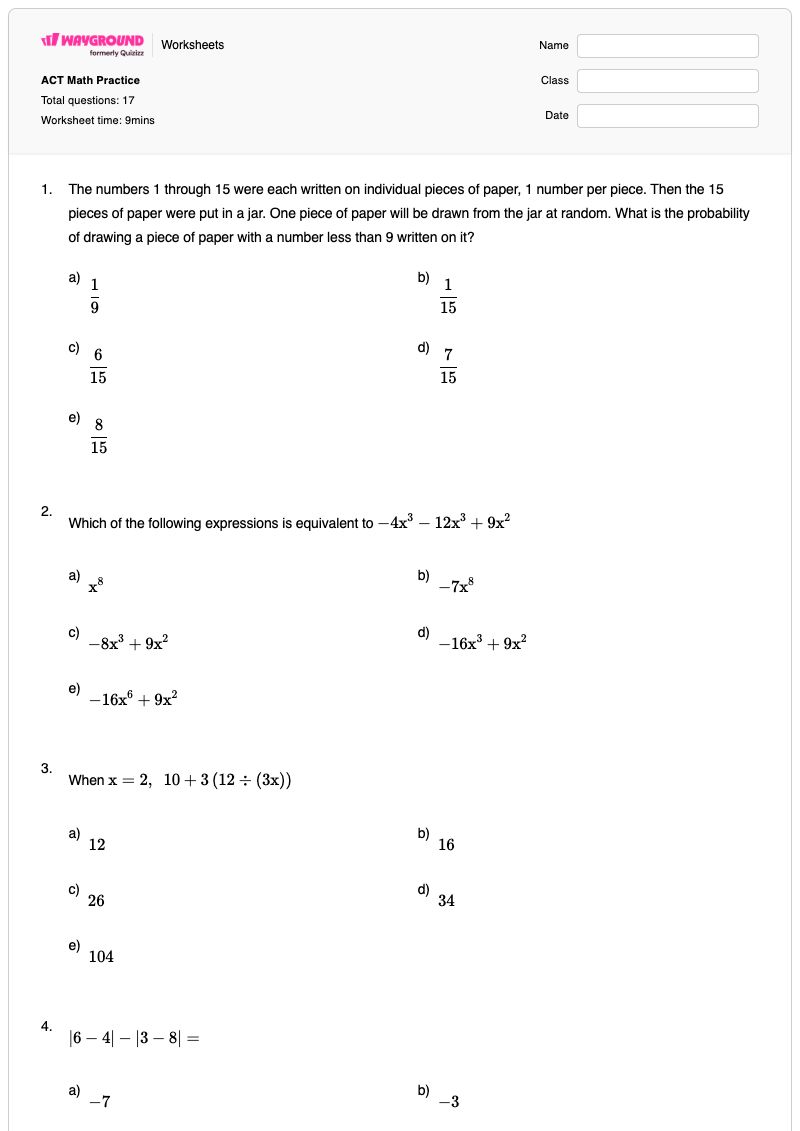
1.

The numbers 1 through 15 were each written on individual pieces of paper, 1 number per piece. Then the 15 pieces of paper were put in a jar. One piece of paper will be drawn from the jar at random. What is the probability of drawing a piece of paper with a number less than 9 written on it?

a)

19\frac{1}{9}  

b)

115\frac{1}{15}  

c)

615\frac{6}{15}  

d)

715\frac{7}{15}  

e)

815\frac{8}{15}  

2.

Which of the following expressions is equivalent to −4x3−12x3+9x2-4x^3-12x^3+9x^2  

a)

x8x^8  

b)

−7x8-7x^8  

c)

−8x3+9x2-8x^3+9x^2  

d)

−16x3+9x2-16x^3+9x^2  

e)

−16x6+9x2-16x^6+9x^2  

3.

When x=2,  10+3(12÷(3x))x=2,\ \ 10+3\left(12\div\left(3x\right)\right)  

a)

1212  

b)

1616  

c)

2626  

d)

3434  

e)

104104  

4.

∣6−4∣−∣3−8∣=\left|6-4\right|-\left|3-8\right|=  

a)

−7-7  

b)

−3-3   

c)

33  

d)

77  

e)

2121  

5.

The expression (4c−3d)(3c+d)\left(4c-3d\right)\left(3c+d\right)  is equivalent to:

a)

12c2−13cd−3d212c^2-13cd-3d^2  

b)

12c2−13cd+3d212c^2-13cd+3d^2  

c)

12c2−5cd−3d212c^2-5cd-3d^2  

d)

12c2−5cd+3d212c^2-5cd+3d^2  

e)

12c2−3d212c^2-3d^2  

6.

Of the 180 students in a college course, 14\frac{1}{4}  of the students earned an A for the course, 13\frac{1}{3}  of the students earned a B for the course, and the rest of the students earned a C for the course. How many of the students earned a C for the course?

a)

7575  

b)

9090  

c)

105105  

d)

120120  

e)

135135  

7.

The number of fish ff  , in Skipper’s Pond at the beginning of each year can be modeled by the equation f(x)=3(2x)f\left(x\right)=3\left(2^x\right) , where xx  represents the number of years after the beginning of the year 20002000  . For example, x=0x=0  represents the beginning of the year 20002000  , x=1x=1   represents the beginning of the year 2001, and so forth. According to the model, how many fish were in Skipper’s Pond at the beginning of the year 2006 ?

a)

9696  

b)

192192  

c)

384384  

d)

1,4581,458  

e)

46,65646,656  

8.

Manish drove from Chicago to Baton Rouge. At 8:00 a.m., he was 510 km from Baton Rouge. At 1:00 p.m., he was 105 km from Baton Rouge. Which of the following values is closest to Manish’s average speed, in kilometers per hour, from 8:00 a.m. to 1:00 p.m. ?

a)

58

b)

68

c)

81

d)

94

e)

102

9.

A bag contains 8 red marbles, 9 yellow marbles, and 7 green marbles. How many additional red marbles must be added to the 24 marbles already in the bag so that the probability of randomly drawing a red marble is 35\frac{3}{5}  

a)

11

b)

16

c)

20

d)

24

e)

32

10.

At his job, the first 40 hours of each week that Thomas works is regular time, and any additional time that he works is overtime. Thomas gets paid $15 per hour during regular time. During overtime Thomas gets paid 1.5 times as much as he gets paid during regular time. Thomas works 46 hours in 1 week and gets $117 in deductions taken out of his pay for this week. After the deductions are taken out, how much of Thomas’s pay for this week remains?

a)

$492

b)

$573

c)

$609

d)

$618

e)

$735

11.

 What is 3%3\%  of 4.14⋅1044.14\cdot10^4  ?

a)

1,242

b)

1,380

c)

12,420

d)

13,800

e)

124,200

12.

The set of all positive integers that are divisible by both 15 and 35 is infinite. What is the least positive integer in this set?

a)

5

b)

50

c)

105

d)

210

e)

525

13.

The average of a list of 4 numbers is 92.0. A new list of 4 numbers has the same first 3 numbers as the original list, but the fourth number in the original list is 40, and the fourth number in the new list is 48. What is the average of this new list of numbers?

a)

81.0

b)

92.0

c)

94.0

d)

94.4

e)

96.6

14.

A barrel contains 25 liters of a solvent mixture that is 40% solvent and 60% water. Lee will add pure solvent to the barrel, without removing any of the mixture currently in the barrel, so that the new mixture will contain 50% solvent and 50% water. How many liters of pure solvent should Lee add to create this new mixture?

a)

2.5

b)

5

c)

10

d)

12.5

e)

15

15.

Regardless of how the graph is oriented in the standard (x,y) coordinate plane, NO graph in one of the following categories has a vertical line of symmetry. Which one?

a)

Line

b)

Square

c)

Pentagon

d)

Parallelogram

e)

Scalene triangle

16.

In a window display at a flower shop, there are 3 spots for 1 plant each. To fill these 3 spots, Emily has 6 plants to select from, each of a different type. Selecting from the 6 plants, Emily can make how many possible display arrangements with 1 plant in each spot?

(Note: The positions of the unselected plants do not matter.)

a)

3

b)

6

c)

15

d)

120

e)

216

17.

Which of the following expressions is equal to (sin 60°)(cos 30°) + (cos 60°)(sin 30°) ?

a)

cos(60° − 30°)

b)

cos(60° + 30°)

c)

sin(60° − 30°)

d)

sin(60° + 30°)

e)

sin (60°+30°2)\left(\frac{60\degree+30\degree}{2}\right)  

WaygroundAnswer Key

ACT Math Practice

Total questions: 17

1.
e)

815\frac{8}{15}  

2.
d)

−16x3+9x2-16x^3+9x^2  

3.
b)

1616  

4.
b)

−3-3   

5.
c)

12c2−5cd−3d212c^2-5cd-3d^2  

6.
a)

7575  

7.
b)

192192  

8.
c)

81

9.
b)

16

10.
d)

$618

11.
a)

1,242

12.
c)

105

13.
c)

94.0

14.
b)

5

15.
a)

Line

16.
d)

120

17.
d)

sin(60° + 30°)

FAQs

What does this ACT Math Practice worksheet cover?

This Grade 9 worksheet contains 17 multiple-choice questions that build ACT-style quantitative reasoning across probability, algebraic expressions, proportions, functions, rates, financial math, averages, mixtures, divisibility, symmetry, and counting arrangements. Students must interpret each scenario, choose an appropriate calculation or algebraic model, and use the answer choices to evaluate their result.

How can I use this worksheet to teach ACT-style math problem solving?

Use the multiple-choice items to model a repeatable process: identify the quantities and relationships, select a strategy, calculate carefully, and check the result against the options. Discuss how different contexts call for different tools—for example, favorable outcomes for probability, distance divided by elapsed time for average speed, total value for averages, and ordered selections for the plant-display problem. After students work independently, ask them to explain why the correct choice fits and why a tempting distractor does not.

What mistakes should I watch for when students complete this ACT Math Practice worksheet?

Watch for students dividing by the wrong total in probability, using total travel time or distance incorrectly in the average-speed item, and forgetting that overtime hours are paid at a different rate before deductions. Other likely errors include changing an average without comparing the original and new totals, confusing a common multiple with a common factor, treating an arrangement as an unordered selection, and overlooking the distinction between a shape’s possible orientation and its line-symmetry property.

How do I assign and grade this ACT Math Practice worksheet?

The worksheet is available as a printable PDF and as a digital quiz on Wayground, and it includes a complete answer key for all 17 multiple-choice questions. You can grade printable submissions by scanning student work with the Wayground for Teachers app, or review responses through the digital quiz.

How can I differentiate this ACT Math Practice worksheet for my students?

Use the worksheet’s Advanced Settings to adjust font spacing or font size so the multi-step quantitative reasoning questions and answer choices are easier to read. You can also apply a dyslexia-friendly font or translate the worksheet into another language when those options help students access the math contexts and instructions.

Where can I find more worksheets like this on Wayground?

Wayground offers a broad collection of free printable worksheets and practice problems across subjects, with downloadable PDFs and answer keys to help students master essential skills and concepts. Browse more resources at https://wayground.com/en-us/worksheets.