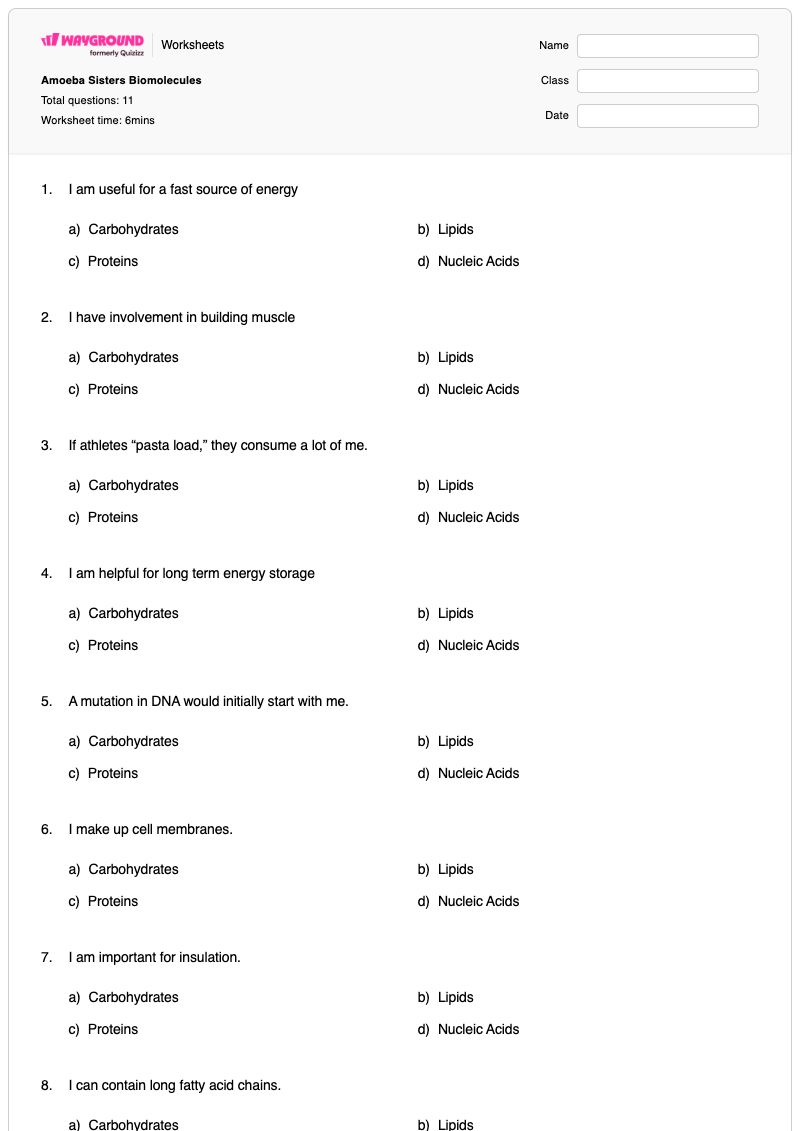
Amoeba Sisters Biomolecules is a free printable Biology worksheet for Grade 9 students learning to identify the four major biomolecule groups: carbohydrates, lipids, proteins, and nucleic acids. The 11 multiple-choice questions present functional, structural, and biological clues, asking students to match each clue to the correct category.
Students use examples such as fast energy, long-term energy storage, muscle building, cell membranes, insulation, fatty acid chains, genetic material, ring-like structures, and enzymes to distinguish biomolecule roles. This format reinforces classification and helps students connect biomolecules with recognizable functions and structures rather than memorizing category names alone. The worksheet includes a complete answer key, making it useful for biology review, independent practice, homework, or a quick formative check.
Worksheet settings
Font size
S
M
L
XL
Worksheets
Amoeba Sisters Biomolecules
Total questions: 11
Name
Class
Date
1.
I am useful for a fast source of energy
a)
Carbohydrates
b)
Lipids
c)
Proteins
d)
Nucleic Acids
2.
I have involvement in building muscle
a)
Carbohydrates
b)
Lipids
c)
Proteins
d)
Nucleic Acids
3.
If athletes “pasta load,” they consume a lot of me.
a)
Carbohydrates
b)
Lipids
c)
Proteins
d)
Nucleic Acids
4.
I am helpful for long term energy storage
a)
Carbohydrates
b)
Lipids
c)
Proteins
d)
Nucleic Acids
5.
A mutation in DNA would initially start with me.
a)
Carbohydrates
b)
Lipids
c)
Proteins
d)
Nucleic Acids
6.
I make up cell membranes.
a)
Carbohydrates
b)
Lipids
c)
Proteins
d)
Nucleic Acids
7.
I am important for insulation.
a)
Carbohydrates
b)
Lipids
c)
Proteins
d)
Nucleic Acids
8.
I can contain long fatty acid chains.
a)
Carbohydrates
b)
Lipids
c)
Proteins
d)
Nucleic Acids
9.
My category includes genetic material.
a)
Carbohydrates
b)
Lipids
c)
Proteins
d)
Nucleic Acids
10.
I contain elements C, H, and O and have a ring-like structure
a)
Carbohydrates
b)
Lipids
c)
Proteins
d)
Nucleic Acids
11.
Enzymes, which can speed up reactions, belong in my category.
a)
Carbohydrates
b)
Lipids
c)
Proteins
d)
Nucleic Acids
Answer Key
Amoeba Sisters Biomolecules
Total questions: 11
1.
a)
Carbohydrates
2.
c)
Proteins
3.
a)
Carbohydrates
4.
b)
Lipids
5.
d)
Nucleic Acids
6.
b)
Lipids
7.
b)
Lipids
8.
b)
Lipids
9.
d)
Nucleic Acids
10.
a)
Carbohydrates
11.
c)
Proteins
140 %
Browse by subjects
Browse by grades
Browse by format
FAQs
What does the Amoeba Sisters Biomolecules worksheet cover?
This Grade 9 Biology worksheet helps students identify carbohydrates, lipids, proteins, and nucleic acids from 11 multiple-choice clues. Students classify examples involving fast energy, long-term energy storage, muscle building, cell membranes, enzymes, fatty acid chains, and genetic material, strengthening their ability to connect each biomolecule group with its functions and structural features.
How can I use this worksheet to teach biomolecule categories?
Introduce the four categories first, then have students explain which clue led them to each answer rather than selecting by memorized terms alone. After students complete the multiple-choice items, discuss contrasting pairs such as carbohydrates for fast energy versus lipids for long-term energy storage, and proteins for enzymes versus nucleic acids for genetic material.
What mistakes should I watch for when students complete this biomolecules worksheet?
Students may confuse carbohydrates and lipids because both are associated with energy; emphasize the worksheet’s distinction between fast energy and long-term storage. They may also select proteins for every body-related clue, overlooking that lipids are linked to membranes, insulation, and fatty acid chains, while nucleic acids include genetic material and are connected to mutations in DNA.
How do I assign and grade this biomolecules worksheet?
Wayground provides this 11-question biomolecules worksheet as a printable PDF and as a digital quiz, and it includes a complete answer key for checking responses. For printable submissions, teachers can scan student work with the Wayground for Teachers app to streamline grading.
How can I differentiate this biomolecules worksheet for my students?
For the 11 multiple-choice biomolecule items, open Advanced Settings to adjust font spacing and font size for easier reading, enable a dyslexia-friendly font, or translate the worksheet into another language. These options can make the category names and function-based clues more accessible without changing the practice task.
Where can I find more worksheets like this on Wayground?
Wayground offers a broad collection of free printable worksheets and practice problems across subjects, with downloadable PDFs and answer keys to support essential skills and concepts. Browse more resources at https://wayground.com/en-us/worksheets.


 Worksheets