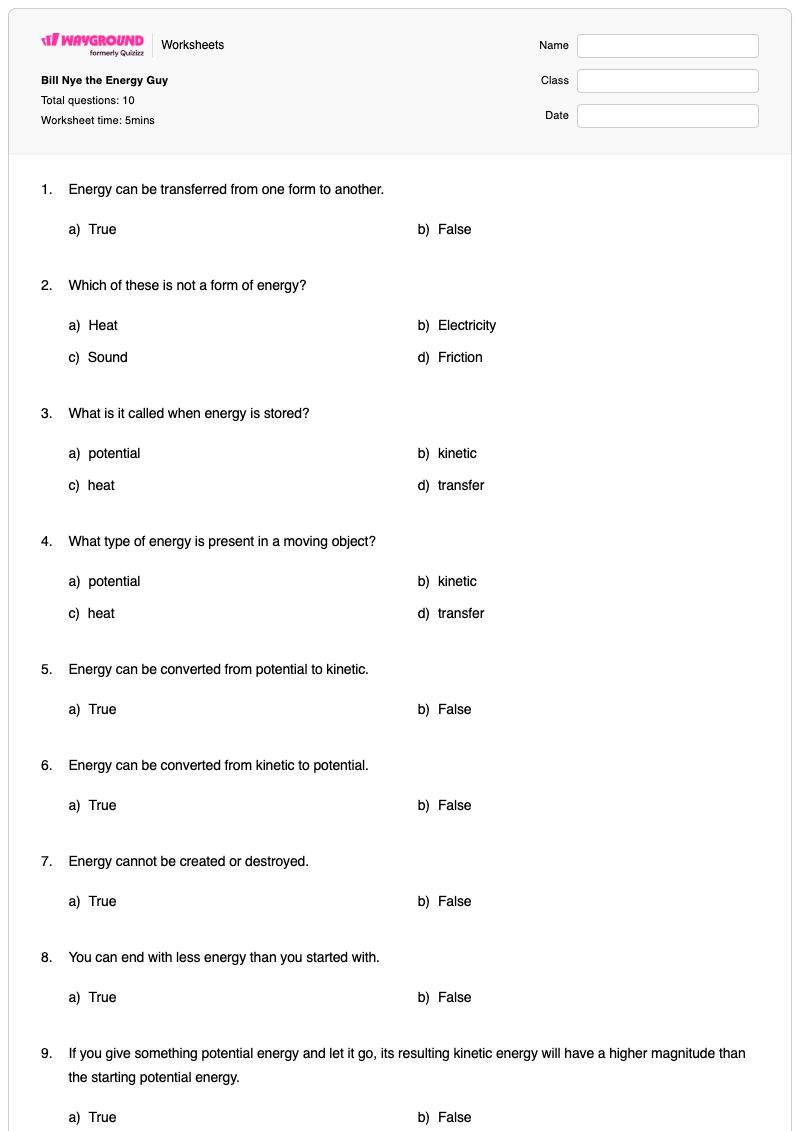
Bill Nye the Energy Guy is a Grade 11 science worksheet that uses 10 multiple-choice questions to build understanding of energy forms, energy transfer, and conservation of energy. Students identify potential energy as stored energy and kinetic energy as the energy of motion, distinguish friction from the listed forms of energy, and evaluate whether energy can be converted between potential and kinetic forms. True-or-false items also address whether energy can be created, destroyed, or end with a lower total amount. The final question applies conservation of energy to a 10 J example in which 2 J becomes heat energy.
This free printable worksheet is useful for introducing or reviewing foundational physics and engineering concepts before a class discussion, lesson check, or independent practice. Its answer key supports efficient review of the multiple-choice responses and helps teachers identify whether students understand energy conversion and where energy goes during a process.
Worksheet settings
Font size
S
M
L
XL
Worksheets
Bill Nye the Energy Guy
Total questions: 10
Name
Class
Date
1.
Energy can be transferred from one form to another.
a)
True
b)
False
2.
Which of these is not a form of energy?
a)
Heat
b)
Electricity
c)
Sound
d)
Friction
3.
What is it called when energy is stored?
a)
potential
b)
kinetic
c)
heat
d)
transfer
4.
What type of energy is present in a moving object?
a)
potential
b)
kinetic
c)
heat
d)
transfer
5.
Energy can be converted from potential to kinetic.
a)
True
b)
False
6.
Energy can be converted from kinetic to potential.
a)
True
b)
False
7.
Energy cannot be created or destroyed.
a)
True
b)
False
8.
You can end with less energy than you started with.
a)
True
b)
False
9.
If you give something potential energy and let it go, its resulting kinetic energy will have a higher magnitude than the starting potential energy.
a)
True
b)
False
10.
If you start with 10 J of potential energy, and end with 8 J of kinetic energy, where did the remaining 2 J of energy go?
a)
It became heat energy.
b)
It was destroyed.
c)
It stayed as potential energy.
d)
It transferred to another dimension.
Answer Key
Bill Nye the Energy Guy
Total questions: 10
1.
a)
True
2.
d)
Friction
3.
a)
potential
4.
b)
kinetic
5.
a)
True
6.
a)
True
7.
a)
True
8.
b)
False
9.
b)
False
10.
a)
It became heat energy.
140 %
Browse by subjects
Browse by grades
Browse by format
FAQs
What does the Bill Nye the Energy Guy worksheet cover?
This Grade 11 science worksheet uses 10 multiple-choice questions to assess potential energy as stored energy, kinetic energy in moving objects, and conversions between the two. It also asks students to apply conservation of energy, including explaining why 2 J is treated as heat when 10 J of potential energy results in 8 J of kinetic energy.
How can I use this worksheet to teach energy transfer and conservation of energy?
Begin by having students distinguish stored energy from energy in motion, then use the worksheet’s potential-to-kinetic and kinetic-to-potential items to discuss conversion. Finish with the 10 J scenario and ask students to explain what happened to the remaining 2 J rather than treating it as destroyed. Reviewing the true-or-false statements aloud can reinforce that energy is transferred or converted rather than lost from the total system.
What mistakes should I watch for when students complete this energy worksheet?
Students may select friction as a form of energy, confuse potential energy with kinetic energy, or assume that ending with less kinetic energy means energy was destroyed. They may also reverse the meaning of stored and moving energy or miss that the worksheet identifies the remaining 2 J as heat energy. Ask students to justify each true-or-false response using the energy-conservation idea.
How do I assign and grade the Bill Nye the Energy Guy worksheet?
The worksheet is available as a printable PDF and as a digital quiz on Wayground, and it includes a complete answer key for all 10 multiple-choice questions. Printable submissions can be graded by scanning student work with the Wayground for Teachers app, while the digital quiz supports online completion and review.
How can I differentiate this energy worksheet for my students?
For the 10 multiple-choice energy questions, use the worksheet’s Advanced Settings to adjust font spacing or choose a larger font size to make the statements and answer choices easier to scan. You can also enable a dyslexia-friendly font or translate the worksheet into another language when those options better support access to the potential-energy, kinetic-energy, and conservation questions.
Where can I find more worksheets like this on Wayground?
Wayground offers a comprehensive collection of free printable worksheets and practice problems across subjects, with downloadable PDFs and answer keys to help students master essential skills and concepts. Browse more resources at https://wayground.com/en-us/worksheets.


 Worksheets