
Wayground
Cambridge Checkpoint Science 8: Light - Printable Science Worksheets 6th - 8th Grade - Wayground

Cambridge Checkpoint Science 8: Light

Edgar Fong

Created by Edgar Fong

44 questions

6th - 8th Grade

Science

Updated Mar 2026

Cambridge Checkpoint Science 8: Light is a free printable worksheet with an answer key for Grade 6–8 science and physics students. It contains 44 questions—42 multiple-choice items and 2 multiple-select items—that assess how light travels and interacts with materials. Students work with primary colours of light, colour mixing, absorption, reflection, refraction, filters, images, and transparent materials. The questions use familiar examples, including an apple appearing red, a pencil looking broken in water, and a laser beam refracting through a glass marble. Students identify scientific terms, interpret how surfaces and objects affect light, and apply concepts such as straight-line travel, reflection from smooth surfaces, and colour filtering. The worksheet is suitable for independent practice, review, or a checkpoint-style science assessment, with the complete answer key supporting efficient feedback and marking.

Worksheet settings

Font size

S
M
L
XL
WaygroundWorksheets

Cambridge Checkpoint Science 8: Light

Total questions: 44

Name
Class
Date
1.

The three primary colours of light are

a)

Red, Blue, Yellow

b)

Cyan, Magenta, Yellow

c)

Cyan, Green, Red

d)

Blue, Green, Red

2.

Why does an apple appear red?

a)

All colours are absorbed & none are reflected

b)

All colours are absorbed except for blue, which is reflected

c)

All colours are reflected and none are absorbed

d)

All colours are absorbed except for red, which is reflected

3.

How does light travel?

a)

It curves around corners

b)

Really slow

c)

In a straight line

d)

In circles

e)

"Uber"

4.

Which colour absorbs the most light?

a)

Black

b)

White

c)

Blue

d)

Red

5.

Which of the following is the best reflector of light?

a)

Glass block

b)

Water

c)

Mirror

d)

Prism

6.

Objects that reflect ALL colours will appear _____?

a)

Black

b)

White

c)

Gray

d)

Multi-coloured

7.
If you are using a green colour filter, what colour will you only see?

If you are using a green colour filter, what colour will you only see?

a)

blue

b)

green

c)

white

d)

red

8.

If you are using a red colour filter, blue objects will appear what colour?

a)

magenta

b)

blue

c)

red

d)

black

9.
Which term describes when light bounces off of a smooth surface?  
a)
Refraction
b)
Transmission
c)
Absorption
d)
Reflection
10.

What two colours make yellow?

a)

Red and White

b)

Red and Blue

c)

Red and Green

d)

Green and Blue

11.

______ is a copy of the object formed by reflected or refracted rays of light

a)

reflection

b)

refraction

c)

object

d)

image

12.
Which of these provides the best explanation for why the pencil appears broken?

Which of these provides the best explanation for why the pencil appears broken?

a)

The pencil absorbs the light rays that hit it.

b)

Water reflects light rays away from the pencil.

c)

Light rays are bent by the water in the glass.

d)

The surface of the water reflects the light rays.

e)

The pencil actually breaks when it enters water

13.

Light travels in straight lines until reflected by another object. Which illustration best shows the light being reflected?

a)
Light travels in straight lines until reflected by another object. Which illustration best shows the light being reflected?
b)
Light travels in straight lines until reflected by another object. Which illustration best shows the light being reflected?
c)
Light travels in straight lines until reflected by another object. Which illustration best shows the light being reflected?
d)
Light travels in straight lines until reflected by another object. Which illustration best shows the light being reflected?
14.
Which object refracted the laser beam?

Which object refracted the laser beam?

a)

Silver locket

b)

Picture frame

c)

Glass marble

d)

Notebook

15.
Material that allows light to pass through allowing you to see "clearly" to the other side
a)
opaque
b)
translucent
c)
transparent
16.
Figure 1 demonstrates light travels in

Figure 1 demonstrates light travels in

a)

zig zags

b)

circles

c)

a straight line

d)

random bursts

17.
Figure 2 demonstrates

Figure 2 demonstrates

a)

Refraction

b)

Reflection

c)

Light travels in a straight line

d)

Rewind

18.
Figure 3 demonstrates

Figure 3 demonstrates

a)

Refraction

b)

Reflection

c)

Light travels in a straight line

d)

Rewind

19.
Opaque means...
a)
No light passes through it
b)
All light passes through it
c)
Some light passes through it
20.
White light is made up of _________________ colors.
a)
10
b)
3
c)
7
d)
70
21.
states that when a wave is reflected from a surface, the angle of reflection is equal to the angle of incidence

states that when a wave is reflected from a surface, the angle of reflection is equal to the angle of incidence

a)

law of refraction

b)

law of dispersion

c)

law of reflection

d)

law of diffraction

e)

law of averages

22.

When a light ray is refracted and its moving from water to air, its speed will ____, and it will bend _______ the normal .

a)

increase, away from

b)

increase, towards

c)

decrease, away from

d)

decrease, towards

23.
Define REFLECTION
a)
When light bounces off something smooth at the same angle it hits the object
b)
When light bends as it passes through an object
c)
When light bounces off a rough surface at the same angle it hits the object
d)
When light bends
24.
Define REFRACTION
a)
When light bounces off something smooth at the same angle it hits the object
b)
When light bends as it passes through an object
c)
When light bounces off a rough surface at the same angle it hits the object
d)
When light looks green but is actually white.
25.
What is the speed of light in air?

What is the speed of light in air?

a)

3 000 m/s

b)

300 000 m/s

c)

300 000 000 m/s

d)

3 000 000 000 m/s

26.
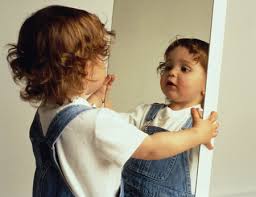
The image formed in a flat mirror is

The image formed in a flat mirror is

a)

larger than the object and farther away.

b)

reduced and closer to the mirror.

c)

a real image of the object.

d)

the same size of the object, and same distance from mirror

27.
What is the angle of reflection (θ r ) in the image?

What is the angle of reflection (θr) in the image?

a)

56o

b)

90o

c)

124o

d)

34o

28.

The angle of the incoming rays of light are called the.....

a)

Angle of reflection

b)

Angle of refraction

c)

Angle of incidence

d)

Wave angle

29.
On the diagram, A is :

On the diagram, A is :

a)

The angle of incidence

b)

The reflection ray

c)

The incidence ray

d)

The refraction ray

30.
On the diagram, B is:

On the diagram, B is:

a)

The refraction ray

b)

The normal

c)

The angle of incidence

d)

The incidence ray

31.
On the diagram, C is :

On the diagram, C is :

a)

The angle of incidence

b)

The angle of reflection

c)

The angle of refraction

d)

The normal

32.
On the diagram, D is:

On the diagram, D is:

a)

The reflected ray

b)

The incidence ray

c)

The normal

d)

The refracted ray

33.
On the diagram, E is:

On the diagram, E is:

a)

The angle of incidence

b)

The normal

c)

The angle of reflection

d)

The angle of refraction

34.
A ray of white light is incident at a certain angle on a block of glass. What colour can be associated with the refracted…

A ray of white light is incident at a certain angle on a block of glass. What colour can be associated with the refracted rays 𝒓𝟏 and 𝒓𝟐 respectively according to the figure shown below?

a)

r1 = red r2 = blue

b)

r1 = red r2 = violet

c)

r1 = violet r2 = red

d)

r1 = blue r2 = violet

35.
What is happening in this picture?

What is happening in this picture?

a)

Reflection

b)

Refraction

c)

Dispersion

d)

Colouring

36.
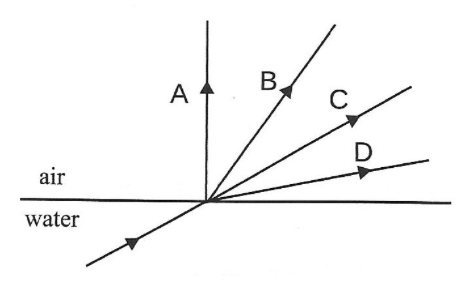
A light ray is incident from water to air. Which of the refracted rays is correct?

A light ray is incident from water to air. Which of the refracted rays is correct?

a)

A

b)

B

c)

C

d)

D

37.
Referring to what is happening in the diagram, then

Referring to what is happening in the diagram, then

a)

na is air, nb is water, nc is glass

b)

na is water, nb is glass, nc is air

c)

na is glass, nb is water, nc is air

d)

na is glass, nb is air, nc is water

e)

na is water, nb is air, nc is glass

38.

When a light ray is refracted and its moving from air to glass, its speed will ____, and it will bend _______ the normal .

a)

increase, away from

b)

increase, towards

c)

decrease, away from

d)

decrease, towards

39.

A shadow is formed whenever

a)

white light is absorbed

b)

white light is reflected

c)

an opaque object blocks light

d)

a shiny object blocks light

40.

On a bright, sunny day, shadows will be the shortest at

a)

in the early morning

b)

at midday

c)

in the early afternoon

d)

in the late afternoon

41.
In order to spear the fish (which is not moving), the fisherman would best

In order to spear the fish (which is not moving), the fisherman would best

a)

aim directly behind the fish

b)

aim directly at the fish

c)

aim directly in front of the fish

42.
The fisherman sees a stationary fish in the water. The fish appears to the fisherman to be

The fisherman sees a stationary fish in the water. The fish appears to the fisherman to be

a)

exactly where the fish actually is

b)

behind where the fish actually is

c)

in front of where the fish actually is

43.

When looking down at a submerged object in water, the object appears ______ because of _____.

a)

closer, refraction

b)

closer, reflection

c)

further away, refraction

d)

further away, reflection

44.

We can see the moon on a clear night because

a)

the moon is a luminous object and reflects light from the sun

b)

the moon is a non-luminous object and gives off it's own light

c)

the moon is a luminous object, and gives off it's own light

d)

the moon is a non-luminous object and reflects light from the sun

e)

the moon is a non-luminous object and reflects light from the Earth

WaygroundAnswer Key

Cambridge Checkpoint Science 8: Light

Total questions: 44

1.
d)

Blue, Green, Red

2.
d)

All colours are absorbed except for red, which is reflected

3.
c)

In a straight line

4.
a)

Black

5.
c)

Mirror

6.
b)

White

7.
b)

green

8.
d)

black

9.
d) Reflection
10.
c)

Red and Green

11.
d)

image

12.
c)

Light rays are bent by the water in the glass.

13.
d)
14.
c)

Glass marble

15.
c) transparent
16.
c)

a straight line

17.
b)

Reflection

18.
a)

Refraction

19.
a) No light passes through it
20.
c) 7
21.
c)

law of reflection

22.
a)

increase, away from

23.
a) When light bounces off something smooth at the same angle it hits the object
24.
b) When light bends as it passes through an object
25.
c)

300 000 000 m/s

26.
d)

the same size of the object, and same distance from mirror

27.
d)

34o

28.
c)

Angle of incidence

29.
c)

The incidence ray

30.
b)

The normal

31.
a)

The angle of incidence

32.
d)

The refracted ray

33.
d)

The angle of refraction

34.
c)

r1 = violet r2 = red

35.
b)

Refraction

, c)

Dispersion

36.
d)

D

37.
d)

na is glass, nb is air, nc is water

38.
d)

decrease, towards

39.
d)

a shiny object blocks light

, c)

an opaque object blocks light

40.
b)

at midday

41.
c)

aim directly in front of the fish

42.
b)

behind where the fish actually is

43.
a)

closer, refraction

44.
d)

the moon is a non-luminous object and reflects light from the sun

FAQs

What does the Cambridge Checkpoint Science 8: Light worksheet cover?

This worksheet practises how light travels and interacts with objects through 42 multiple-choice questions and 2 multiple-select questions. Students apply concepts including the primary colours of light, colour absorption and reflection, filters, reflection, refraction, images, and transparent materials rather than simply recalling the word “light.”

How can I use this worksheet to teach reflection, refraction, and colour?

Introduce the worksheet after demonstrating light with a mirror, a coloured filter, and a glass of water. As students answer, ask them to explain why an apple reflects red light, why a pencil appears bent in water, and why a red filter makes a blue object appear black. Use those explanations to connect the selected answers to absorption, reflection, and refraction.

What mistakes should I watch for when students complete this light worksheet?

Students may confuse the primary colours of light—red, green, and blue—with colour systems used for paints, or confuse reflection with refraction. Watch for errors in filter questions, especially treating a filter as if it adds a colour rather than allowing selected light through, and for confusing transparent materials with opaque or translucent ones. The pencil-in-water and laser-beam items can reveal whether students understand that refraction bends light.

How do I assign and grade this light worksheet?

The worksheet is available on Wayground as a printable PDF and as a digital quiz, with a complete answer key for all 44 questions. Printable submissions can be graded by scanning student work with the Wayground for Teachers app. The printable format also gives schools an option for reducing screen time during science practice.

How can I differentiate this light worksheet for my students?

In the worksheet’s Advanced Settings, adjust font spacing or choose a larger font size to make the multiple-choice options and multiple-select items easier to read. You can also enable a dyslexia-friendly font or translate the worksheet into another language while students practise concepts such as colour filters, reflection, and refraction.

Where can I find more worksheets like this on Wayground?

Wayground offers a broad collection of free printable worksheets and practice problems across subjects, along with downloadable PDFs and answer keys to support essential skills and concepts. Browse more resources at https://wayground.com/en-us/worksheets.