

Wayground
Drug Abuse - Printable Science Worksheets 9th - 12th Grade - Wayground

Drug Abuse

ROLANDO SALINAS

Created by ROLANDO SALINAS

10 questions

9th - 12th Grade

Science

Updated Jun 2026

This Grade 9–12 worksheet introduces key ideas related to drug abuse, brain function, and addiction through 10 multiple-choice questions. Students identify neuron structures such as dendrites, the cell body, and axons; recognize neurons as the brain’s nerve cells; connect the reward system with its associated neurotransmitter; and review the roles of glucose and the nervous system’s “command central.” The worksheet also checks students’ understanding of drug-related vocabulary, including cocaine, alcohol, and addiction, and asks them to identify the full name of a PET scanner. These definition-based questions help students distinguish closely related terms and apply health-science vocabulary in context. It is a free printable worksheet with a complete answer key for classroom practice, review, or formative assessment.

Worksheet settings

Font size

S
M
L
XL
WaygroundWorksheets

Drug Abuse

Total questions: 10

Name
Class
Date
1.
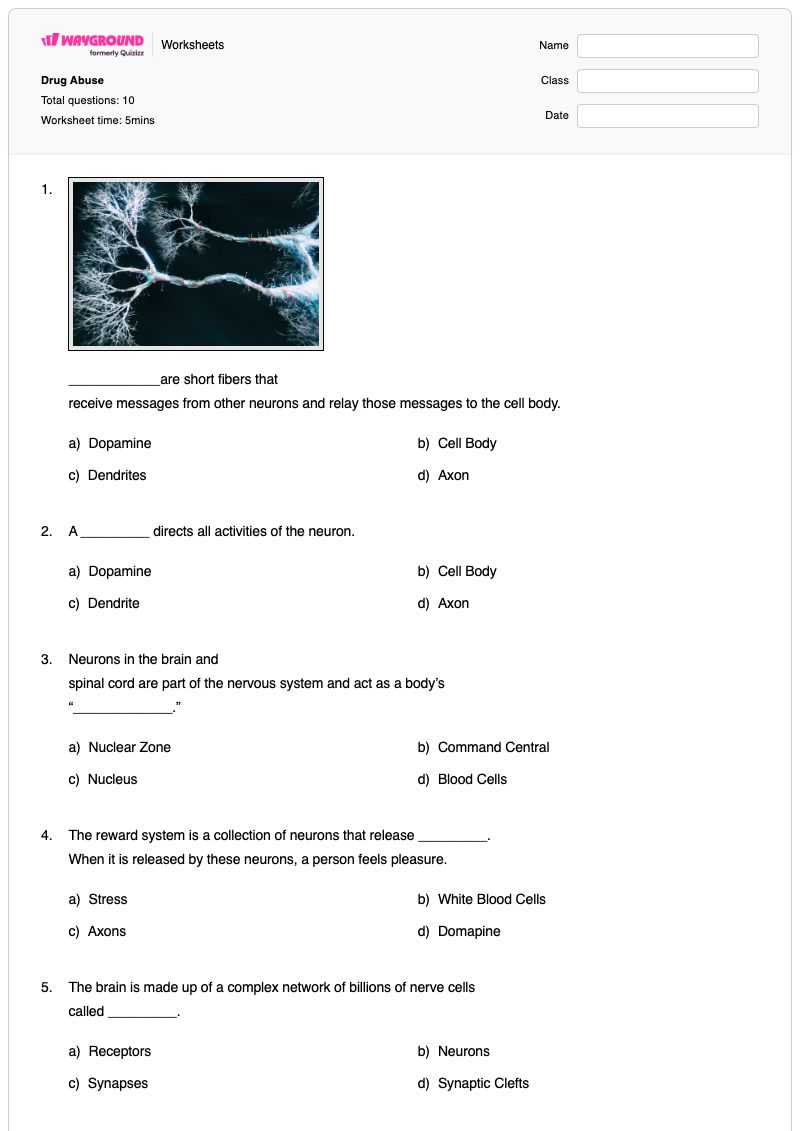
____________are short fibers that receive messages from other neurons and relay those messages to the cell body.

____________are short fibers that

receive messages from other neurons and relay those messages to the cell body.

a)

Dopamine

b)

Cell Body

c)

Dendrites

d)

Axon

2.

A _________ directs all activities of the neuron.

a)

Dopamine

b)

Cell Body

c)

Dendrite

d)

Axon

3.

Neurons in the brain and

spinal cord are part of the nervous system and act as a body’s

“_____________.”

a)

Nuclear Zone

b)

Command Central

c)

Nucleus

d)

Blood Cells

4.

The reward system is a collection of neurons that release _________.

When it is released by these neurons, a person feels pleasure.

a)

Stress

b)

White Blood Cells

c)

Axons

d)

Domapine

5.

The brain is made up of a complex network of billions of nerve cells

called _________.

a)

Receptors

b)

Neurons

c)

Synapses

d)

Synaptic Clefts

6.

_________ is an addictive drug derived from coca or prepared synthetically.

a)

Marijuana

b)

Cocaine

c)

Inhalants

d)

Prescription Pills

7.

_________ is a depressant, meaning it can disrupt the balance of neurotransmitters in your brain and affect your feelings, thoughts and behavior.

a)

Opioid

b)

Bath Salts

c)

Alcohol

d)

Prescription Pills

8.
What is the true, full name for the PET Scanner?

What is the true, full name for the PET Scanner?

a)

Positron Emission Tomography

b)

Positron Egregious Topography

c)

Position Tomography

d)

Position Emission Topography

9.

________ is a type of sugar that is our brain’s

primary fuel.

a)

Salt

b)

Striatum

c)

Glucose

d)

Photosynthesis

10.

________ is a chronic relapsing disease characterized by compulsive, often uncontrollable, drug seeking and drug use in the face of negative consequences.

a)

Withdrawals

b)

Voluntary choice

c)

Persuaded

d)

Addiction

WaygroundAnswer Key

Drug Abuse

Total questions: 10

1.
c)

Dendrites

2.
b)

Cell Body

3.
b)

Command Central

4.
d)

Domapine

5.
b)

Neurons

6.
b)

Cocaine

7.
c)

Alcohol

8.
a)

Positron Emission Tomography

9.
c)

Glucose

10.
d)

Addiction

FAQs

What does the Drug Abuse worksheet cover?

This worksheet uses 10 multiple-choice questions to assess vocabulary about neuron structures and functions, the brain’s reward system, drug effects, PET scanning, glucose, and addiction. Students build recognition skills by distinguishing terms such as dendrites, cell body, neurons, cocaine, alcohol, and addiction from plausible distractors.

How can I use this worksheet to teach brain and addiction concepts?

Introduce the worksheet by reviewing a simple neuron diagram and defining dendrites, the cell body, and axons before students begin the multiple-choice items. After completion, have students explain why each selected term fits its definition, then connect the reward-system, drug, and addiction questions to a broader discussion of how substance use can affect the brain and behavior.

What mistakes should I watch for when students complete this worksheet?

Students may confuse dendrites, the cell body, and axons because all three are neuron-related terms, or select synapses and synaptic clefts when the question asks for the brain’s nerve cells, neurons. They may also mix up drug categories such as cocaine and alcohol, confuse addiction with withdrawal, or choose a distractor instead of the full term Positron Emission Tomography for PET.

How do I assign and grade this Drug Abuse worksheet?

The worksheet is available as a printable PDF and as a digital quiz on Wayground, and it includes a complete answer key for all 10 multiple-choice questions. For printable submissions, you can grade student work by scanning it with the Wayground for Teachers app.

How can I differentiate this worksheet for my students?

Because this worksheet presents 10 definition-based multiple-choice questions, you can adjust font spacing and font size to make the question stems and answer choices easier to read, or enable a dyslexia-friendly font. These options, along with translation into another language, are available under the worksheet’s Advanced Settings.

Where can I find more worksheets like this on Wayground?

Wayground offers a broad collection of free printable worksheets and practice problems across subjects, with downloadable PDFs and answer keys to support essential skills and concepts. Browse more resources at https://wayground.com/en-us/worksheets.