Measurement in Science is a free printable Grade 6 science worksheet that builds practical metric-measurement skills through 17 multiple-choice questions. Students identify the metric units for length, mass, volume, and temperature; match tools such as a triple beam balance, graduated cylinder, metric ruler, and thermometer to their uses; and read measurements from illustrated instruments.
The worksheet also asks students to interpret ruler, thermometer, and graduated-cylinder readings, calculate an object's volume by water displacement, add triple-beam values to find mass, convert millimeters to meters, and use length × width × height to calculate volume. These varied items help students connect measurement tools, units, and basic calculations rather than memorizing definitions alone. The worksheet includes a complete answer key, making it useful for Grade 6 science practice, review, independent work, or a quick assessment.
Worksheet settings
Font size
S
M
L
XL
Worksheets
Measurement in Science
Total questions: 17
Name
Class
Date
1.
What are the four quantities measured in the METRIC SYSTEM?
a)
meters, liters, grams and degrees celsius
b)
inches, pounds and cups
c)
cups, ounces, pounds, and tons
d)
weight, liters, meters, and angles
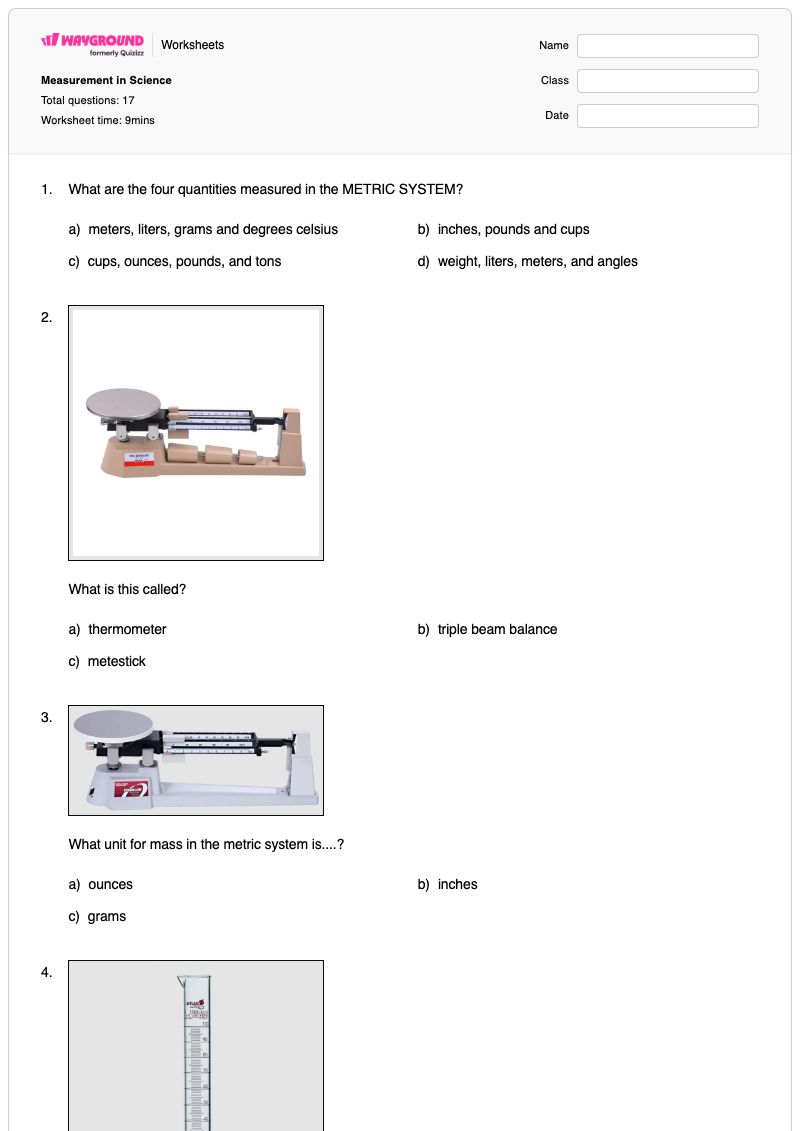
2.
What is this called?
a)
thermometer
b)
triple beam balance
c)
metestick
3.
What unit for mass in the metric system is....?
a)
ounces
b)
inches
c)
grams
4.
To measure volume we use a:
a)
graduated cylinder
b)
triple beam balance
c)
meterstick
5.
Use the METRIC RULER shown in the picture to find the length.
a)
13.9cm
b)
14cm
c)
14.2cm
6.
What is the measurement in celsius?
a)
70 C
b)
20C
c)
15C
7.
Use the metric thermometer shown in the picture to find the temperature
a)
45 C
b)
44 C
c)
40 C
d)
38 C
8.
Use the graduated cylinder shown in the picture to find the volume
a)
31
b)
32
c)
33
9.
Use the graduated cylinder shown in the picture to find the volume
a)
20
b)
21
c)
22
d)
23
10.
The graduated cylinder shows the starting point of the water before the glue stick is placed in the cylinder. Determine the volume of the glue stick.
(Amount with - amount without)
a)
8 ML
b)
15 ML
c)
12 ML
d)
10 ML
11.
Add the value of all three beams in the picture.
a)
38
b)
37.7
c)
37.3
d)
39.2
12.
A table is 392 millimeters = ____ meters (basic unit)
a)
.392 m
b)
39.2 m
c)
392,000
13.
What is the volume? (length x width x height)
a)
180 in
b)
15 in
c)
60 in
d)
20 in
14.
What does the triple beam measure?
a)
mass
b)
volume
c)
density
15.
What is the basic unit of the triple beam?
a)
kilos
b)
grams
c)
inches
16.
What is the tool pictured?
a)
triple beam
b)
beaker
c)
meter stick
17.
What does the meter stick measure?
a)
weight
b)
distance
c)
volume
Answer Key
Measurement in Science
Total questions: 17
1.
a)
meters, liters, grams and degrees celsius
2.
b)
triple beam balance
3.
c)
grams
4.
a)
graduated cylinder
5.
a)
13.9cm
6.
b)
20C
7.
b)
44 C
8.
c)
33
9.
c)
22
10.
a)
8 ML
11.
c)
37.3
12.
a)
.392 m
13.
a)
180 in
14.
a)
mass
15.
b)
grams
16.
c)
meter stick
17.
b)
distance
140 %
Browse by subjects
Browse by grades
Browse by format
FAQs
What does the Measurement in Science worksheet cover?
This Grade 6 science worksheet uses 17 multiple-choice questions to practice identifying metric units and measurement tools, including the metric ruler, thermometer, graduated cylinder, and triple beam balance. Students read illustrated scales, calculate volume by water displacement, add triple-beam readings for mass, convert millimeters to meters, and apply length × width × height for volume.
How can I use this worksheet to teach metric measurement?
Introduce the four measurement contexts—length, mass, volume, and temperature—by displaying the tools named in the worksheet and discussing what each tool measures. Then model how to read one ruler, thermometer, graduated cylinder, and triple beam balance before students complete the multiple-choice items; use the displacement question to demonstrate subtracting the starting water volume from the final volume.
What mistakes should I watch for when students complete this measurement worksheet?
Students may confuse grams with ounces, select a balance for volume, or identify the triple beam balance as measuring density rather than mass. Watch for errors caused by choosing a nearby ruler, thermometer, or graduated-cylinder value, failing to subtract the starting water level for the glue-stick problem, or adding the three beam values incorrectly; metric conversions may also be written with the decimal in the wrong place.
How do I assign and grade this Measurement in Science worksheet?
Wayground provides this worksheet as a printable PDF and as a digital quiz, and it includes a complete answer key for the 17 multiple-choice questions. You can grade printable submissions by scanning student work with the Wayground for Teachers app, while the digital quiz supports online assignment and grading.
How can I differentiate this measurement worksheet for my students?
In the worksheet’s Advanced Settings, adjust font spacing or choose a larger font size to make the measurement diagrams, scale labels, and multiple-choice options easier to read. You can also apply a dyslexia-friendly font or translate the worksheet into another language while keeping the ruler, thermometer, graduated-cylinder, and triple-beam measurement tasks intact.
Where can I find more worksheets like this on Wayground?
Wayground offers a comprehensive collection of free printable worksheets and practice problems across all subjects, with downloadable PDFs and answer keys to support essential skills and concepts. Browse more resources at https://wayground.com/en-us/worksheets.


 Worksheets


