

Wayground
N.1.1, N.1.2, N.1.3 and N.2.1 review - Printable Science Worksheets 5th Grade - Wayground

N.1.1, N.1.2, N.1.3 and N.2.1 review

Alisa Blackman

Created by Alisa Blackman

12 questions

5th Grade

Science

Updated Oct 2026

N.1.1, N.1.2, N.1.3 and N.2.1 review is a Grade 5 science worksheet that reinforces core practices for planning, conducting, and evaluating investigations. Students answer 12 questions—11 multiple choice and one multiple-select—about repeating experiments for consistent and accurate data, identifying a test variable, recording detailed notes, recognizing testable observations, and reviewing procedures when results differ. They also identify what distinguishes an experiment, including a testable question, one variable, and testing. The worksheet also reviews four investigation types: demonstration, experiment, survey, and simulation. It helps students distinguish showing how something works, testing something, gathering opinions, and using a computer to show what would happen. Use this free printable worksheet as independent practice, a review activity, or a formative check after instruction. A complete answer key is included for efficient checking and feedback.

Worksheet settings

Font size

S
M
L
XL
WaygroundWorksheets

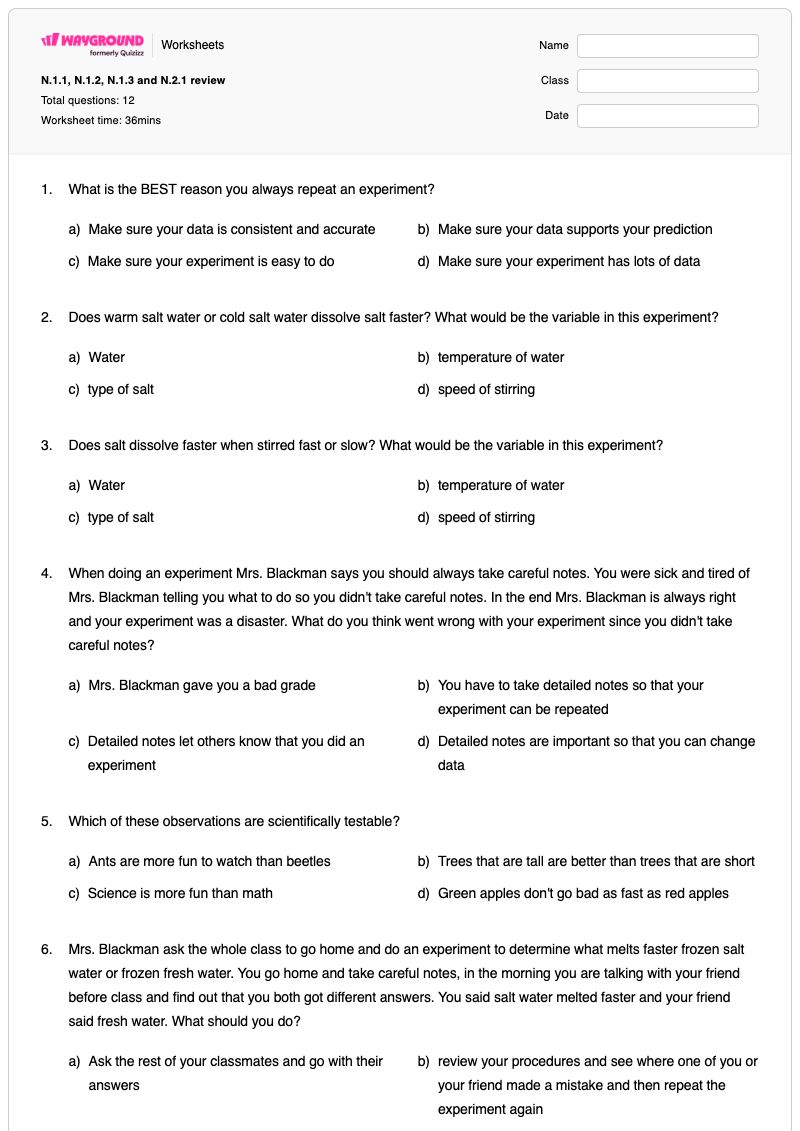
N.1.1, N.1.2, N.1.3 and N.2.1 review

Total questions: 12

Name
Class
Date
1.

What is the BEST reason you always repeat an experiment?

a)

Make sure your data is consistent and accurate

b)

Make sure your data supports your prediction

c)

Make sure your experiment is easy to do

d)

Make sure your experiment has lots of data

2.

Does warm salt water or cold salt water dissolve salt faster? What would be the variable in this experiment?

a)

Water

b)

temperature of water

c)

type of salt

d)

speed of stirring

3.

Does salt dissolve faster when stirred fast or slow? What would be the variable in this experiment?

a)

Water

b)

temperature of water

c)

type of salt

d)

speed of stirring

4.

When doing an experiment Mrs. Blackman says you should always take careful notes. You were sick and tired of Mrs. Blackman telling you what to do so you didn't take careful notes. In the end Mrs. Blackman is always right and your experiment was a disaster. What do you think went wrong with your experiment since you didn't take careful notes?

a)

Mrs. Blackman gave you a bad grade

b)

You have to take detailed notes so that your experiment can be repeated

c)

Detailed notes let others know that you did an experiment

d)

Detailed notes are important so that you can change data

5.

Which of these observations are scientifically testable?

a)

Ants are more fun to watch than beetles

b)

Trees that are tall are better than trees that are short

c)

Science is more fun than math

d)

Green apples don't go bad as fast as red apples

6.

Mrs. Blackman ask the whole class to go home and do an experiment to determine what melts faster frozen salt water or frozen fresh water. You go home and take careful notes, in the morning you are talking with your friend before class and find out that you both got different answers. You said salt water melted faster and your friend said fresh water. What should you do?

a)

Ask the rest of your classmates and go with their answers

b)

review your procedures and see where one of you or your friend made a mistake and then repeat the experiment again

c)

Change your answer cause your friend gets higher grades than you

d)

Go ask Mrs. Miller

7.

What makes an experiment different from any other scientific investigation? Select all that apply

a)

It has one variable

b)

It test something

c)

It has a testable question

d)

It gathers opinions

e)

It gathers data

8.

What is the best way to make sure your data is accurate in an experiment?

a)

Do research

b)

Do your experiment multiple times

c)

Make a prediction

d)

Form a conclusion

9.

When you show how something works and not testing. What type of investigation is that?

a)

Survey

b)

Demonstration

c)

Experiment

d)

Simulation

10.

When you test something. What type of investigation is that?

a)

Survey

b)

Demonstration

c)

Experiment

d)

Simulation

11.

When you gather opinions from others, what type of investigation is that?

a)

Survey

b)

Demonstration

c)

Experiment

d)

Simulation

12.

When you use a computer to show what would happen, what type of investigation is that?

a)

Survey

b)

Demonstration

c)

Experiment

d)

Simulation

WaygroundAnswer Key

N.1.1, N.1.2, N.1.3 and N.2.1 review

Total questions: 12

1.
a)

Make sure your data is consistent and accurate

2.
b)

temperature of water

3.
d)

speed of stirring

4.
b)

You have to take detailed notes so that your experiment can be repeated

5.
d)

Green apples don't go bad as fast as red apples

6.
b)

review your procedures and see where one of you or your friend made a mistake and then repeat the experiment again

7.
a)

It has one variable

, b)

It test something

, c)

It has a testable question

8.
b)

Do your experiment multiple times

9.
b)

Demonstration

10.
c)

Experiment

11.
a)

Survey

12.
d)

Simulation

FAQs

What does this Grade 5 science worksheet cover?

This worksheet reviews how to plan and evaluate scientific investigations through 12 multiple-choice and multiple-select questions. Students practice identifying variables, explaining why experiments are repeated, recognizing the importance of detailed notes and testable observations, evaluating differing results, and distinguishing experiments from other investigation types.

How can I use this worksheet to teach scientific investigations?

Introduce the worksheet by modeling an investigation about dissolving salt and asking students to identify the variable being changed, such as water temperature or stirring speed. Then have students complete the questions and explain why repeated trials, careful notes, and procedure reviews make results more reliable; finish by sorting the investigation examples into demonstration, experiment, survey, and simulation.

What mistakes should I watch for when students complete this investigation review?

Students may confuse the variable in an investigation with the material being tested, choosing water or salt instead of the temperature of the water or speed of stirring. They may also think a friend’s result should replace their own, overlook the need to repeat an experiment after checking procedures, or select opinions as scientifically testable observations. In the multiple-select item, check that students distinguish testing with one variable and a testable question from gathering opinions.

How do I assign and grade this science worksheet?

You can assign this investigation review as a printable PDF or as a digital quiz on Wayground, and it includes a complete answer key for all 12 questions. For printable submissions, scan student work with the Wayground for Teachers app to grade responses efficiently.

Which types of scientific investigations do the questions review?

The final four questions ask students to match investigation descriptions with demonstration, experiment, survey, and simulation. Students learn to distinguish showing how something works, testing something, gathering opinions, and using a computer to show what would happen.

Where can I find more worksheets like this on Wayground?

Wayground offers a broad collection of free printable worksheets and practice problems across subjects, with downloadable PDFs and answer keys to help students build essential skills and concepts. Browse more resources at https://wayground.com/en-us/worksheets.