
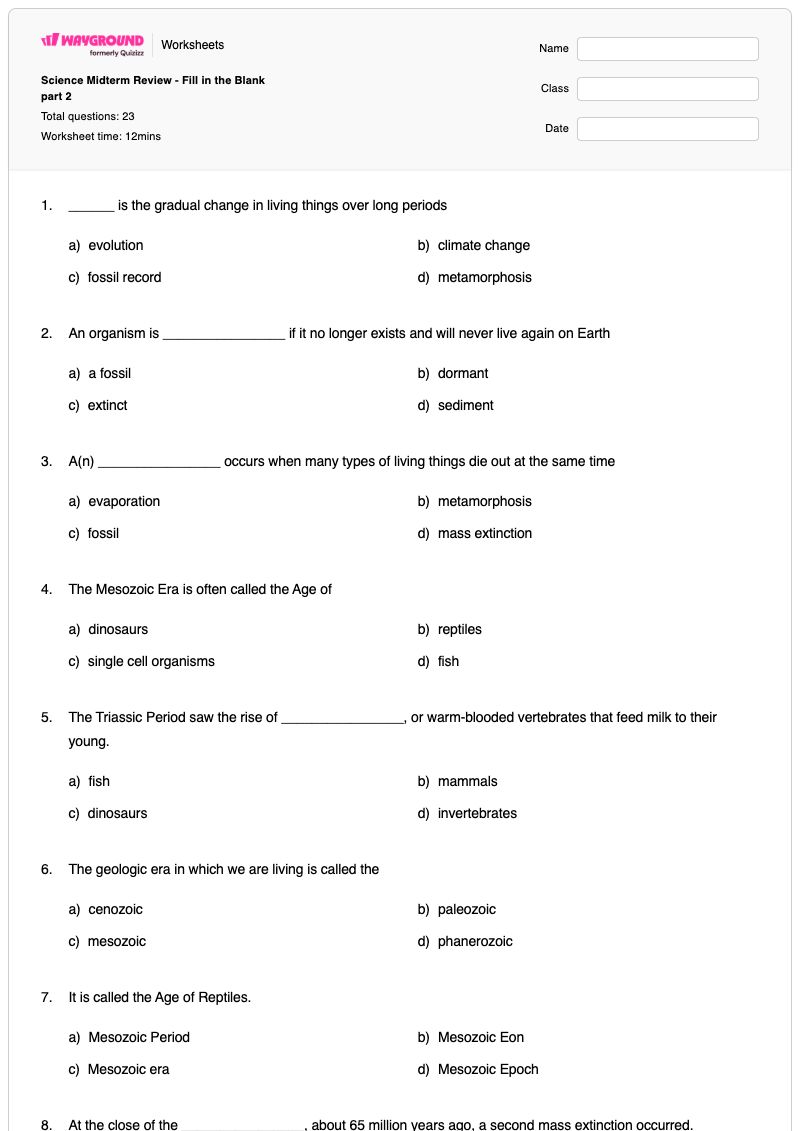

This Grade 6 science midterm review worksheet uses 23 multiple-choice, sentence-completion questions to reinforce key Earth and life science vocabulary. Students identify evolution, extinction, mass extinction, the Mesozoic and Cenozoic eras, major developments during geologic time, and the relationships among erosion, deposition, sediment, mass movement, and gravity. The format asks students to select the term that correctly completes each statement, making it useful for checking recall and distinguishing closely related concepts.
Use this free printable worksheet with an answer key as independent practice, a review activity before a science assessment, or a quick diagnostic of students’ understanding of geologic history and surface processes. The completed items can help teachers identify whether students recognize definitions and connect each process or event with its correct term, era, or time period.
Worksheet settings
Font size
S
M
L
XL
Worksheets
Science Midterm Review - Fill in the Blank part 2
Total questions: 23
Name
Class
Date
1.
______ is the gradual change in living things over long periods
a)
evolution
b)
climate change
c)
fossil record
d)
metamorphosis
2.
An organism is ________________ if it no longer exists and will never live again on Earth
a)
a fossil
b)
dormant
c)
extinct
d)
sediment
3.
A(n) ________________ occurs when many types of living things die out at the same time
a)
evaporation
b)
metamorphosis
c)
fossil
d)
mass extinction
4.
The Mesozoic Era is often called the Age of
a)
dinosaurs
b)
reptiles
c)
single cell organisms
d)
fish
5.
The Triassic Period saw the rise of ________________, or warm-blooded vertebrates that feed milk to their young.
a)
fish
b)
mammals
c)
dinosaurs
d)
invertebrates
6.
The geologic era in which we are living is called the
a)
cenozoic
b)
paleozoic
c)
mesozoic
d)
phanerozoic
7.
It is called the Age of Reptiles.
a)
Mesozoic Period
b)
Mesozoic Eon
c)
Mesozoic era
d)
Mesozoic Epoch
8.
At the close of the ________________, about 65 million years ago, a second mass extinction occurred.
a)
Mesozoic
b)
Paleozoic
c)
Cenozoic
d)
Holocene
9.
The first dinosaurs appeared during the __
a)
Holocene Epoch
b)
Paleozoic era
c)
Cenozoic era
d)
Mesozoic era
10.
During the ________________, mammals evolved to live in many different environments—on land, in water, and even in the air.
a)
Pre Cambrian time
b)
mesozoic
c)
paleozoic
d)
cenozoic
11.
agents of erosion lay down sediment in a new location
a)
collection
b)
deposition
c)
sedimentation
d)
cementation
12.
The material moved by erosion is called _
a)
sediment
b)
minerals
c)
grains
d)
faults
13.
The process by which natural forces move weathered rock and soil from one place to another is called _
a)
cementation
b)
erosion
c)
weathering
d)
deposition
14.
includes several processes caused by gravity that move sediment downhill.
a)
slump
b)
weathering
c)
mass movement
d)
creep
15.
a force that pull objects toward the Earth
a)
erosion
b)
mass
c)
weight
d)
gravity
16.
The type of __________________ and the climate determine the rate at which weathering occurs.
a)
grains
b)
mineral
c)
weathering
d)
weather
17.
__ weathering occurs when abrasion and other natural agents physically wear away rock.
a)
abrasive
b)
chemical
c)
mechanical
d)
liquid
18.
The process by which ice widens and deepens a crack in a rock is called ____
a)
frost wedging
b)
amber
c)
shearing
d)
abrasion
19.
The change in elevation from one contour line to the next line is called__
a)
contour index
b)
contour interval
c)
contour line
d)
elevation
20.
_ are lines on a map labeled with the elevation.
a)
index contour
b)
contour lines
c)
contour interval
d)
elevation
21.
_ connects points of equal elevation on a topographic map.
a)
contour index
b)
contour interval
c)
contour line
d)
elevation
22.
This map shows the surface features of an area.
a)
geographical
b)
aerial
c)
street
d)
topographic
23.
Widely spaced contour lines indicate a relatively _______ area
a)
low
b)
steep
c)
flat
d)
high
Answer Key
Science Midterm Review - Fill in the Blank part 2
Total questions: 23
1.
a)
evolution
2.
c)
extinct
3.
d)
mass extinction
4.
b)
reptiles
5.
b)
mammals
6.
a)
cenozoic
7.
c)
Mesozoic era
8.
a)
Mesozoic
9.
d)
Mesozoic era
10.
d)
cenozoic
11.
b)
deposition
12.
a)
sediment
13.
b)
erosion
14.
c)
mass movement
15.
d)
gravity
16.
b)
mineral
17.
c)
mechanical
18.
a)
frost wedging
19.
b)
contour interval
20.
a)
index contour
21.
c)
contour line
22.
d)
topographic
23.
c)
flat
140 %
Browse by subjects
Browse by grades
Browse by format
FAQs
What does this Grade 6 science worksheet cover?
This worksheet reviews evolution, extinct organisms, mass extinction, the Mesozoic and Cenozoic eras, and Earth-surface processes such as erosion, deposition, sediment, mass movement, and gravity. Its 23 multiple-choice sentence-completion items help students select the precise term, era, or process that completes each statement.
How can I use this worksheet to teach geologic eras and erosion processes?
Introduce the review by grouping the items into two discussions: geologic history and surface processes. Have students explain why terms such as Mesozoic era, Cenozoic era, mass extinction, erosion, deposition, and mass movement fit their statements, then use the worksheet for guided practice before independent completion.
What mistakes should I watch for when students complete this worksheet?
Students may confuse related terms such as erosion, weathering, deposition, and mass movement, or choose sediment instead of the process that moves or deposits it. They may also mix up the Mesozoic and Cenozoic eras, confuse an era with a period or epoch, or select dinosaurs when a statement specifically describes mammals.
How do I assign and grade this worksheet?
On Wayground, assign this worksheet as a printable PDF or as a digital quiz, and use the complete answer key to check responses. Printable submissions can also be graded by scanning student work with the Wayground for Teachers app.
How can I differentiate this worksheet for my students?
Use the worksheet’s Advanced Settings to adjust font spacing and font size for the multiple-choice sentence-completion items. You can also enable a dyslexia-friendly font or translate the worksheet into another language when those options better support access to the science vocabulary.
Where can I find more worksheets like this on Wayground?
Wayground offers a broad collection of free printable worksheets and practice problems across subjects, with downloadable PDFs and answer keys to support essential skills and concepts. Browse more resources at https://wayground.com/en-us/worksheets.