

Wayground
Science U4.1Forces - Printable Science Worksheets 5th Grade - Wayground

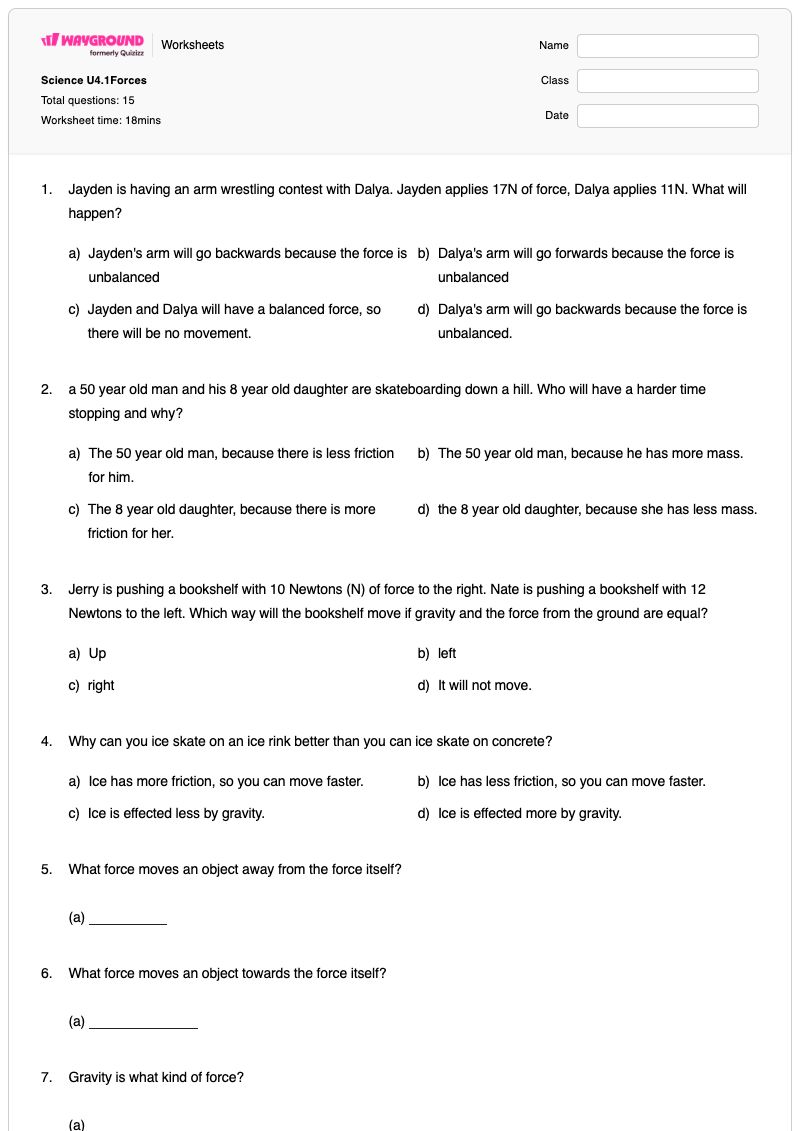
Science U4.1Forces

Brent Fulmer

Created by Brent Fulmer

15 questions

5th Grade

Science

Science U4.1Forces is a Grade 5 science worksheet that helps students apply force concepts to familiar situations. Across 15 questions, students analyze balanced and unbalanced forces, compare how mass affects stopping, determine the direction of net force, distinguish push and pull forces, and explain how gravity and friction affect motion. They also evaluate how changing force, drop height, or surface friction changes an object’s movement. The worksheet uses 10 multiple-choice questions, four fill-in-the-blank items, and one multiple-select question. Students identify examples such as a stronger arm-wrestling force moving an opponent’s arm, friction differences between ice and concrete, gravity bringing a gliding squirrel down, and mass making trains harder to stop. This free printable worksheet includes a complete answer key and is designed for Grade 5 science practice, review, or an understanding check after instruction on forces and motion.

Worksheet settings

Font size

S
M
L
XL
WaygroundWorksheets

Science U4.1Forces

Total questions: 15

Name
Class
Date
1.

Jayden is having an arm wrestling contest with Dalya. Jayden applies 17N of force, Dalya applies 11N. What will happen?

a)

Jayden's arm will go backwards because the force is unbalanced

b)

Dalya's arm will go forwards because the force is unbalanced

c)

Jayden and Dalya will have a balanced force, so there will be no movement.

d)

Dalya's arm will go backwards because the force is unbalanced.

2.

a 50 year old man and his 8 year old daughter are skateboarding down a hill. Who will have a harder time stopping and why?

a)

The 50 year old man, because there is less friction for him.

b)

The 50 year old man, because he has more mass.

c)

The 8 year old daughter, because there is more friction for her.

d)

the 8 year old daughter, because she has less mass.

3.

Jerry is pushing a bookshelf with 10 Newtons (N) of force to the right. Nate is pushing a bookshelf with 12 Newtons to the left. Which way will the bookshelf move if gravity and the force from the ground are equal?

a)

Up

b)

left

c)

right

d)

It will not move.

4.

Why can you ice skate on an ice rink better than you can ice skate on concrete?

a)

Ice has more friction, so you can move faster.

b)

Ice has less friction, so you can move faster.

c)

Ice is effected less by gravity.

d)

Ice is effected more by gravity.

5.

What force moves an object away from the force itself?

(a)  

6.

What force moves an object towards the force itself?

(a)  

7.

Gravity is what kind of force?

(a)  

8.

A rollercoaster designer wants to increase the speed of the big drop that starts her rollercoaster. What can she do? (Choose two)

a)

decrease the angle of the drop.

b)

increase the amount of friction the drop has.

c)

increase the amount of force applied to the cart

d)

decrease the height of the drop

e)

increase the height of the drop

9.

A flying squirrel doesn't really "fly," it actually glides. What is the force that eventually brings it back down to Earth?

(a)  

10.

Which is an example of an object overcoming, or temporarily defying gravity?

a)

a basketball bouncing off of the court

b)

a bowling ball gliding down the lane

c)

a golf ball being putted into the hole

d)

a football laying on the ground

11.

Milo has a mass of 55kg. She throws the football with 9 N of force.

Michell has a mass of 46kg. She throws the football with 17 N of force. What is true about Michell's throw?

a)

The football will move with more distance but less speed because she has less mass.

b)

The football will move with less distance but more speed because she has less mass.

c)

The football will move with more distance and more speed, because the force applied to it is stronger.

d)

The football will move with less distance and less speed, because the force applied to it is stronger.

12.

Which surface has the MOST amount of friction?

a)

smooth concrete

b)

tall grass

c)

an air hockey table

d)

a waxed wooden floor bowling alley

13.

Seabass was showing off his dance moves on a wooden floor. He tried to slide barefoot but didn't go very far. Which decision he made would NOT decrease the friction to help him slide farther?

a)

put mountain boots with thick tread on

b)

put soft slick socks on

c)

put water on the floor

d)

put oil on his feet

14.

Trains that have many railroad cars attached to them cannot stop as easily as a train without. Why?

a)

Trains with railroad cars move faster.

b)

Trains with railroad cars have a bigger engine.

c)

Trains with railroad cars like to take their sweet time stopping.

d)

Trains with railroad cars have more mass.

15.

Which animal is best at overcoming gravity through the following actions?

a)

A hawk sitting on the ground eating a pigmy rattlesnake

b)

A pigmy rattlesnake slithering across your shoe.

c)

A dragonfly shedding its skin.

d)

A kangaroo jumping over a barrier fence.

WaygroundAnswer Key

Science U4.1Forces

Total questions: 15

1.
d)

Dalya's arm will go backwards because the force is unbalanced.

2.
b)

The 50 year old man, because he has more mass.

3.
b)

left

4.
b)

Ice has less friction, so you can move faster.

5.
push
6.
pull, gravity
7.
pull
8.
e)

increase the height of the drop

, c)

increase the amount of force applied to the cart

9.
gravity
10.
a)

a basketball bouncing off of the court

11.
c)

The football will move with more distance and more speed, because the force applied to it is stronger.

12.
b)

tall grass

13.
a)

put mountain boots with thick tread on

14.
d)

Trains with railroad cars have more mass.

15.
d)

A kangaroo jumping over a barrier fence.

FAQs

What does this Grade 5 forces worksheet cover?

This worksheet asks students to apply force and motion concepts in 15 scenario-based questions, including 10 multiple-choice items, four fill-in-the-blank items, and one multiple-select item. Students determine the effects of unbalanced forces, mass, friction, pushes, pulls, and gravity—for example, predicting an object’s direction of movement or identifying how to increase a rollercoaster’s speed.

How can I use this worksheet to teach forces and motion?

Introduce the worksheet by modeling how to compare opposing forces, such as the 17 N and 11 N arm-wrestling forces, and how the larger force determines movement. Then have students explain their reasoning for the bookshelf, ice-skating, rollercoaster, and gravity scenarios before completing the fill-in-the-blank vocabulary items and the final multiple-select question independently.

What mistakes should I watch for when students complete this forces worksheet?

Students may choose balanced force when two forces are merely opposite, without checking whether their magnitudes are equal, as in the bookshelf and arm-wrestling items. They may also confuse mass with applied force, reverse push and pull definitions, or select only one answer on the rollercoaster item instead of identifying both changes that increase speed.

How do I assign and grade this forces worksheet?

The worksheet is available as a printable PDF and as a digital quiz on Wayground, and it includes a complete answer key for all 15 questions. You can grade printed student work by scanning it with the Wayground for Teachers app, while the digital quiz can be completed and graded online.

How can I differentiate this forces and motion worksheet for my students?

In Advanced Settings, adjust font spacing and font size to make the multiple-choice options and fill-in-the-blank prompts easier to read. You can also apply a dyslexia-friendly font or translate the worksheet’s force, friction, mass, and gravity questions into another language.

Where can I find more worksheets like this on Wayground?

Wayground offers a comprehensive collection of free printable worksheets and practice problems across all subjects, with downloadable PDFs and answer keys to support essential skills and concepts. Browse more resources at https://wayground.com/en-us/worksheets.