

Wayground
The Tell Tale Heart - Printable ELA Worksheets year 8 - Wayground

The Tell Tale Heart

DIANA SILENO

Created by DIANA SILENO

11 questions

8th Grade

ELA

Updated Oct 2026

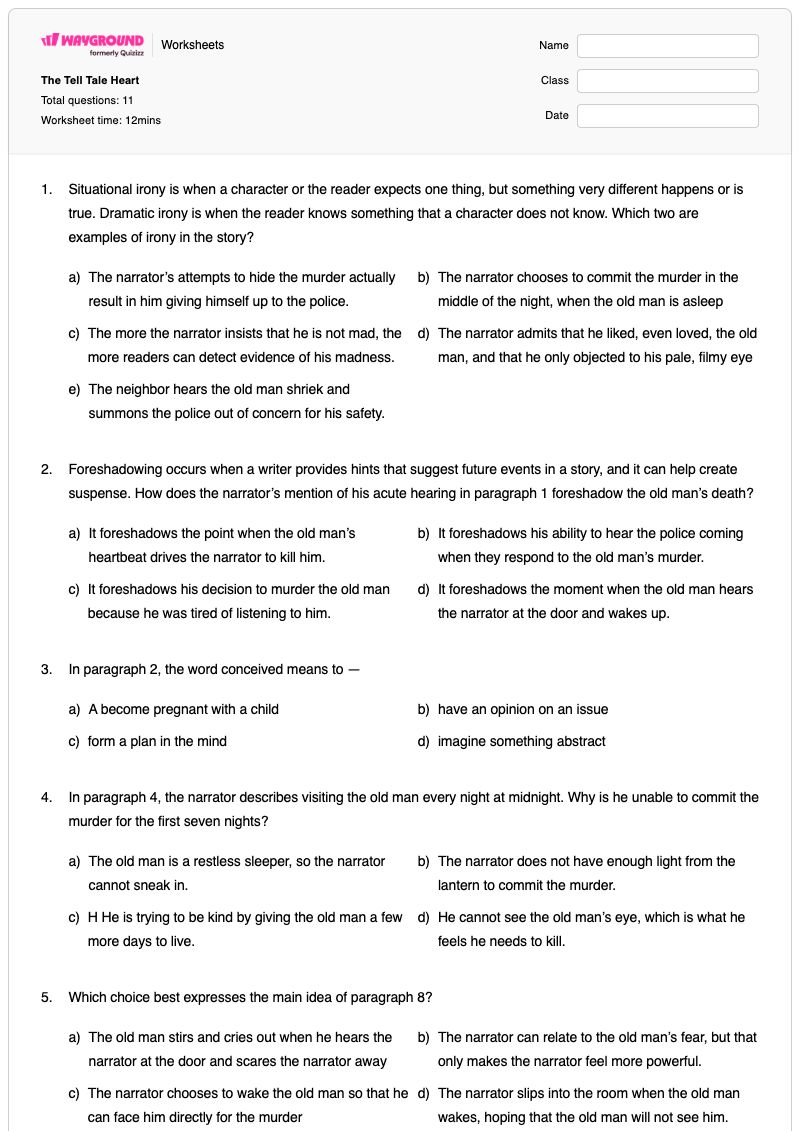
The Tell-Tale Heart worksheet helps Grade 8 English students analyze how Edgar Allan Poe develops meaning and suspense through literary elements. Across 11 items—one multiple-select question, eight multiple-choice questions, and two open-ended responses—students identify situational and dramatic irony, explain foreshadowing, determine word meaning from context, analyze main idea and tone, and examine how first-person narration reveals the narrator’s mental instability. They also interpret the beating heart as a symbol and support their understanding of the horror genre with evidence from the story. This free printable worksheet is designed for close reading, independent practice, or a literature assessment after students read the story. The selected-response items focus on specific paragraphs and details, while the open-ended prompts require text-based explanation and cited evidence. An answer key is included to support efficient review and grading.

Worksheet settings

Font size

S
M
L
XL
WaygroundWorksheets

The Tell Tale Heart

Total questions: 11

Name
Class
Date
1.

Situational irony is when a character or the reader expects one thing, but something very different happens or is true. Dramatic irony is when the reader knows something that a character does not know. Which two are examples of irony in the story?

a)

The narrator’s attempts to hide the murder actually result in him giving himself up to the police.

b)

The narrator chooses to commit the murder in the middle of the night, when the old man is asleep

c)

The more the narrator insists that he is not mad, the more readers can detect evidence of his madness.

d)

The narrator admits that he liked, even loved, the old man, and that he only objected to his pale, filmy eye

e)

The neighbor hears the old man shriek and summons the police out of concern for his safety.

2.

Foreshadowing occurs when a writer provides hints that suggest future events in a story, and it can help create suspense. How does the narrator’s mention of his acute hearing in paragraph 1 foreshadow the old man’s death?

a)

It foreshadows the point when the old man’s heartbeat drives the narrator to kill him.

b)

It foreshadows his ability to hear the police coming when they respond to the old man’s murder.

c)

It foreshadows his decision to murder the old man because he was tired of listening to him.

d)

It foreshadows the moment when the old man hears the narrator at the door and wakes up.

3.

In paragraph 2, the word conceived means to —

a)

A become pregnant with a child

b)

have an opinion on an issue

c)

form a plan in the mind

d)

imagine something abstract

4.

In paragraph 4, the narrator describes visiting the old man every night at midnight. Why is he unable to commit the murder for the first seven nights?

a)

The old man is a restless sleeper, so the narrator cannot sneak in.

b)

The narrator does not have enough light from the lantern to commit the murder.

c)

H He is trying to be kind by giving the old man a few more days to live.

d)

He cannot see the old man’s eye, which is what he feels he needs to kill.

5.

Which choice best expresses the main idea of paragraph 8?

a)

The old man stirs and cries out when he hears the narrator at the door and scares the narrator away

b)

The narrator can relate to the old man’s fear, but that only makes the narrator feel more powerful.

c)

The narrator chooses to wake the old man so that he can face him directly for the murder

d)

The narrator slips into the room when the old man wakes, hoping that the old man will not see him.

6.

In paragraphs 14–15, the narrator describes his cleanup and first encounter with the police with a tone of —

a)

anxiety

b)

melancholy

c)

confidence

d)

indifference

7.

Which word from paragraph 18 is closest to meaning contempt?

a)

Agony

b)

Derision

c)

Swore

d)

Hypocritical

8.

Poe’s extensive use of dashes in the last two paragraphs is effective because it —

a)

Highlights the narrator’s increased sense of nervousness

b)

slows down the story so that it is easier to understand

c)

suggests that the police know more than they are letting on

d)

allows the readers to understand the narrator’s motives

9.

The use of a first-person narrator in the story —

a)

allows readers to understand each character’s point of view

b)

helps to explain how the characters are related to each other

c)

gives readers insight into the narrator’s mental instability

d)

illustrates how the old man treats the narrator every day

10.

After murdering the old man, the narrator becomes convinced that he can still hear the man’s heart beating. What does this symbolize, or represent? Cite evidence from the text to support your answer.

4 lines
11.

In what ways is the story a model of the horror genre? Cite examples from the text to support your response.

4 lines
WaygroundAnswer Key

The Tell Tale Heart

Total questions: 11

1.
a)

The narrator’s attempts to hide the murder actually result in him giving himself up to the police.

, c)

The more the narrator insists that he is not mad, the more readers can detect evidence of his madness.

2.
a)

It foreshadows the point when the old man’s heartbeat drives the narrator to kill him.

3.
c)

form a plan in the mind

4.
d)

He cannot see the old man’s eye, which is what he feels he needs to kill.

5.
b)

The narrator can relate to the old man’s fear, but that only makes the narrator feel more powerful.

6.
d)

indifference

7.
b)

Derision

8.
a)

Highlights the narrator’s increased sense of nervousness

9.
c)

gives readers insight into the narrator’s mental instability

10.
n/a
11.
n/a

FAQs

What does The Tell-Tale Heart worksheet help students analyze?

This Grade 8 worksheet uses one multiple-select question, eight multiple-choice questions, and two open-ended responses to analyze irony, foreshadowing, characterization, tone, symbolism, point of view, and horror-genre features in The Tell-Tale Heart. Students connect specific details—such as the narrator’s acute hearing, the heartbeat, the dashes in the final paragraphs, and the first-person narration—to larger interpretations of suspense and mental instability.

How can I use this worksheet to teach literary analysis of The Tell-Tale Heart?

Use the paragraph-based multiple-choice questions to model how readers move from a quoted detail to an interpretation: for example, connect the narrator’s acute hearing to the later heartbeat and explain how that creates foreshadowing. Then have students complete the two open-ended prompts, using evidence to interpret the heartbeat’s symbolism and explain how the story follows the horror genre.

What mistakes should I watch for when students complete this worksheet?

Students may confuse situational irony with dramatic irony, choose a general definition instead of the context-based meaning of “conceived,” or overlook that the narrator waits seven nights because he cannot see the old man’s eye. In the written responses, watch for claims about the heartbeat or horror genre that are not supported with textual evidence, as well as explanations that describe first-person narration without connecting it to the narrator’s mental instability.

How do I assign and grade The Tell-Tale Heart worksheet?

The worksheet is available as a printable PDF and as a digital quiz on Wayground, and it includes a complete answer key for the selected-response items. You can grade printable submissions by scanning student work with the Wayground for Teachers app, while reviewing the two open-ended answers for an interpretation supported by evidence from the story.

How can I differentiate this The Tell-Tale Heart worksheet for my students?

In the worksheet’s Advanced Settings, adjust font spacing or choose a larger font size to make the paragraph-based questions and open-ended prompts easier to read. You can also apply a dyslexia-friendly font or translate the worksheet into another language when those options support students working with the literary-analysis questions.

Where can I find more worksheets like this on Wayground?

Wayground offers a comprehensive collection of free printable worksheets and practice problems across subjects, with downloadable PDFs and answer keys to help students master essential skills and concepts. Browse more resources at https://wayground.com/en-us/worksheets.