

Wayground
Elearning 1-23 Review of Sine and Cosine graphs - Printable Mathematics Worksheets - Wayground

Elearning 1-23 Review of Sine and Cosine graphs

20 questions

11th - 11th Grade

Mathematics

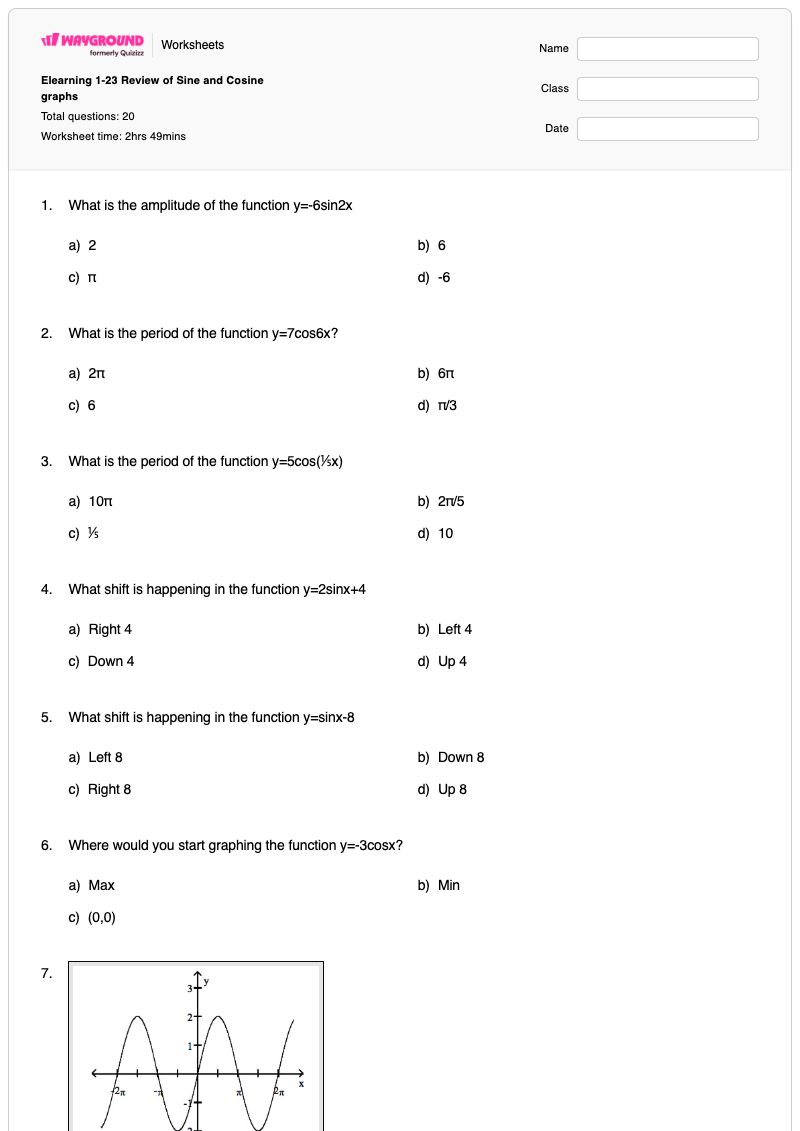
This Grade 11 mathematics review worksheet helps students analyze and write equations for sine and cosine functions. It focuses on identifying amplitude, period, vertical shifts, and whether a graph begins at a maximum or minimum, then applying those features to interpret graphs and select or construct matching equations. Students also work with functions whose periods and amplitudes require connecting the coefficient of x to the graph’s behavior. The 20-question review uses varied digital and printable item types: 15 multiple-choice questions, 3 multiple-select questions, 1 hotspot, and 1 matching item. It is suitable for checking understanding after instruction, preparing for an assessment, or identifying which sinusoidal-graph skills need reteaching. This free printable worksheet includes a complete answer key, giving teachers a ready-to-use way to review students’ ability to move between equations, graph features, and visual representations.

Worksheet settings

Font size

S
M
L
XL
Worksheets

Elearning 1-23 Review of Sine and Cosine graphs

Total questions: 20

Name
Class
Date
1.
What is the amplitude of the function y=-6sin2x
a)
2
b)
6
c)
π
d)
-6
2.
What is the period of the function y=7cos6x?
a)
2π
b)
6π
c)
6
d)
π/3
3.
What is the period of the function y=5cos(⅕x)
a)
10π
b)
2π/5
c)
⅕
d)
10
4.
What shift is happening in the function y=2sinx+4
a)
Right 4
b)
Left 4
c)
Down 4
d)
Up 4
5.
What shift is happening in the function y=sinx-8
a)
Left 8
b)
Down 8
c)
Right 8
d)
Up 8
6.
Where would you start graphing the function y=-3cosx?
a)
Max
b)
Min
c)
(0,0)
7.
What is the equation of the function shown?
a)
y=2sinx
b)
y=2sin(2πx)
c)
y=sinx
d)
y=-2sinx
8.
What is the equation of the function shown?
a)
y=-2cosx
b)
y=cos2x
c)
y=2cosx
d)
y=2cos2x
9.
Write an equation of a sine function with a period of π and amplitude of 7.
a)
y=7sin2πx
b)
y=7sinπx
c)
y=2sin7x
d)
y=7sin2x
10.
Write an equation of a sine function with a period of 4π and amplitude of 5.
a)
y=5sin½x
b)
y=5sin2πx
c)
y=5sin4πx
d)
y=5sin4x
11.
Write an equation of a cosine function with a period of 3π, amplitude of 2, and shift up 4.
a)
y=2cos⅔x-4
b)
y=2cos⅔(x+4)
c)
y=2cos3x+4
d)
y=2cos⅔x+4
12.
What is the equation of graph? 
a)
y = sin 5x
b)
y =  cos 5x
c)
y = 5 sin x
d)
y = 5 cos x 
13.
Write the equation for a sine function with an amplitude of 6 and a period of π/4.
a)
y=6sin(8x)
b)
y=6sin8(x-1)
c)
y=6sin1/4x
d)
y=6sinx
14.
What is the vertical shift? 
a)
Down 1
b)
Down 5
c)
Down 3
d)
Down 4
15.

Angle θ\theta , measured in radians, satisfies cos⁡(θ)=0\cos\left(\theta\right)=0 . What could the value of θ\theta be? Select ALL the answers that apply.

a)

00

b)

π4\frac{\pi}{4}

c)

π2\frac{\pi}{2}

d)

π\pi

e)

3π2\frac{3\pi}{2}

16.

Which statements are true for BOTH functions y=sin⁡(θ)y=\sin\left(\theta\right) and y=cos⁡(θ)y=\cos\left(\theta\right) ? Select ALL that apply.

a)

The period is 2π2\pi

b)

The maximum value is 1

c)

The maximum value occurs at θ=0\theta=0

d)

The function has a value of 22\frac{\sqrt[]{2}}{2} when θ=π4\theta=\frac{\pi}{4} .

e)

The minimum value is 0.

17.

Plot the points on the graph where sin⁡(θ)= 22\sin\left(\theta\right)=\frac{\ \sqrt[]{2}}{2}

18.

For which of these angles is the sine negative? Select ALL that apply.

a)

−π4-\frac{\pi}{4}

b)

−π3-\frac{\pi}{3}

c)

−2π3-\frac{2\pi}{3}

d)

−4π3-\frac{4\pi}{3}

e)

−11π6-\frac{11\pi}{6}

19.
Question Image

Match the following

2sin⁡(θ)−32\sin\left(\theta\right)-3

Graph 1

3cos⁡(θ)−23\cos\left(\theta\right)-2

Graph 2

2cos⁡(θ)−32\cos\left(\theta\right)-3

Graph 4

3sin⁡(θ)−23\sin\left(\theta\right)-2

Graph 3

20.

Which of these is true for the function y=3sin⁡(x2)y=3\sin\left(\frac{x}{2}\right) ?

a)

Period is π\pi

b)

Period is 3

c)

Period is 2π2\pi

d)

Period is 4π4\pi

Answer Key

Elearning 1-23 Review of Sine and Cosine graphs

Total questions: 20

1.
b) 6
2.
d) π/3
3.
a) 10π
4.
d) Up 4
5.
b) Down 8
6.
b) Min
7.
a) y=2sinx
8.
c) y=2cosx
9.
d) y=7sin2x
10.
a) y=5sin½x
11.
d) y=2cos⅔x+4
12.
d) y = 5 cos x 
13.
a) y=6sin(8x)
14.
c) Down 3
15.
c)

π2\frac{\pi}{2}

, e)

3π2\frac{3\pi}{2}

16.
a)

The period is 2π2\pi

, b)

The maximum value is 1

, d)

The function has a value of 22\frac{\sqrt[]{2}}{2} when θ=π4\theta=\frac{\pi}{4} .

17.
18.
a)

−π4-\frac{\pi}{4}

, b)

−π3-\frac{\pi}{3}

, c)

−2π3-\frac{2\pi}{3}

19.

2sin⁡(θ)−32\sin\left(\theta\right)-3

 - 

Graph 1

, 

3cos⁡(θ)−23\cos\left(\theta\right)-2

 - 

Graph 2

, 

2cos⁡(θ)−32\cos\left(\theta\right)-3

 - 

Graph 4

, 

3sin⁡(θ)−23\sin\left(\theta\right)-2

 - 

Graph 3

20.
d)

Period is 4π4\pi

FAQs

What does this sine and cosine graphs review worksheet cover?

This Grade 11 worksheet reviews how to identify amplitude, period, vertical shifts, and starting behavior in sine and cosine functions, then use those features to interpret graphs or choose an equation. Its 20 items include multiple-choice, multiple-select, hotspot, and matching questions, so students practice both recognizing graph features and constructing equations such as functions with specified amplitude, period, and vertical shift.

How can I use this worksheet to teach amplitude, period, and shifts in sine and cosine graphs?

Use the multiple-choice items to model how the coefficient outside a trigonometric function determines amplitude and how the coefficient of x affects period. Next, have students explain why a constant added outside the function creates an upward or downward shift and why a negative cosine begins at a minimum. Finish with the equation-writing items, asking students to justify each coefficient from the requested graph features.

What mistakes should I watch for on this sine and cosine graphs worksheet?

Watch for students treating the coefficient of x as the period instead of using the relationship period = 2π divided by the absolute value of that coefficient. Students may also confuse amplitude with the signed coefficient, read a vertical shift as a horizontal shift, or choose a sine equation when a graph’s starting point identifies cosine. In the equation-writing items, check that students combine amplitude, period, and vertical shift rather than matching only one feature.

How do I assign and grade this sine and cosine graphs worksheet?

You can assign this worksheet as a printable PDF or as a digital quiz on Wayground, and it includes a complete answer key for checking the amplitude, period, shift, graph-identification, and equation-writing items. For printable submissions, scan student work with the Wayground for Teachers app to support faster grading.

How can I differentiate this sine and cosine graphs worksheet for my students?

In the worksheet’s Advanced Settings, adjust font spacing or choose a larger font size so the equation choices and graph-related prompts are easier to read. You can also enable a dyslexia-friendly font or translate the worksheet into another language while keeping the focus on the amplitude, period, and vertical-shift questions.

Where can I find more worksheets like this on Wayground?

Wayground offers a broad collection of free printable worksheets and practice problems across subjects, with downloadable PDFs and answer keys to help students build essential skills and concepts. Browse more resources at https://wayground.com/en-us/worksheets.