
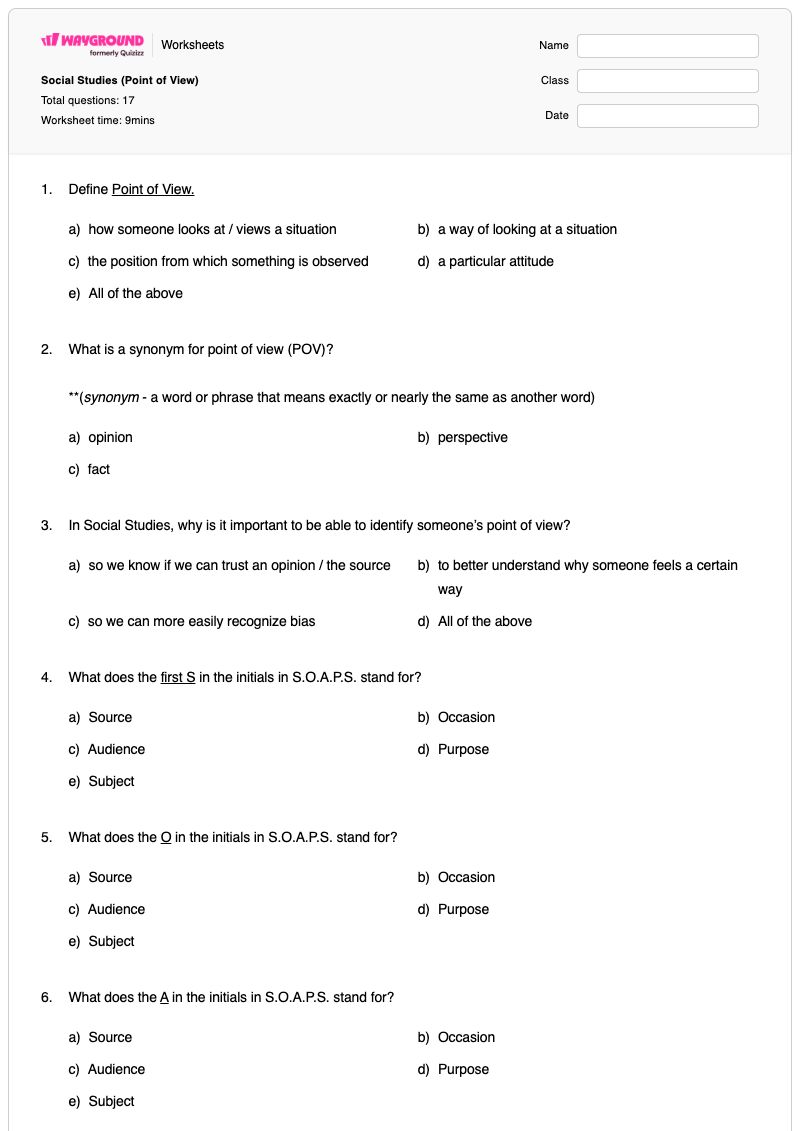

This Grade 5 Social Studies worksheet develops students’ ability to identify and explain point of view (POV). Across 17 questions—7 multiple-choice, 3 multiple-select, and 7 fill-in-the-blank items—students define POV, identify synonyms such as opinion and perspective, and explain why recognizing a source’s viewpoint matters. They also learn the five parts of the S.O.A.P.S. framework: Source, Occasion, Audience, Purpose, and Subject.
Students apply these ideas to a map about differing views on celebrating Columbus Day and identify examples of primary sources, including firsthand descriptions and historical artwork. The mix of selected-response and written-response questions checks both vocabulary recall and students’ ability to distinguish perspectives, sources, and evidence. This free printable Grade 5 worksheet is useful for introducing or reviewing historical point-of-view analysis in Social Studies, and it includes a complete answer key for efficient checking.
Worksheet settings
Font size
S
M
L
XL
Worksheets
Social Studies (Point of View)
Total questions: 17
Name
Class
Date
1.
Define Point of View.
a)
how someone looks at / views a situation
b)
a way of looking at a situation
c)
the position from which something is observed
d)
a particular attitude
e)
All of the above
2.
What is a synonym for point of view (POV)?
**(synonym - a word or phrase that means exactly or nearly the same as another word)
a)
opinion
b)
perspective
c)
fact
3.
In Social Studies, why is it important to be able to identify someone’s point of view?
a)
so we know if we can trust an opinion / the source
b)
to better understand why someone feels a certain way
c)
so we can more easily recognize bias
d)
All of the above
4.
What does the first S in the initials in S.O.A.P.S. stand for?
a)
Source
b)
Occasion
c)
Audience
d)
Purpose
e)
Subject
5.
What does the O in the initials in S.O.A.P.S. stand for?
a)
Source
b)
Occasion
c)
Audience
d)
Purpose
e)
Subject
6.
What does the A in the initials in S.O.A.P.S. stand for?
a)
Source
b)
Occasion
c)
Audience
d)
Purpose
e)
Subject
7.
What does the P in the initials in S.O.A.P.S. stand for?
a)
Source
b)
Occasion
c)
Audience
d)
Purpose
e)
Subject
8.
What does the last S in the initials in S.O.A.P.S. stand for?
a)
Source
b)
Occasion
c)
Audience
d)
Purpose
e)
Subject
9.
What does this map reveal about the country’s point of view (POV) about celebrating Columbus Day?
a)
People feel differently about celebrating Columbus Day
b)
This map is not about Columbus Day.
c)
there is not one point of view about celebrating Columbus Day but many
d)
Everyone has the same point of view
10.
Which of the following is most likely considered a primary source?
**A primary source is a first-hand account of an event or topic. Someone who was there)
a)
A TV show about the Lenape
b)
The passages you just read
c)
Christopher Columbus’s description on the people he encountered when he landed in Hispaniola
d)
A cave painting done by a Native American artist in 1150
e)
A textbook passage explaining the life of the Hopi
11.
Define Point of View.
(a)
12.
What is a synonym for point of view (POV)?
**(synonym - a word or phrase that means exactly or nearly the same as another word)
(a)
13.
What does the first S in the initials in S.O.A.P.S. stand for?
(a)
14.
What does the O in the initials in S.O.A.P.S. stand for?
(a)
15.
What does the A in the initials in S.O.A.P.S. stand for?
(a)
16.
What does the P in the initials in S.O.A.P.S. stand for?
(a)
17.
What does the last S in the initials in S.O.A.P.S. stand for?
(a)
Answer Key
Social Studies (Point of View)
Total questions: 17
1.
e)
All of the above
2.
a)
opinion
, b)
perspective
3.
d)
All of the above
4.
a)
Source
5.
b)
Occasion
6.
c)
Audience
7.
d)
Purpose
8.
e)
Subject
9.
a)
People feel differently about celebrating Columbus Day
, c)
there is not one point of view about celebrating Columbus Day but many
10.
d)
A cave painting done by a Native American artist in 1150
, c)
Christopher Columbus’s description on the people he encountered when he landed in Hispaniola
11.
the position from which something is observed, how someone looks at / views a situation, a way of looking at a situation, a particular attitude
12.
opinion, perspective
13.
Source
14.
Occasion
15.
Audience
16.
Purpose
17.
subject
140 %
Browse by subjects
Browse by grades
Browse by format
FAQs
What does this Grade 5 worksheet cover about point of view?
This worksheet teaches students to define point of view, recognize opinion and perspective as synonyms, and explain why identifying a source’s viewpoint helps reveal bias and meaning. Its 17 multiple-choice, multiple-select, and fill-in-the-blank questions also guide students through the S.O.A.P.S. framework and apply POV analysis to a Columbus Day map and examples of primary sources.
How can I use this worksheet to teach point of view and the S.O.A.P.S. framework?
Introduce point of view with a situation that two people might interpret differently, then have students connect their ideas to the worksheet’s definitions of POV, opinion, and perspective. Teach S.O.A.P.S. as a source-analysis routine—Source, Occasion, Audience, Purpose, and Subject—before students use the map and primary-source items to discuss how evidence can reflect different viewpoints.
What mistakes should I watch for when students complete this point-of-view worksheet?
In the multiple-select questions, students may select only one correct synonym for point of view or overlook that the Columbus Day map represents multiple perspectives rather than one shared opinion. They may also confuse a primary source with a later TV show or textbook explanation, or mix up the S.O.A.P.S. letters, especially Occasion, Audience, Purpose, and Subject.
How do I assign and grade this Social Studies worksheet?
The point-of-view worksheet is available as a printable PDF and as a digital quiz on Wayground, with a complete answer key for all 17 questions. You can grade printable submissions by scanning student work with the Wayground for Teachers app, while the digital version supports online assignment and response collection.
How can I differentiate this point-of-view worksheet for my students?
Under the worksheet’s Advanced Settings, adjust font spacing or font size to make the S.O.A.P.S. items, map question, and fill-in-the-blank responses easier to read. You can also select a dyslexia-friendly font or translate the worksheet into another language when that better supports students working with the point-of-view and primary-source questions.
Where can I find more free worksheets like this on Wayground?
Wayground offers a broad collection of free printable worksheets and practice problems across all subjects, with downloadable PDFs and answer keys to help students master essential skills and concepts. Browse more resources at https://wayground.com/en-us/worksheets.