

Wayground
Inclusive Classrooms: Social Skills Development for Students with Autism - Printable Special Education Worksheets - Wayground

Inclusive Classrooms: Social Skills Development for Students with Autism

10 questions

Special Education

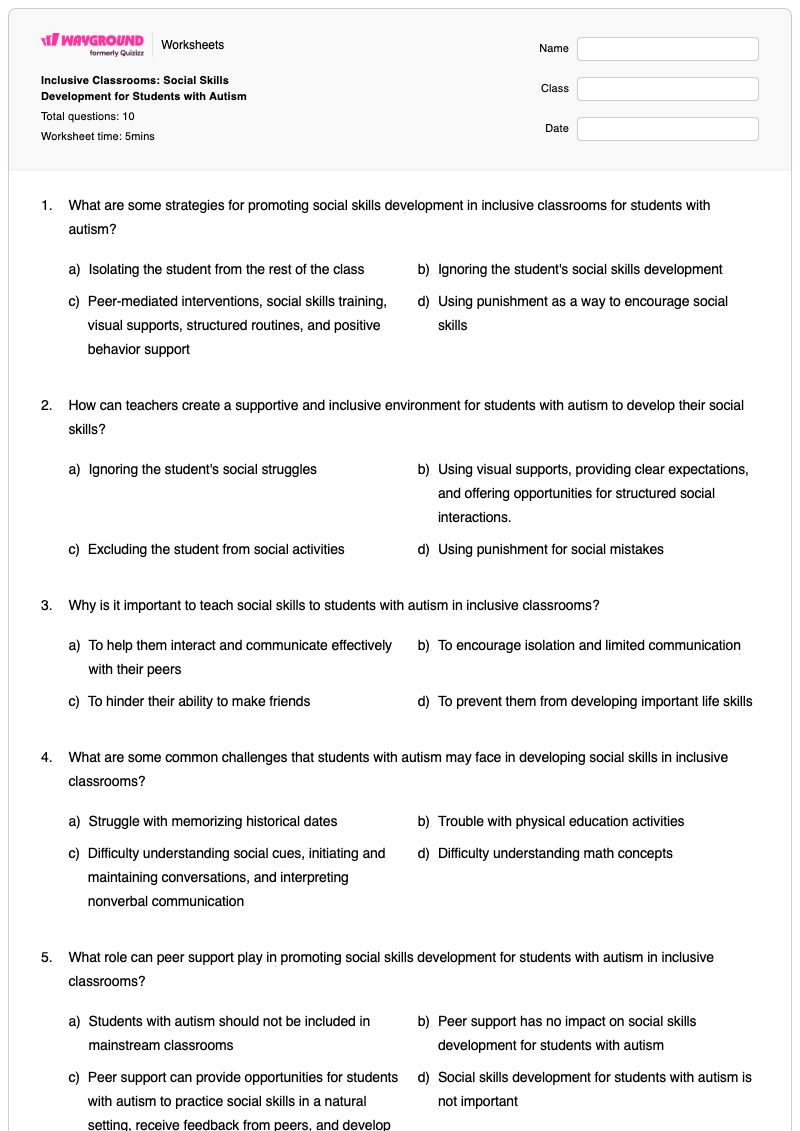
Inclusive Classrooms: Social Skills Development for Students with Autism is a free printable worksheet for university-level Special Education study. It contains 10 multiple-choice questions about supporting social skills development for students with autism in inclusive classrooms. Students identify effective strategies such as peer-mediated interventions, visual supports, structured routines, social stories, positive behavior support, and clear communication. The questions also address common social challenges, peer support, technology-based tools, social skills training, IEPs, and collaboration with parents and caregivers. A complete answer key is included. This worksheet helps learners distinguish supportive, individualized practices from approaches based on exclusion, punishment, or unclear expectations. As students evaluate each set of options, they connect inclusive classroom practices to specific outcomes, including improved communication, peer interaction, meaningful relationships, and tailored social goals. Teachers can use it for guided instruction, independent review, or a knowledge check in a special education course focused on autism support and inclusive practice.

Worksheet settings

Font size

S
M
L
XL
Worksheets

Inclusive Classrooms: Social Skills Development for Students with Autism

Total questions: 10

Name
Class
Date
1.

What are some strategies for promoting social skills development in inclusive classrooms for students with autism?

a)

Isolating the student from the rest of the class

b)

Ignoring the student's social skills development

c)

Peer-mediated interventions, social skills training, visual supports, structured routines, and positive behavior support

d)

Using punishment as a way to encourage social skills

2.

How can teachers create a supportive and inclusive environment for students with autism to develop their social skills?

a)

Ignoring the student's social struggles

b)

Using visual supports, providing clear expectations, and offering opportunities for structured social interactions.

c)

Excluding the student from social activities

d)

Using punishment for social mistakes

3.

Why is it important to teach social skills to students with autism in inclusive classrooms?

a)

To help them interact and communicate effectively with their peers

b)

To encourage isolation and limited communication

c)

To hinder their ability to make friends

d)

To prevent them from developing important life skills

4.

What are some common challenges that students with autism may face in developing social skills in inclusive classrooms?

a)

Struggle with memorizing historical dates

b)

Trouble with physical education activities

c)

Difficulty understanding social cues, initiating and maintaining conversations, and interpreting nonverbal communication

d)

Difficulty understanding math concepts

5.

What role can peer support play in promoting social skills development for students with autism in inclusive classrooms?

a)

Students with autism should not be included in mainstream classrooms

b)

Peer support has no impact on social skills development for students with autism

c)

Peer support can provide opportunities for students with autism to practice social skills in a natural setting, receive feedback from peers, and develop meaningful relationships.

d)

Social skills development for students with autism is not important

6.

How can technology be used to support social skills development for students with autism in inclusive classrooms?

a)

By ignoring the use of technology and focusing solely on traditional teaching methods

b)

By limiting students' access to technology

c)

By banning the use of technology in the classroom

d)

By providing interactive and visual learning tools, social skills training apps, virtual reality simulations, and video modeling programs.

7.

What are some effective communication strategies for teachers to use when working with students with autism on social skills development?

a)

Ignoring individual student needs, lack of patience, inconsistent expectations, and no positive reinforcement

b)

Visual supports, clear and concise language, structured routines, and social stories

c)

Loud and crowded environments, long and complex verbal instructions, unpredictable schedules

d)

No visual supports, using ambiguous language, unstructured routines, and no social stories

8.

What are some potential benefits of incorporating social skills training into the curriculum for students with autism in inclusive classrooms?

a)

Improved communication and interaction skills

b)

Limited access to resources

c)

Increased anxiety and stress

d)

Decreased academic performance

9.

How can individualized education plans (IEPs) support the social skills development of students with autism in inclusive classrooms?

a)

By excluding the student from social activities

b)

By focusing only on academic goals

c)

By including specific social goals, strategies, and accommodations tailored to the individual needs of the student.

d)

By ignoring the individual needs of the student

10.

What are some best practices for collaborating with parents and caregivers to support the social skills development of students with autism in inclusive classrooms?

a)

Excluding parents and caregivers from the student's education

b)

Not providing any updates or progress reports to parents and caregivers

c)

Open communication, sharing strategies and resources, providing regular updates, involving parents and caregivers in goal-setting and intervention planning

d)

Ignoring parents and caregivers' input

Answer Key

Inclusive Classrooms: Social Skills Development for Students with Autism

Total questions: 10

1.
c)

Peer-mediated interventions, social skills training, visual supports, structured routines, and positive behavior support

2.
b)

Using visual supports, providing clear expectations, and offering opportunities for structured social interactions.

3.
a)

To help them interact and communicate effectively with their peers

4.
c)

Difficulty understanding social cues, initiating and maintaining conversations, and interpreting nonverbal communication

5.
c)

Peer support can provide opportunities for students with autism to practice social skills in a natural setting, receive feedback from peers, and develop meaningful relationships.

6.
d)

By providing interactive and visual learning tools, social skills training apps, virtual reality simulations, and video modeling programs.

7.
b)

Visual supports, clear and concise language, structured routines, and social stories

8.
a)

Improved communication and interaction skills

9.
c)

By including specific social goals, strategies, and accommodations tailored to the individual needs of the student.

10.
c)

Open communication, sharing strategies and resources, providing regular updates, involving parents and caregivers in goal-setting and intervention planning

FAQs

What does this worksheet cover about social skills development for students with autism?

This worksheet uses 10 multiple-choice questions to examine how inclusive classrooms can support social skills development for students with autism. Students identify effective practices—including peer-mediated interventions, visual supports, structured routines, social stories, positive behavior support, technology tools, individualized social goals, and family collaboration—and connect them to communication and peer interaction outcomes.

How can I use this worksheet to teach inclusive social skills support?

Introduce the worksheet by grouping its ideas into classroom supports, communication strategies, peer involvement, individualized planning, and family collaboration. After students select answers, ask them to explain why options involving visual supports, clear expectations, structured interactions, and positive support are more appropriate than exclusion or punishment. Use the peer support, technology, and IEP questions to discuss how strategies can be matched to individual student needs.

What mistakes should I watch for when students complete this worksheet?

Students may choose distractors that describe isolating students, ignoring social needs, excluding them from activities, or using punishment instead of recognizing supportive practices. They may also overlook the specific challenges named in the worksheet—interpreting social cues, initiating or maintaining conversations, and understanding nonverbal communication—or confuse general academic goals with individualized social goals in an IEP. Review why clear language, visual supports, structured routines, peer feedback, and regular family communication address these needs.

How do I assign and grade this social skills worksheet?

This 10-question worksheet is available as a printable PDF and as a digital quiz on Wayground, and it includes a complete answer key for checking responses. Printable submissions can be graded by scanning student work with the Wayground for Teachers app, while the digital version can be assigned through the platform for online completion.

How can I differentiate this worksheet for my students?

For the multiple-choice items about inclusive classroom strategies, use Advanced Settings to adjust font spacing or choose a larger font size to make the options easier to scan. You can also enable a dyslexia-friendly font or translate the worksheet into another language when those changes support access to the questions and answer choices.

Where can I find more worksheets like this on Wayground?

Wayground offers a broad collection of free printable worksheets and practice problems across all subjects, with downloadable PDFs and answer keys to help students build essential skills and concepts. Browse more resources at https://wayground.com/en-us/worksheets.