

Wayground
Quiz on Building Strong Social Skills for Teens - Printable Education Worksheets - Wayground

Quiz on Building Strong Social Skills for Teens

20 questions

11th - 11th Grade

Education

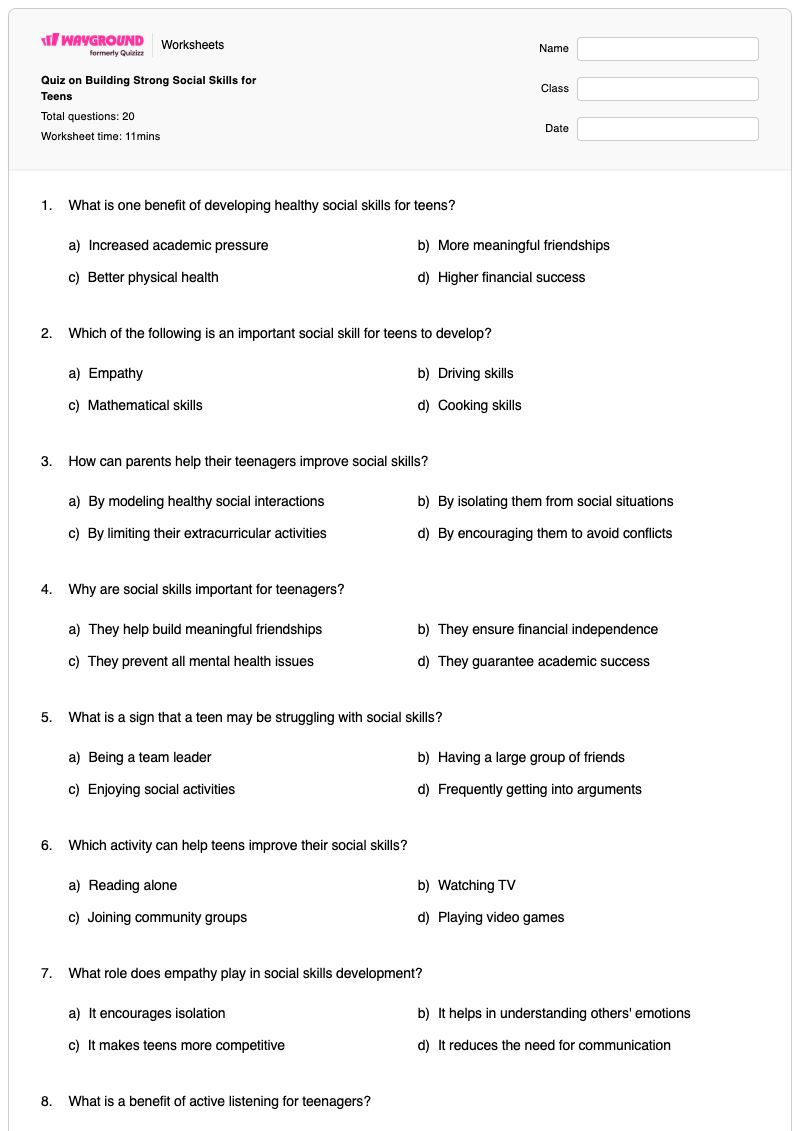
This Grade 11 worksheet develops students’ understanding of healthy social skills through 20 multiple-choice questions. Students identify the value of meaningful friendships, empathy, active listening, teamwork, conversational practice, media literacy, emotional expression, and community involvement. They also recognize signs and possible effects of social-skill difficulties, such as frequent arguments, withdrawal from social activities, and difficulty making friends. Designed for high school education lessons, advisory periods, health instruction, or independent review, the worksheet checks whether students can connect specific behaviors with effective social interaction. The questions provide a focused way to discuss how teens build communication skills, understand others’ emotions, respond in groups, and participate more successfully in social settings. This is a free printable worksheet with an answer key for quick review, instruction, or assessment.

Worksheet settings

Font size

S
M
L
XL
Worksheets

Quiz on Building Strong Social Skills for Teens

Total questions: 20

Name
Class
Date
1.

What is one benefit of developing healthy social skills for teens?

a)

Increased academic pressure

b)

More meaningful friendships

c)

Better physical health

d)

Higher financial success

2.

Which of the following is an important social skill for teens to develop?

a)

Empathy

b)

Driving skills

c)

Mathematical skills

d)

Cooking skills

3.

How can parents help their teenagers improve social skills?

a)

By modeling healthy social interactions

b)

By isolating them from social situations

c)

By limiting their extracurricular activities

d)

By encouraging them to avoid conflicts

4.

Why are social skills important for teenagers?

a)

They help build meaningful friendships

b)

They ensure financial independence

c)

They prevent all mental health issues

d)

They guarantee academic success

5.

What is a sign that a teen may be struggling with social skills?

a)

Being a team leader

b)

Having a large group of friends

c)

Enjoying social activities

d)

Frequently getting into arguments

6.

Which activity can help teens improve their social skills?

a)

Reading alone

b)

Watching TV

c)

Joining community groups

d)

Playing video games

7.

What role does empathy play in social skills development?

a)

It encourages isolation

b)

It helps in understanding others' emotions

c)

It makes teens more competitive

d)

It reduces the need for communication

8.

What is a benefit of active listening for teenagers?

a)

It improves their argumentative skills

b)

It makes them better at picking up social cues

c)

It reduces their need to communicate

d)

It helps them ignore others

9.

How can expanding media literacy benefit teenagers?

a)

By encouraging oversharing

b)

By improving digital communication skills

c)

By increasing screen time

d)

By reducing face-to-face interactions

10.

What is a recommended way to practice conversational skills?

a)

Only talking to close friends

b)

Greeting at least five people daily

c)

Focusing on deep conversations only

d)

Avoiding small talk

11.

What is a potential outcome of poor social skills in teens?

a)

Improved mental health

b)

Increased self-esteem

c)

Better adaptability

d)

Difficulty in making friends

12.

Which of the following is NOT a sign of struggling with social skills?

a)

Withdrawing from social activities

b)

Preferring digital communication

c)

Limiting eye contact

d)

Enjoying social activities

13.

What is a key takeaway from the guide on social skills?

a)

Teens should avoid social interactions

b)

Social skills training is critical for future success

c)

Social skills are not important for teens

d)

Social skills are innate and cannot be developed

14.

What is an effective way for teens to understand their emotions?

a)

Providing a safe space for expression

b)

Judging their feelings

c)

Encouraging them to suppress emotions

d)

Ignoring their emotional needs

15.

What is the role of teamwork in social skills development?

a)

It isolates teens from others

b)

It reduces the need for collaboration

c)

It encourages individual success

d)

It helps in sharing responsibilities

16.

What should you do if you disagree with someone to resolve a conflict?

a)

Yell louder than the other person

b)

Stop talking to them

c)

Listen to their perspective and explain yours calmly

d)

Insist that you are right

17.

How can you demonstrate empathy towards a friend who is upset?

a)

By telling them to stop feeling upset

b)

By listening to them and acknowledging their feelings

c)

By ignoring their feelings and changing the subject

d)

By giving advice immediately without listening

18.

How can you show you are actively listening?

a)

By looking at your phone

b)

Nodding and making eye contact

c)

Thinking about what to say next

d)

Turning away from the speaker

19.

Active listening can help in which of the following ways?

a)

Making the speaker feel ignored

b)

Reducing misunderstandings

c)

Making conversations shorter

d)

Increasing conflicts

20.

Why is it important to use "I" statements in a conflict?

a)

They make the other person defensive

b)

They express personal feelings without blaming the other person

c)

They help in proving the other person wrong

d)

They are not important in conflicts

Answer Key

Quiz on Building Strong Social Skills for Teens

Total questions: 20

1.
b)

More meaningful friendships

2.
a)

Empathy

3.
a)

By modeling healthy social interactions

4.
a)

They help build meaningful friendships

5.
d)

Frequently getting into arguments

6.
c)

Joining community groups

7.
b)

It helps in understanding others' emotions

8.
b)

It makes them better at picking up social cues

9.
b)

By improving digital communication skills

10.
b)

Greeting at least five people daily

11.
d)

Difficulty in making friends

12.
d)

Enjoying social activities

13.
b)

Social skills training is critical for future success

14.
a)

Providing a safe space for expression

15.
d)

It helps in sharing responsibilities

16.
c)

Listen to their perspective and explain yours calmly

17.
b)

By listening to them and acknowledging their feelings

18.
b)

Nodding and making eye contact

19.
b)

Reducing misunderstandings

20.
b)

They express personal feelings without blaming the other person

FAQs

What does this worksheet cover, and how does it help students build social skills?

This Grade 11 worksheet uses 20 multiple-choice questions to examine how teens develop healthy social skills, including empathy, active listening, teamwork, conversational practice, media literacy, and emotional expression. By distinguishing effective strategies from unhelpful behaviors, students build knowledge of how social skills support meaningful friendships, communication, and participation in groups.

How can I use this worksheet to teach teens about building strong social skills?

Introduce the worksheet by asking students to name behaviors that help people understand others and communicate effectively, then use the multiple-choice items to check those ideas. After students answer, discuss why choices such as modeling healthy interactions, joining community groups, practicing greetings, and providing a safe space for emotional expression are more effective than isolation, avoidance, or emotional suppression.

What mistakes should I watch for when students complete this social-skills worksheet?

Students may confuse a sign of social-skill difficulty with a positive social behavior, especially in the questions about arguing, withdrawing, limited eye contact, and enjoying social activities. They may also overlook the specific purpose of empathy and active listening, selecting answers about isolation, competition, or argument instead of understanding others’ emotions and noticing social cues.

How do I assign and grade this social-skills worksheet?

The worksheet is available as a printable PDF and as a digital quiz on Wayground, and it includes a complete answer key for checking the 20 multiple-choice responses. Printable submissions can be graded by scanning student work with the Wayground for Teachers app, while the digital version supports online completion and grading.

How can I differentiate this worksheet for my students?

Use the worksheet’s Advanced Settings to adjust font spacing or font size so the multiple-choice questions and answer options are easier to read. You can also apply a dyslexia-friendly font or translate the social-skills questions and choices into another language when appropriate.

Where can I find more worksheets like this on Wayground?

Wayground offers a broad collection of free printable worksheets and practice problems across subjects, with downloadable PDFs and answer keys to support mastery of essential skills and concepts. Browse more resources at https://wayground.com/en-us/worksheets.