

Wayground
Combining Like Terms with Variables on Both Sides of the Equation - Printable Math Worksheets year 8 - Wayground

Combining Like Terms with Variables on Both Sides of the Equation

Anthony Clark

Created by Anthony Clark

18 questions

8th Grade

Math

Updated Oct 2026

This Grade 8 mathematics worksheet develops fluency with combining like terms and solving linear equations with variables on both sides. Students simplify expressions, apply the distributive property, isolate the variable using inverse operations, and recognize possible outcomes such as a single solution, no solution, or infinite solutions. The equations include constants, negative values, parentheses, and variable terms on both sides, providing practice with multi-step algebraic reasoning. The 20-item set combines nine math-response problems, nine multiple-choice questions, a fill-in-the-blank item, and a comprehension question about the solving process. Students work with equations such as 3x − x + 2 = 4(2x − 1) and 7(1 + 4n) = 7(6 + 3n), while selected items ask them to identify a simplified equation or the next correct step. Designed for Grade 8 math instruction, this free printable worksheet includes a complete answer key for independent practice, review, or assessment.

Worksheet settings

Font size

S
M
L
XL
WaygroundWorksheets

Combining Like Terms with Variables on Both Sides of the Equation

Total questions: 18

Name
Class
Date
1.

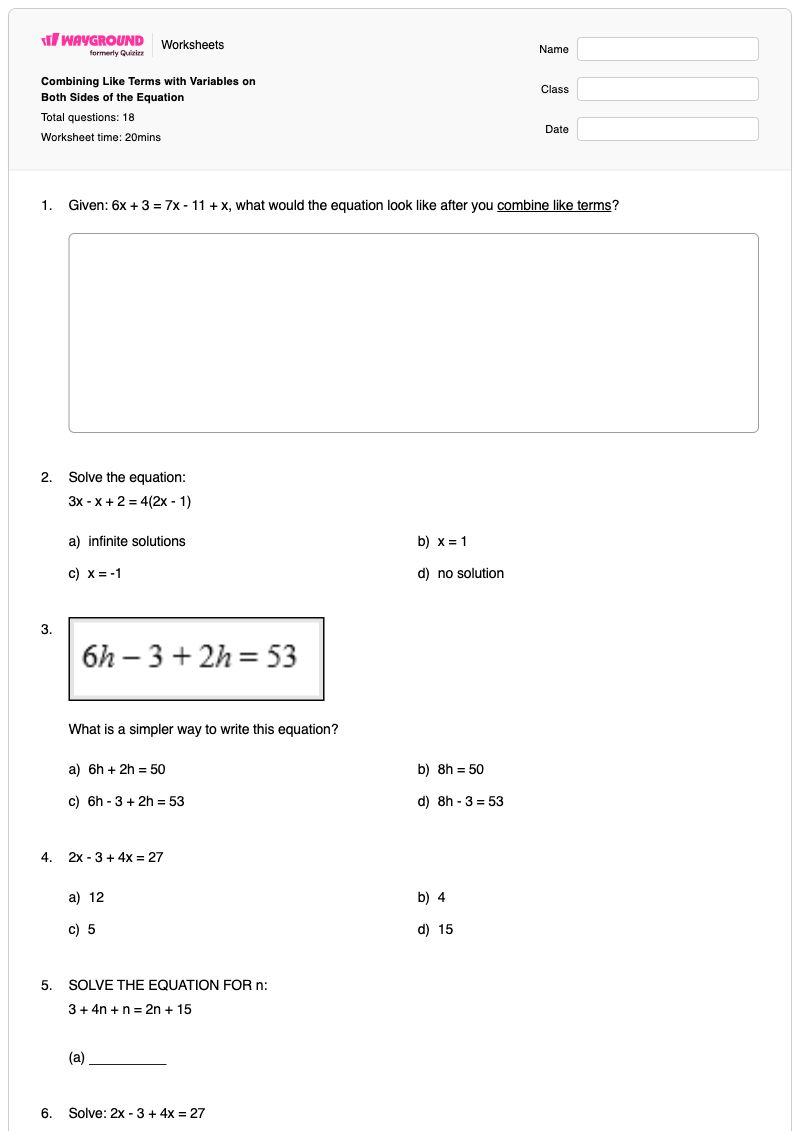
Given: 6x + 3 = 7x - 11 + x, what would the equation look like after you combine like terms?

2.

Solve the equation:
3x - x + 2 = 4(2x - 1)

a)

infinite solutions

b)

x = 1

c)

x = -1

d)

no solution

3.
What is a simpler way to write this equation?

What is a simpler way to write this equation?

a)

6h + 2h = 50

b)

8h = 50

c)

6h - 3 + 2h = 53

d)

8h - 3 = 53

4.

2x - 3 + 4x = 27

a)

12

b)

4

c)

5

d)

15

5.

SOLVE THE EQUATION FOR n:

3 + 4n + n = 2n + 15

(a)  

6.

Solve: 2x - 3 + 4x = 27

7.

Solve: 5x - 4 + 2x = 3

8.

Solve: 7 + 5r + 3 + 5 = 1 + 7r

9.

Solve: 7(1 + 4n) = 7(6 + 3n)

10.

Solve: 8x - 6 - 8 = x + 4 + x

11.

Solve: 4(n + 6) = 4n + 8(n + 13)

12.

Solve: 3x + 9 + 4x = -8(x - 6) - 8(13 + 5)

13.

Solve: -14(3a + 6) = 12(6 - 4a) + 12

14.

Solve the equation: 3x + 5 = 2x - 7

a)

-6

b)

10

c)

4

d)

-12

15.

What is the next step after combining like terms in an equation with variables on both sides?

a)

Isolate the variable on one side of the equation by performing inverse operations.

b)

Multiply or divide both sides by a variable

c)

Add or subtract a constant from both sides

d)

Combine unlike terms

16.

What is the final step to solve an equation with variables on both sides?

a)

Multiply both sides by a common denominator

b)

Simplify and combine like terms on both sides

c)

Isolate the variable on one side

d)

Distribute the terms on both sides

17.

Which shows an equation with variables on both sides?

a)
Which shows an equation with variables on both sides?
b)
Which shows an equation with variables on both sides?
c)
Which shows an equation with variables on both sides?
d)
Which shows an equation with variables on both sides?
18-19.

Solving Equations with Variables on Both Sides When solving equations with variables on both sides, the first step is to combine like terms. This means you should look for terms that have the same variable and combine them into a single term. For example, if you have 3x and 2x on one side of the equation, you can combine them to get 5x. Combining like terms simplifies the equation and makes it easier to solve. None of the terms should be left uncombined if they are similar. After combining like terms, the next step is to use inverse operations to simplify the equation further. Inverse operations are operations that undo each other, such as addition and subtraction or multiplication and division. If you have an equation like 5x + 3 = 2x + 9, you can subtract 2x from both sides to start isolating the variable. This step is crucial because it helps to eliminate terms on one side of the equation. None of the operations should be skipped to ensure accuracy. The final step in solving these equations is to isolate the variable completely. This means getting the variable by itself on one side of the equation. Continuing with the previous example, after subtracting 2x from both sides, you would subtract 3 from both sides to get 3x = 6. Then, divide both sides by 3 to solve for x, resulting in x = 2. None of the steps should be ignored to reach the correct solution.

18.

What is the first step in solving equations with variables on both sides?

a)

Combine like terms

b)

Use inverse operations

c)

Isolate the variable

d)

Multiply both sides by the same number

19.

After combining like terms and using inverse operations, what is the final step in solving equations with variables on both sides?

a)

Isolate the variable

b)

Combine like terms again

c)

Add the same number to both sides

d)

Multiply both sides by the variable

WaygroundAnswer Key

Combining Like Terms with Variables on Both Sides of the Equation

Total questions: 18

1.

6x+3=8x−116x+3=8x-11

2.
b)

x = 1

3.
d)

8h - 3 = 53

4.
c)

5

5.
4, n=4, n= 4
6.

55

7.

11

8.

77

9.

55

10.

33

11.

−10-10

12.

−7-7

13.

2828

14.
a)

-6

15.
a)

Isolate the variable on one side of the equation by performing inverse operations.

16.
b)

Simplify and combine like terms on both sides

17.
c)
18-19.
18.
a)

Combine like terms

19.
a)

Isolate the variable

FAQs

What does this worksheet cover?

This Grade 8 worksheet covers combining like terms and solving multi-step linear equations with variables on both sides. Its 20 items mix math-response, multiple-choice, fill-in-the-blank, and comprehension formats, asking students to simplify expressions, use the distributive property, isolate variables, and identify outcomes such as one solution, no solution, or infinite solutions.

How can I use this worksheet to teach equations with variables on both sides?

Introduce the worksheet by modeling how to combine variable terms and constants on each side before using inverse operations to isolate the variable. Use the multiple-choice item about the next step to discuss why the variable must be isolated after simplification, then assign the response problems for students to show the full process with parentheses, negative values, and variables on both sides.

What mistakes should I watch for when students complete this worksheet?

Watch for students combining unlike terms, losing a negative sign, or distributing a factor incorrectly when parentheses appear. Students may also stop after simplifying instead of isolating the variable, apply an operation to only one side, or confuse a simplified equation with its solution. The multiple-choice and fill-in-the-blank items can reveal whether the error is in simplifying, choosing the next step, or solving.

How do I assign and grade this worksheet?

You can assign this worksheet as a printable PDF or as a digital quiz on Wayground. The complete answer key supports grading the nine math-response items, nine multiple-choice items, fill-in-the-blank item, and comprehension question; printable student work can also be graded by scanning it with the Wayground for Teachers app. The printable format can support schools that are reducing screen time.

How can I differentiate this worksheet for my students?

Use the worksheet’s Advanced Settings to adjust font spacing and font size so the multi-step equations and response areas are easier to read. You can also apply a dyslexia-friendly font or translate the worksheet into another language, while keeping the same equation-solving practice and question formats.

Where can I find more worksheets like this on Wayground?

Wayground offers a broad collection of free printable worksheets and practice problems across subjects, with downloadable PDFs and answer keys to support mastery of essential skills and concepts. Browse more resources at https://wayground.com/en-us/worksheets.