

Wayground
Spring ACPR: Vectors - Printable Mathematics Worksheets year 12 - Wayground

Spring ACPR: Vectors

10 questions

12th - 12th Grade

Mathematics

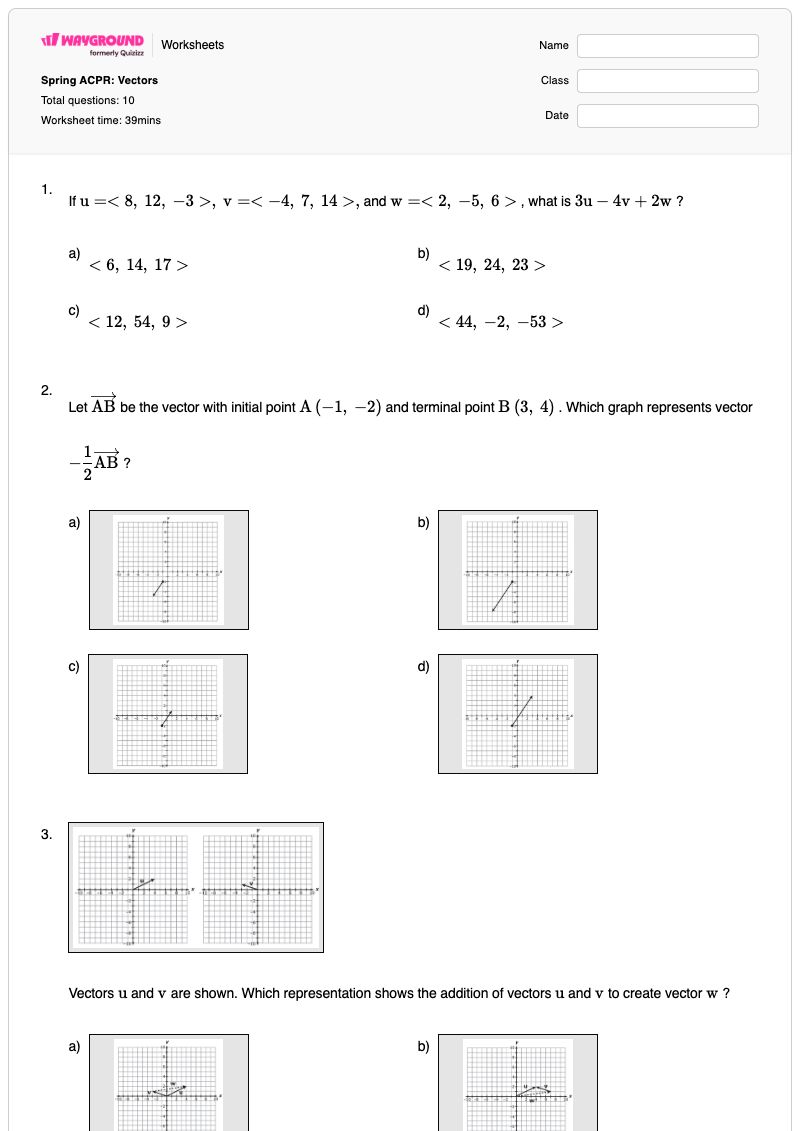
Spring ACPR: Vectors is a Grade 12 mathematics worksheet focused on interpreting and applying vectors in component and graphical form. Across 10 questions—9 multiple choice and 1 fill-in-the-blank—students identify vector representations, add vectors, interpret displacement, and determine the magnitude and direction of resultant vectors. The worksheet also connects vector operations to practical contexts, including travel routes, an airplane’s movement, a ship’s position, and forces acting on a child sliding down a slide. This free printable worksheet gives students practice moving between vector notation, diagrams, components, and real-world applications. It is suitable for independent practice, review, homework, or an assessment of vector skills, and it includes a complete answer key so teachers can check understanding efficiently.

Worksheet settings

Font size

S
M
L
XL
Worksheets

Spring ACPR: Vectors

Total questions: 10

Name
Class
Date
1.

If u=<8, 12, −3>, v=<−4, 7, 14>,u=<8,\ 12,\ -3>,\ v=<-4,\ 7,\ 14>, and w=<2, −5, 6>w=<2,\ -5,\ 6> , what is 3u−4v+2w3u-4v+2w ?

a)

<6, 14, 17><6,\ 14,\ 17>

b)

<19, 24, 23><19,\ 24,\ 23>

c)

<12, 54, 9><12,\ 54,\ 9>

d)

<44, −2, −53><44,\ -2,\ -53>

2.

Let AB→\overrightarrow{AB} be the vector with initial point A(−1, −2)A\left(-1,\ -2\right) and terminal point B(3, 4)B\left(3,\ 4\right) . Which graph represents vector −12AB→-\frac{1}{2}\overrightarrow{AB} ?

a)

b)

c)

d)

3.

Vectors uu and vv are shown. Which representation shows the addition of vectors uu and vv to create vector ww ?

a)

b)

c)

d)

4.

Carla leaves home and walks 40°40\degree East of North for 1.5 miles, then turns and continues due West for 2 miles. At this point in her trip, how far is she from home to the nearest tenth of a mile?

(a)  

5.

An airplanes flies east for 200 miles before turning 60°60\degree south and flying for 100 miles. What are the magnitude and the direction of the airplane from its starting point?

a)

b)

c)

d)

6.

In physics, a force diagram is used to show the effects of all the different forces acting on an object. The diagram shown represents the forces acting on a child sliding down a slide. What is the component form of the resultant vector representing the forces acting upon the child?

a)

<61, 198><61,\ 198>

b)

<49,−142><49,-142>

c)

<−49, −142><-49,\ -142>

d)

<−49, −298><-49,\ -298>

7.

In physics, a force diagram is used to show the effects of all the different forces acting on an object. The diagram shown represents the forces acting on a child sliding down a slide. What is the magnitude of the resultant vector representing the forces acting upon the child?

a)

−191 N-191\ N

b)

−93 N-93\ N

c)

150 N150\ N

d)

304 N304\ N

8.

If r=<4, −2>r=<4,\ -2> , which graph represents −2r-2r ?

a)

b)

c)

d)

9.

A ship leaves port and travels on a constant course and at a constant speed for 15 days to reach its destination. If the ship's port is represented by the vector <0,0><0,0> and its destination is represented by the vector <−825, −30><-825,\ -30> , which vector represents the ship's position at the third day?

a)

<−55, −2><-55,\ -2>

b)

<−165, −6><-165,\ -6>

c)

<−275, −10><-275,\ -10>

d)

<−2475, −90><-2475,\ -90>

10.

Harrison walks to the library after school every day. When Harrison leaves school, he walks 16 blocks due West and then 12 blocks due North to get to the library. What is the magnitude and direction of the resultant vector?

a)

b)

c)

d)

Answer Key

Spring ACPR: Vectors

Total questions: 10

1.
d)

<44, −2, −53><44,\ -2,\ -53>

2.
a)
3.
c)
4.
1.5
5.
b)
6.
c)

<−49, −142><-49,\ -142>

7.
c)

150 N150\ N

8.
b)
9.
b)

<−165, −6><-165,\ -6>

10.
d)

FAQs

What does the Spring ACPR: Vectors worksheet cover?

This Grade 12 worksheet helps students interpret vectors in component and graphical form, add vectors, and find the magnitude and direction of resultant vectors. Its 9 multiple-choice and 1 fill-in-the-blank questions apply these skills to vector diagrams, travel and displacement problems, ship and airplane motion, and resultant forces.

How can I use this vectors worksheet to teach vector addition and resultant vectors?

Introduce vector components and graphical representations before having students work through the diagram-based addition questions. Then use the travel, airplane, ship, and force problems to discuss how component values combine and how a resultant’s magnitude and direction describe the overall movement or force.

What mistakes should I watch for when students complete this vectors worksheet?

Watch for students reversing the initial and terminal points, choosing a graph with the wrong direction, or adding vector components without tracking their signs. In the application problems, students may also confuse a resultant vector’s component form with its magnitude and direction, or use only one leg of a route instead of combining the full displacement.

How do I assign and grade this vectors worksheet?

The worksheet is available as a printable PDF and as a digital quiz on Wayground, and it includes a complete answer key. You can grade printed submissions by scanning student work with the Wayground for Teachers app, while the digital quiz supports online completion and grading.

How can I differentiate this vectors worksheet for my students?

Use the worksheet’s Advanced Settings to adjust font spacing and font size so vector notation, diagrams, and application problems are easier to read. You can also enable a dyslexia-friendly font or translate the worksheet into another language when that better supports students working with the vector questions.

Where can I find more worksheets like this on Wayground?

Wayground offers a broad collection of free printable worksheets and practice problems across subjects, with downloadable PDFs and answer keys to support essential skills and concepts. Browse more resources at https://wayground.com/en-us/worksheets.