

Wayground
Solute Solvent Solution - Printable Physical Education Worksheets year 7 - Wayground

Solute Solvent Solution

DeNae Dandridge

Created by DeNae Dandridge

10 questions

7th Grade

Physical Education

Updated Oct 2026

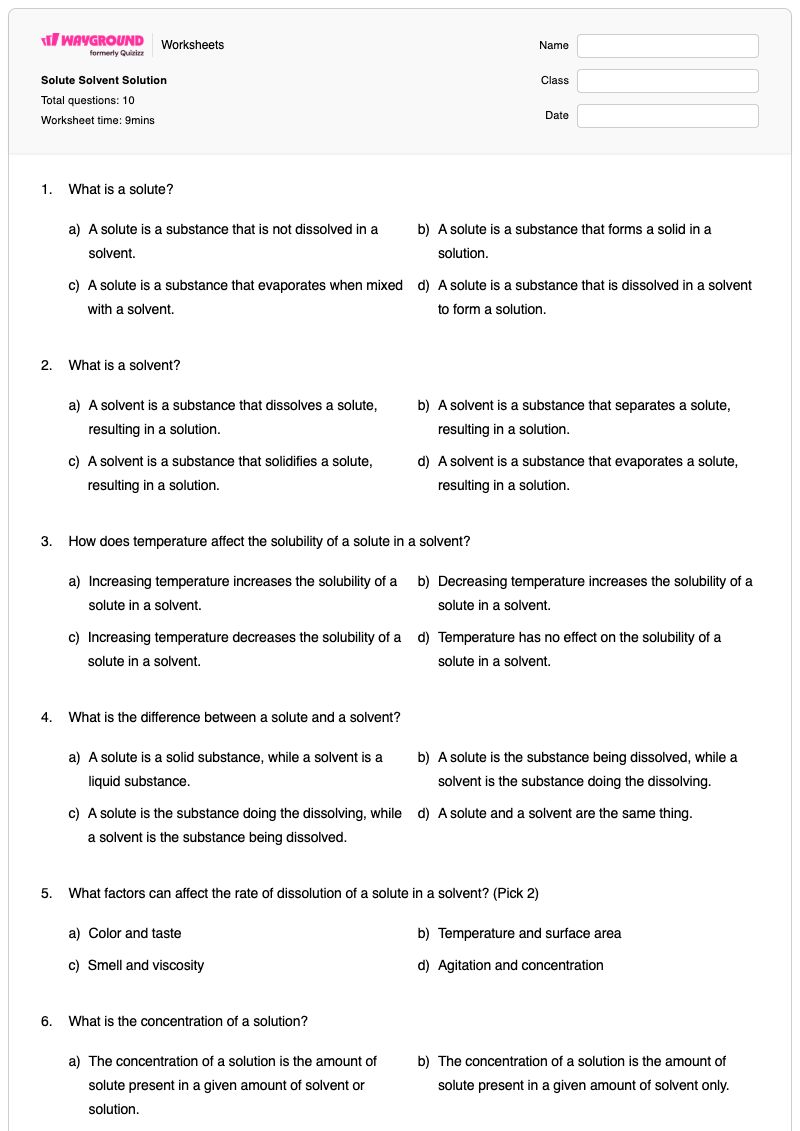
Solute Solvent Solution is a Grade 7 chemistry worksheet that builds understanding of how solutes, solvents, and solutions relate. Students answer multiple-choice questions defining each term, distinguish the substance being dissolved from the substance doing the dissolving, identify concentration, and consider how temperature affects solubility. A multiple-select item also asks students to recognize factors that affect dissolution, including temperature, surface area, agitation, and concentration. The 10-question worksheet uses varied formats to reinforce application, not just recall. Students match images to a factor of chemical reaction, complete endothermic and exothermic terminology, label the solute, solvent, and solution in a hot chocolate process, and identify how grinding a solid into powder affects reaction rate. This free printable worksheet is designed for Grade 7 chemistry instruction, review, or formative assessment and includes a complete answer key for efficient checking.

Worksheet settings

Font size

S
M
L
XL
WaygroundWorksheets

Solute Solvent Solution

Total questions: 10

Name
Class
Date
1.

What is a solute?

a)

A solute is a substance that is not dissolved in a solvent.

b)

A solute is a substance that forms a solid in a solution.

c)

A solute is a substance that evaporates when mixed with a solvent.

d)

A solute is a substance that is dissolved in a solvent to form a solution.

2.

What is a solvent?

a)

A solvent is a substance that dissolves a solute, resulting in a solution.

b)

A solvent is a substance that separates a solute, resulting in a solution.

c)

A solvent is a substance that solidifies a solute, resulting in a solution.

d)

A solvent is a substance that evaporates a solute, resulting in a solution.

3.

How does temperature affect the solubility of a solute in a solvent?

a)

Increasing temperature increases the solubility of a solute in a solvent.

b)

Decreasing temperature increases the solubility of a solute in a solvent.

c)

Increasing temperature decreases the solubility of a solute in a solvent.

d)

Temperature has no effect on the solubility of a solute in a solvent.

4.

What is the difference between a solute and a solvent?

a)

A solute is a solid substance, while a solvent is a liquid substance.

b)

A solute is the substance being dissolved, while a solvent is the substance doing the dissolving.

c)

A solute is the substance doing the dissolving, while a solvent is the substance being dissolved.

d)

A solute and a solvent are the same thing.

5.

What factors can affect the rate of dissolution of a solute in a solvent? (Pick 2)

a)

Color and taste

b)

Temperature and surface area

c)

Smell and viscosity

d)

Agitation and concentration

6.

What is the concentration of a solution?

a)

The concentration of a solution is the amount of solute present in a given amount of solvent or solution.

b)

The concentration of a solution is the amount of solute present in a given amount of solvent only.

c)

The concentration of a solution is the amount of solvent present in a given amount of solute or solution.

d)

The concentration of a solution is the amount of solute present in a given amount of solution only.

7.

Match the following images with the correct factor of chemical reaction.

Match the following images with the correct factor of chemical reaction.

Temperature

Match the following images with the correct factor of chemical reaction.

Surface Area

Match the following images with the correct factor of chemical reaction.

Concentration

Match the following images with the correct factor of chemical reaction.

Agitation

8.

Some chemical reactions are ​ (a)   where the heat energy is absorbed. Other chemical reactions release heat energy are known as ​ (b)   .​

Choose from the below words
endothermic
exothermic
thermal
geothermal
9.

Label these parts of the hot chocolate process!

10.

If you grind a solid into a powder, this ​ (a)   the rate of the chemical reaction.

Choose from the below words
increases
decreases
WaygroundAnswer Key

Solute Solvent Solution

Total questions: 10

1.
d)

A solute is a substance that is dissolved in a solvent to form a solution.

2.
a)

A solvent is a substance that dissolves a solute, resulting in a solution.

3.
a)

Increasing temperature increases the solubility of a solute in a solvent.

4.
b)

A solute is the substance being dissolved, while a solvent is the substance doing the dissolving.

5.
b)

Temperature and surface area

, d)

Agitation and concentration

6.
a)

The concentration of a solution is the amount of solute present in a given amount of solvent or solution.

7.

 - 

Temperature

, 

 - 

Surface Area

, 

 - 

Concentration

, 

 - 

Agitation

8.
endothermic, exothermic
9.
10.
increases

FAQs

What does the Solute Solvent Solution worksheet cover?

This Grade 7 chemistry worksheet practices identifying solutes, solvents, and solutions and applying related ideas about solubility, concentration, and dissolution. Its 10 items use multiple choice, multiple select, matching, drag-and-drop, image labeling, and dropdown formats, including labeling the parts of a hot chocolate process and distinguishing endothermic from exothermic reactions.

How can I use this worksheet to teach solute, solvent, and solution?

Introduce the three terms with a familiar mixture such as hot chocolate, asking students which substance is dissolved, which substance does the dissolving, and what the resulting solution is. Then use the worksheet’s multiple-choice and image-labeling items to check those relationships before discussing temperature, surface area, agitation, concentration, and the effect of grinding a solid into powder.

What mistakes should I watch for when students complete this worksheet?

Watch for students reversing solute and solvent, treating a solution as only the solvent, or selecting fewer or more than two choices in the dissolution-factors item. Students may also confuse endothermic with exothermic, mislabel the solute and solvent in the hot chocolate diagram, or choose that powdered material decreases rather than increases reaction rate.

How do I assign and grade this Solute Solvent Solution worksheet?

The worksheet is available as a printable PDF and as a digital quiz on Wayground, and it includes a complete answer key. You can grade printable submissions by scanning student work with the Wayground for Teachers app, while the digital version can be assigned and checked through Wayground.

How can I differentiate this worksheet for my students?

Use the worksheet’s Advanced Settings to adjust font spacing and font size so the mixed-format questions, image labels, and answer choices are easier to navigate. You can also apply a dyslexia-friendly font or translate the worksheet into another language when those options better support students working with the solute, solvent, and solution content.

Where can I find more worksheets like this on Wayground?

Wayground offers a comprehensive collection of free printable worksheets and practice problems across all subjects, with downloadable PDFs and answer keys to help students master essential skills and concepts. Browse more resources at https://wayground.com/en-us/worksheets.