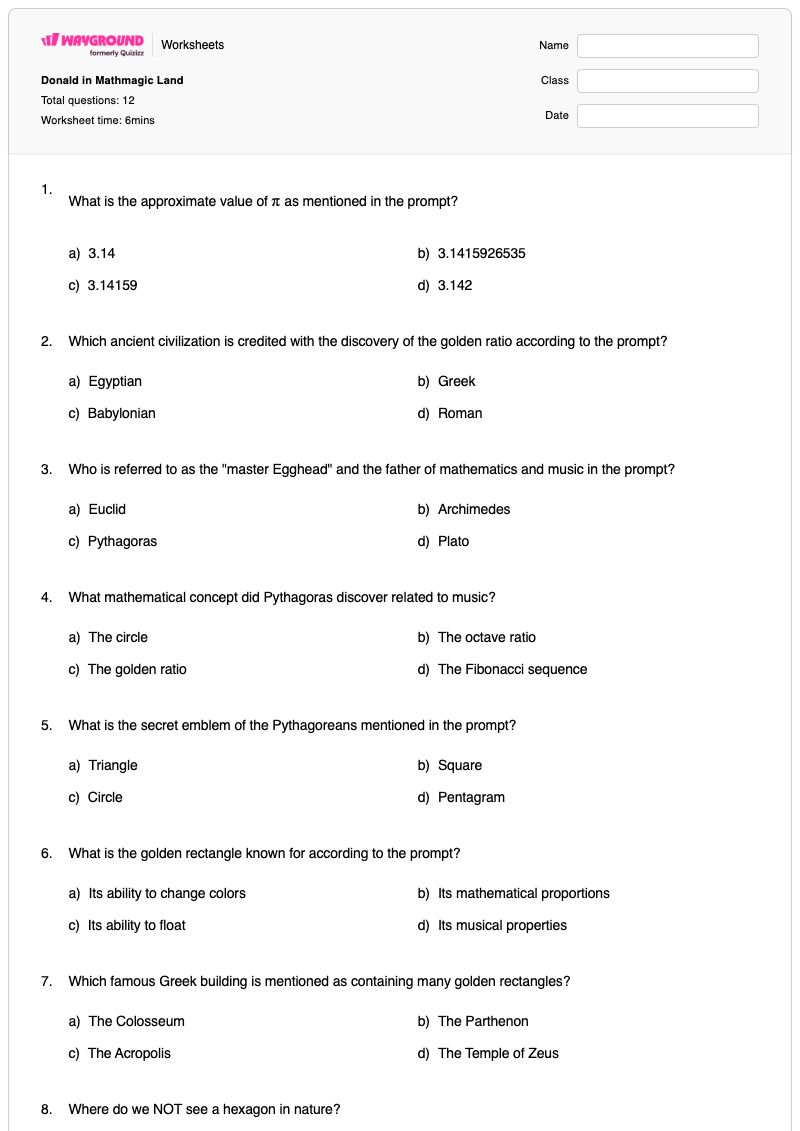
Donald in Mathmagic Land is a free printable Grade 6 mathematics worksheet that uses 12 multiple-choice questions to check students’ understanding of mathematics in everyday life, history, music, games, architecture, and nature. Students identify the approximate value of pi, recognize the Greek origins of the golden ratio, connect Pythagoras with the octave ratio, and identify features such as the pentagram, golden rectangles, hexagons, and the billiards diamond system.
The worksheet helps students recognize how mathematical ideas appear across different fields rather than treating mathematics as isolated formulas. Questions also ask students to connect concepts with examples such as the Parthenon, chess, baseball, and billiards, building comprehension and mathematical vocabulary through selected-response practice. It is suitable for Grade 6 review, a lesson follow-up, or a quick understanding check. The worksheet is available as a free printable PDF and includes a complete answer key for efficient grading.
Worksheet settings
Font size
S
M
L
XL
Worksheets
Donald in Mathmagic Land
Total questions: 12
Name
Class
Date
1.
What is the approximate value of π as mentioned in the prompt?
a)
3.14
b)
3.1415926535
c)
3.14159
d)
3.142
2.
Which ancient civilization is credited with the discovery of the golden ratio according to the prompt?
a)
Egyptian
b)
Greek
c)
Babylonian
d)
Roman
3.
Who is referred to as the "master Egghead" and the father of mathematics and music in the prompt?
a)
Euclid
b)
Archimedes
c)
Pythagoras
d)
Plato
4.
What mathematical concept did Pythagoras discover related to music?
a)
The circle
b)
The octave ratio
c)
The golden ratio
d)
The Fibonacci sequence
5.
What is the secret emblem of the Pythagoreans mentioned in the prompt?
a)
Triangle
b)
Square
c)
Circle
d)
Pentagram
6.
What is the golden rectangle known for according to the prompt?
a)
Its ability to change colors
b)
Its mathematical proportions
c)
Its ability to float
d)
Its musical properties
7.
Which famous Greek building is mentioned as containing many golden rectangles?
a)
The Colosseum
b)
The Parthenon
c)
The Acropolis
d)
The Temple of Zeus
8.
Where do we NOT see a hexagon in nature?
a)
Starfish
b)
Petunia
c)
Wax Flower
d)
Stingrays
9.
What game is described as a "mathematical contest between two minds"?
a)
Checkers
b)
Chess
c)
Tic-tac-toe
d)
Sudoku
10.
What is the shape of the baseball field as mentioned in the prompt?
a)
Circle
b)
Square
c)
Diamond
d)
Rectangle
11.
In the game of billiards, what is the "diamond system" used for?
a)
To calculate the score
b)
To determine the color of the balls
c)
To guide the cue ball's path
d)
To decide the order of play
12.
What is the main theme of the journey described in the prompt?
a)
The history of art
b)
The exploration of mathematics in various fields
c)
The development of music
d)
The evolution of games
Answer Key
Donald in Mathmagic Land
Total questions: 12
1.
b)
3.1415926535
2.
b)
Greek
3.
c)
Pythagoras
4.
b)
The octave ratio
5.
d)
Pentagram
6.
b)
Its mathematical proportions
7.
b)
The Parthenon
8.
d)
Stingrays
9.
b)
Chess
10.
c)
Diamond
11.
c)
To guide the cue ball's path
12.
b)
The exploration of mathematics in various fields
140 %
Browse by subjects
Browse by grades
Browse by format
FAQs
What does the Donald in Mathmagic Land worksheet cover?
This Grade 6 mathematics worksheet uses 12 multiple-choice questions to assess students’ understanding of mathematical ideas presented through music, history, architecture, nature, and games. Students identify concepts and examples such as pi, the golden ratio, Pythagoras’s octave ratio, golden rectangles, hexagons, chess, baseball’s diamond-shaped field, and billiards’ diamond system.
How can I use this worksheet to teach mathematics in everyday contexts?
Introduce the worksheet by asking students where they notice mathematics outside a textbook, then use the multiple-choice items to connect each example to a mathematical idea. After students answer, discuss why the Parthenon relates to golden rectangles, how music connects to the octave ratio, and how the diamond system guides a cue ball’s path.
What mistakes should I watch for when students complete this worksheet?
Students may confuse closely related names and concepts, such as attributing the octave ratio or the Pythagoreans’ pentagram to another historical figure or symbol. They may also select familiar but incorrect examples, such as identifying stingrays as hexagonal or treating the billiards diamond system as a scoring method instead of a way to guide the cue ball.
How do I assign and grade this Donald in Mathmagic Land worksheet?
Wayground provides this worksheet as a printable PDF and as a digital quiz, with a complete answer key for all 12 multiple-choice questions. For printable submissions, you can scan student work with the Wayground for Teachers app to grade responses efficiently.
How can I differentiate this multiple-choice worksheet for my students?
In the worksheet’s Advanced Settings, adjust font spacing or choose a larger font size to make the 12 question-and-option sets easier to read. You can also enable a dyslexia-friendly font or translate the worksheet into another language when those changes support access to its mathematics vocabulary and examples.
Where can I find more worksheets like this on Wayground?
Wayground offers a comprehensive collection of free printable worksheets and practice problems across subjects, including downloadable PDFs and answer keys to support essential skills and concepts. Browse more resources at https://wayground.com/en-us/worksheets.

 Worksheets