

Wayground
Atomic Theory - Printable Chemistry Worksheets - Wayground

Atomic Theory

20 questions

9th - 9th Grade

Chemistry

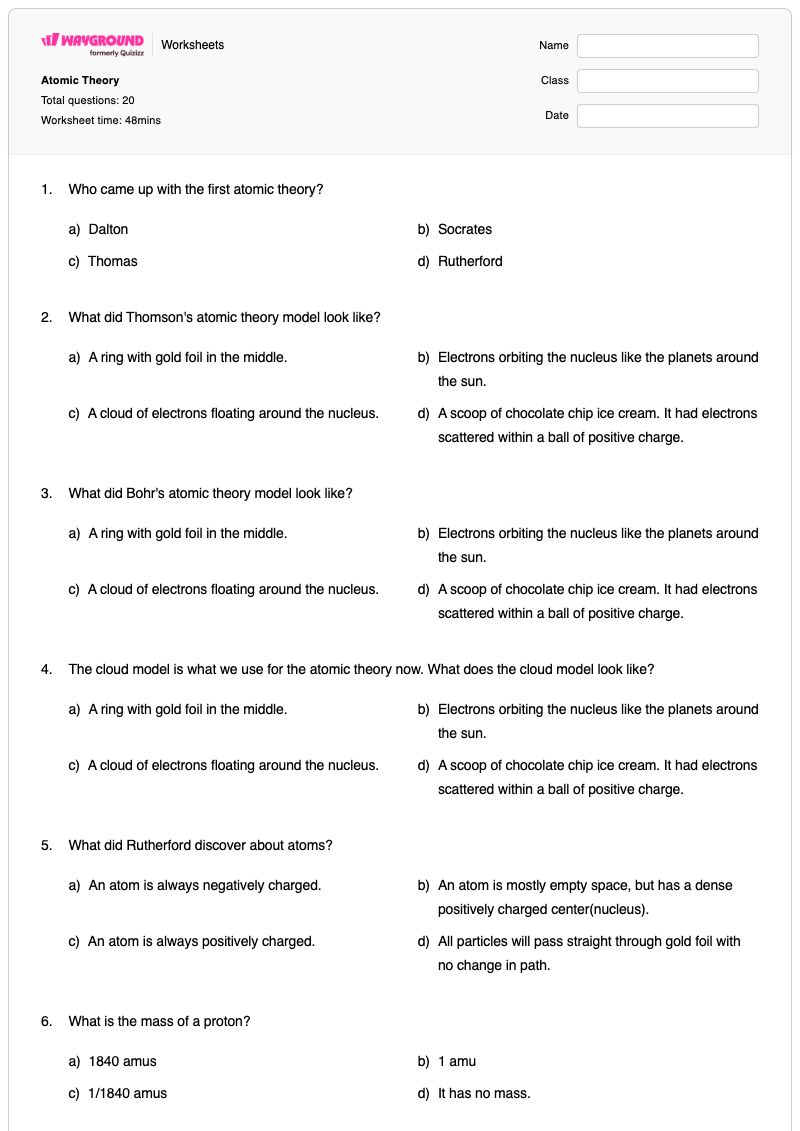
This Grade 9 chemistry worksheet uses 20 multiple-choice questions to review the development of atomic theory and the evidence behind major atomic models. Students identify contributions from Democritus, Dalton, Thomson, Rutherford, Bohr, and Chadwick; match scientists with discoveries; and distinguish the plum pudding, planetary, nuclear, and electron cloud models. The questions also reinforce core subatomic-particle knowledge, including proton mass, particle charge, neutron identity, and which particles occupy the nucleus. Students must connect descriptions to the correct scientist, model, or particle rather than simply recall isolated vocabulary. This free printable worksheet is designed for Grade 9 chemistry review, guided practice, or an introductory assessment, and it includes a complete answer key for efficient checking.

Worksheet settings

Font size

S
M
L
XL
Worksheets

Atomic Theory

Total questions: 20

Name
Class
Date
1.

Who came up with the first atomic theory?

a)

Dalton

b)

Socrates

c)

Thomas

d)

Rutherford

2.

What did Thomson's atomic theory model look like?

a)

A ring with gold foil in the middle.

b)

Electrons orbiting the nucleus like the planets around the sun.

c)

A cloud of electrons floating around the nucleus.

d)

A scoop of chocolate chip ice cream. It had electrons scattered within a ball of positive charge.

3.

What did Bohr's atomic theory model look like?

a)

A ring with gold foil in the middle.

b)

Electrons orbiting the nucleus like the planets around the sun.

c)

A cloud of electrons floating around the nucleus.

d)

A scoop of chocolate chip ice cream. It had electrons scattered within a ball of positive charge.

4.

The cloud model is what we use for the atomic theory now. What does the cloud model look like?

a)

A ring with gold foil in the middle.

b)

Electrons orbiting the nucleus like the planets around the sun.

c)

A cloud of electrons floating around the nucleus.

d)

A scoop of chocolate chip ice cream. It had electrons scattered within a ball of positive charge.

5.

What did Rutherford discover about atoms?

a)

An atom is always negatively charged.

b)

An atom is mostly empty space, but has a dense positively charged center(nucleus).

c)

An atom is always positively charged.

d)

All particles will pass straight through gold foil with no change in path.

6.

What is the mass of a proton?

a)

1840 amus

b)

1 amu

c)

1/1840 amus

d)

It has no mass.

7.

What is a particle with no charge?

a)

neutron

b)

electron

c)

proton

d)

atom

8.

What is a negatively charged particle?

a)

neutron

b)

electron

c)

proton

d)

atom

9.

What two particles would you find in the nucleus of an atom?

a)

Protons and electrons

b)

Neutrons and electrons

c)

Protons and neutrons

d)

Electrons and negatrons

10.

He discovered neutrons.

a)
Rutherford
b)
Bohr
c)
Chadwick
d)
Dalton
e)

Thomson

11.

Which scientist discovered the electrons?

a)

Dalton

b)

Thomson

c)

Atristotle

d)

Bohr

12.

Who first came up with the idea of an atom and called them "atomos"?

a)

o Democritus

b)

o Thomson

c)

o Rutherford

d)

o Bohr

13.
What scientist is best known for his "Plum Pudding" model of the atom?
a)
J.J. Tomson
b)
Ernest Rutherford
c)
John Dalton
d)
Democritus
14.
What did James Chadwick discover?
a)
neutrons
b)
electrons
c)
the atomic theory
d)
protons
15.

Rutherford and his students did experiments that showed

a)

Atoms contain negative particles, now called electrons.

b)

Atoms are mostly empty space.

c)

Neutrons are located in the nucleus.

d)

Matter cannot be lost or gained.

16.
All of the following of Dalton's theories were correct EXCEPT - 
a)
All atoms are identical.
b)
All matter is made of atoms.
c)
Chemical reactions rearrange atoms.
d)
Compounds contain different atoms.
17.
He developed the planetary model of the atom.
a)
Rutherford
b)
Bohr
c)
Chadwick
d)
Dalton
18.

Subatomic particles with a negative charge

a)

Electrons

b)

Neutrons

c)

Protons

d)

Quarks

19.
Subatomic particles that are neutral in charge
a)
Neutrons
b)
Protons
c)
Nucleus 
d)
Electrons
20.
The scientist responsible for "discovering" the nucleus is:
a)
Bohr
b)
Rutherford
c)
Schroedinger
d)
Einstein
Answer Key

Atomic Theory

Total questions: 20

1.
a)

Dalton

2.
d)

A scoop of chocolate chip ice cream. It had electrons scattered within a ball of positive charge.

3.
b)

Electrons orbiting the nucleus like the planets around the sun.

4.
c)

A cloud of electrons floating around the nucleus.

5.
b)

An atom is mostly empty space, but has a dense positively charged center(nucleus).

6.
b)

1 amu

7.
a)

neutron

8.
b)

electron

9.
c)

Protons and neutrons

10.
c) Chadwick
11.
b)

Thomson

12.
a)

o Democritus

13.
a) J.J. Tomson
14.
a) neutrons
15.
b)

Atoms are mostly empty space.

16.
a) All atoms are identical.
17.
b) Bohr
18.
a)

Electrons

19.
a) Neutrons
20.
b) Rutherford

FAQs

What does this Atomic Theory worksheet cover?

This Grade 9 chemistry worksheet covers the scientists, discoveries, and model descriptions used to explain the development of atomic theory. Its 20 multiple-choice questions ask students to distinguish Thomson’s plum pudding model, Rutherford’s nuclear model, Bohr’s planetary model, and the current electron cloud model, while also identifying particle charges, mass, and location.

How can I use this worksheet to teach the development of atomic theory?

Introduce the worksheet after students have encountered the major scientists and models, then have them complete the multiple-choice questions individually or in pairs. Ask students to justify model choices using the descriptions—for example, why scattered electrons in positive charge indicate Thomson’s model or why mostly empty space points to Rutherford’s findings. Review the scientist-and-discovery items afterward to build a sequence from Democritus and Dalton through the modern cloud model.

What mistakes should I watch for when students complete this atomic theory worksheet?

Students may confuse the scientists associated with discoveries, especially Thomson’s discovery of electrons, Chadwick’s discovery of neutrons, and Rutherford’s evidence that atoms are mostly empty space. They may also mix up the plum pudding, planetary, and electron cloud model descriptions or incorrectly place electrons in the nucleus. Check the particle-identification items for confusion between charge, mass, and location, such as selecting a proton instead of a neutron for a particle with no charge.

How do I assign and grade this Atomic Theory worksheet?

You can assign this worksheet as a printable PDF or as a digital quiz on Wayground. It includes a complete answer key for the 20 multiple-choice questions, and printable submissions can be graded by scanning student work with the Wayground for Teachers app. The printable format can also support classrooms or schools that are reducing screen time.

How can I differentiate this atomic theory worksheet for my students?

Use the worksheet’s Advanced Settings to adjust font spacing or choose a larger font size so the multiple-choice model descriptions and particle questions are easier to read. You can also apply a dyslexia-friendly font or translate the worksheet into another language when helpful for students working with the atomic theory vocabulary.

Where can I find more worksheets like this on Wayground?

Wayground offers a comprehensive collection of free printable worksheets and practice problems across subjects, with downloadable PDFs and answer keys to help students master essential skills and concepts. Browse more resources at https://wayground.com/en-us/worksheets.