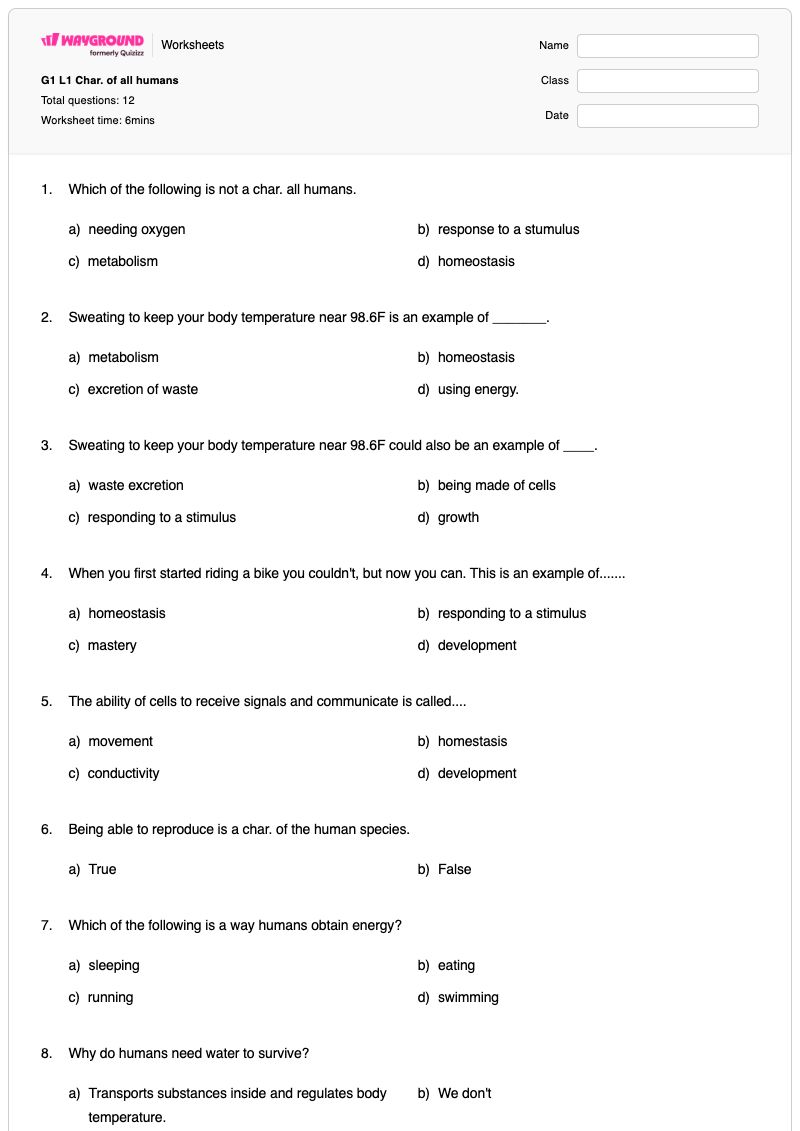
This free printable Grade 11–12 science worksheet helps students identify characteristics of all humans and connect those characteristics to basic human physiology. Across 12 multiple-choice questions, students distinguish concepts such as homeostasis, response to a stimulus, development, conductivity, reproduction, metabolism, and energy acquisition. They also apply these ideas to familiar examples, including sweating, learning to ride a bike, eating for energy, and cells communicating through signals.
The worksheet extends the review to essential survival processes: students consider why the body needs water, how food supplies nutrients, energy, and building materials, how oxygen helps release energy from nutrients, and how heat and pressure relate to body function. It is suitable for introducing or reviewing the characteristics of humans as living organisms in upper-secondary science. The worksheet is available as a free printable PDF and includes an answer key for efficient checking and feedback.
Worksheet settings
Font size
S
M
L
XL
Worksheets
G1 L1 Char. of all humans
Total questions: 12
Name
Class
Date
1.
Which of the following is not a char. all humans.
a)
needing oxygen
b)
response to a stumulus
c)
metabolism
d)
homeostasis
2.
Sweating to keep your body temperature near 98.6F is an example of _______.
a)
metabolism
b)
homeostasis
c)
excretion of waste
d)
using energy.
3.
Sweating to keep your body temperature near 98.6F could also be an example of ____.
a)
waste excretion
b)
being made of cells
c)
responding to a stimulus
d)
growth
4.
When you first started riding a bike you couldn't, but now you can. This is an example of.......
a)
homeostasis
b)
responding to a stimulus
c)
mastery
d)
development
5.
The ability of cells to receive signals and communicate is called....
a)
movement
b)
homestasis
c)
conductivity
d)
development
6.
Being able to reproduce is a char. of the human species.
a)
True
b)
False
7.
Which of the following is a way humans obtain energy?
a)
sleeping
b)
eating
c)
running
d)
swimming
8.
Why do humans need water to survive?
a)
Transports substances inside and regulates body temperature.
b)
We don't
c)
To provide nutrients
d)
To keep our pressures correct.
9.
Food provides us with...
a)
nutrients
b)
energy
c)
materials to build living matter
d)
all of the above
10.
Which gas is used to release energy from nutrients?
a)
carbon dioxide
b)
oxygen
c)
phosphorous
d)
nitrate
11.
This controls the rate at which these metabolic reactions occur.
a)
how fast we eat
b)
carbon dioxide
c)
heat
d)
pressure
12.
What keeps the blood flowing?
a)
Pressure
b)
breathing
c)
body movement
d)
cells
Answer Key
G1 L1 Char. of all humans
Total questions: 12
1.
a)
needing oxygen
2.
b)
homeostasis
3.
c)
responding to a stimulus
4.
d)
development
5.
c)
conductivity
6.
a)
True
7.
b)
eating
8.
a)
Transports substances inside and regulates body temperature.
9.
d)
all of the above
10.
b)
oxygen
11.
c)
heat
12.
a)
Pressure
140 %
Browse by subjects
Browse by grades
Browse by format
FAQs
What does this worksheet cover about the characteristics of all humans?
This 12-question multiple-choice worksheet covers how humans exhibit characteristics of living organisms, including homeostasis, response to stimuli, development, conductivity, reproduction, metabolism, and obtaining energy. Students apply the concepts to examples such as sweating, learning to ride a bike, eating for energy, and using oxygen to release energy from nutrients.
How can I use this worksheet to teach the characteristics of humans?
Introduce the characteristics with concrete examples, then use the multiple-choice items to have students explain why sweating can represent both homeostasis and a response to a stimulus. After students complete the worksheet, discuss how water transport, food, oxygen, heat, and pressure support human survival and connect each example back to the relevant characteristic.
What mistakes should I watch for when students complete this worksheet?
Students may confuse homeostasis with responding to a stimulus, even though the sweating example illustrates both a response and temperature regulation. They may also select mastery instead of development when considering learning to ride a bike, confuse conductivity with movement or homeostasis, or overlook that food provides nutrients, energy, and materials to build living matter.
How do I assign and grade this human characteristics worksheet?
Wayground provides this worksheet as both a printable PDF and a digital quiz, with a complete answer key for all 12 multiple-choice questions. You can grade printed submissions by scanning student work with the Wayground for Teachers app, or review responses through the digital quiz.
How can I differentiate this worksheet for my students?
Use the worksheet’s Advanced Settings to adjust font spacing or increase the font size so the 12 multiple-choice questions are easier to read. You can also enable a dyslexia-friendly font or translate the worksheet into another language while keeping the human-characteristics and physiology questions intact.
Where can I find more free worksheets like this on Wayground?
Wayground offers a comprehensive collection of free printable worksheets and practice problems across subjects, with downloadable PDFs and answer keys to support mastery of essential skills and concepts. Browse more resources at https://wayground.com/en-us/worksheets.

 Worksheets