This Grade 8 science worksheet builds foundational vocabulary for describing waves and their properties. Students complete 10 multiple-choice questions that distinguish a wave from its measurable features, including amplitude, wave crest, wave trough, wave height, wavelength, and wave frequency. The final items extend the vocabulary to compression, rarefaction, and particles by matching each description to the correct term.
The worksheet is useful for introducing wave terminology, reinforcing definitions after instruction, or checking students’ understanding before they interpret wave diagrams or data. Its definition-based format asks students to identify the precise term represented by each description, helping them separate related concepts such as amplitude and wave height or wavelength and frequency. This is a free printable worksheet with a complete answer key for efficient review and assessment.
Worksheet settings
Font size
S
M
L
XL
Worksheets
Waves
Total questions: 10
Name
Class
Date
1.
A pattern of disturbance that travels through a substance from one location to another location.
a)
Wave
b)
Amplitude
c)
Wave Crest
d)
Wave Trough
e)
Wave Height
2.
The distance from the wave crest or trough to the equilibrium Level
a)
Wave
b)
Amplitude
c)
Wave Crest
d)
Wave Trough
e)
Wave Height
3.
The highest part of a wave.
a)
Wave
b)
Amplitude
c)
Wave Crest
d)
Wave Trough
e)
Wave Height
4.
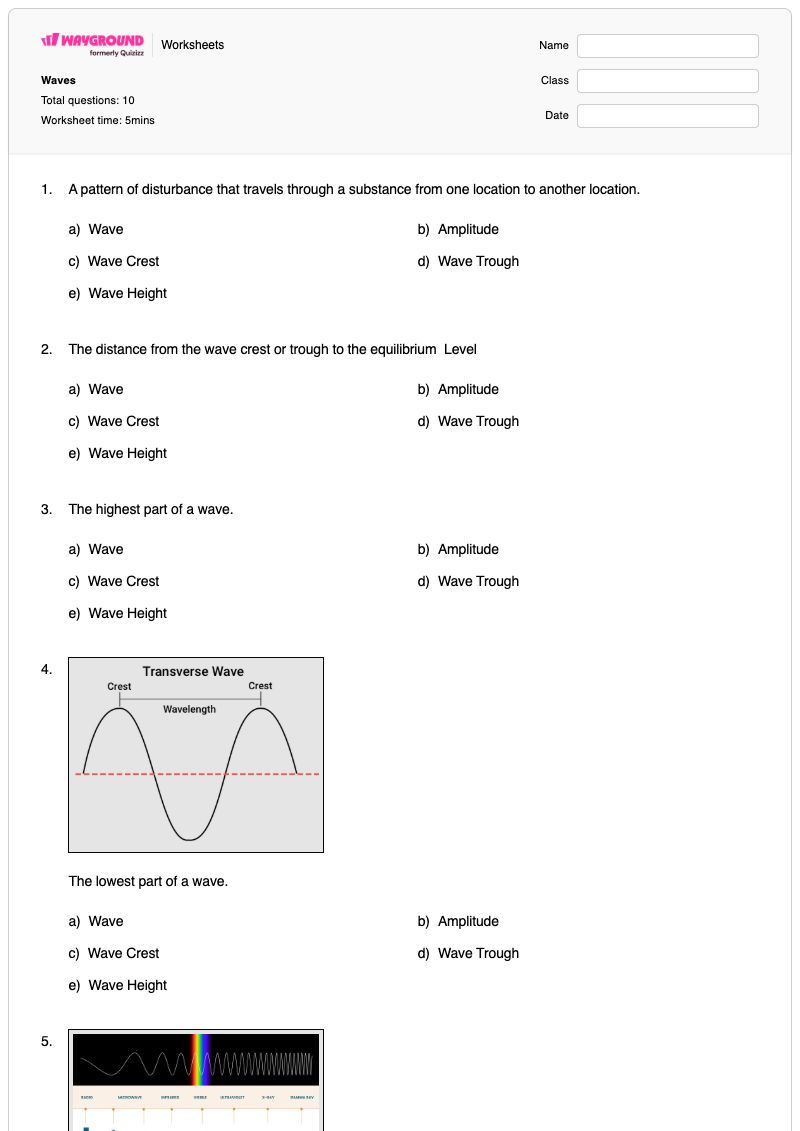
The lowest part of a wave.
a)
Wave
b)
Amplitude
c)
Wave Crest
d)
Wave Trough
e)
Wave Height
5.
The vertical distance between the wave trough and the wave crest.
a)
Wave
b)
Amplitude
c)
Wave Crest
d)
Wave Trough
e)
Wave Height
6.
distance between two consecutive wave crests or between two consecutive wave troughs.
a)
Wave
b)
Amplitude
c)
Wave Length
d)
Wave Trough
e)
Wave Height
7.
The number of waves passing a fixed point in a specified period of time
a)
Wave Height
b)
Wave Length
c)
Wave Frequency
d)
Wave Trough
8.
The part of a wave that the particles are more pushed together.
a)
Compression
b)
Rarefaction
c)
Particles
d)
Wave
9.
The part of a wave that the particles are pulled apart
a)
Compression
b)
Rarefaction
c)
Particles
d)
Wave
10.
Are the small piece of matter that make up an object.
a)
Compression
b)
Rarefaction
c)
Particles
d)
Wave
Answer Key
Waves
Total questions: 10
1.
a)
Wave
2.
b)
Amplitude
3.
c)
Wave Crest
4.
d)
Wave Trough
5.
e)
Wave Height
6.
c)
Wave Length
7.
c)
Wave Frequency
8.
a)
Compression
9.
b)
Rarefaction
10.
c)
Particles
140 %
Browse by subjects
Browse by grades
Browse by format
FAQs
What does the Waves worksheet cover?
This Grade 8 science worksheet uses 10 multiple-choice definition questions to develop students’ ability to identify core wave vocabulary. Students distinguish a wave, amplitude, crest, trough, wave height, wavelength, and frequency, then identify compression, rarefaction, and particles from descriptions of how wave matter is arranged or moves.
How can I use this worksheet to teach wave properties?
Introduce the vocabulary by having students compare related terms before they begin the 10 multiple-choice items—for example, discuss how amplitude measures from the equilibrium level while wave height spans from trough to crest. After students choose answers, ask them to explain the difference between wavelength and frequency and to connect compression and rarefaction to the arrangement of particles described in the final questions.
What mistakes should I watch for when students complete this Waves worksheet?
Students may confuse amplitude with wave height because both describe vertical distance, or choose wavelength when a question asks for the number of waves passing a fixed point, which is frequency. They may also reverse crest and trough or confuse compression, where particles are pushed together, with rarefaction, where particles are pulled apart.
How do I assign and grade this Waves worksheet?
Wayground provides this worksheet as a printable PDF and as a digital quiz, and it includes a complete answer key for checking all 10 multiple-choice responses. For printable submissions, scan student work with the Wayground for Teachers app to help grade responses efficiently.
How can I differentiate this wave vocabulary worksheet for my students?
Under the worksheet’s Advanced Settings, adjust font spacing and font size to make the definition-and-choice layout easier to read. You can also apply a dyslexia-friendly font or translate the wave terminology and descriptions into another language while keeping the multiple-choice format.
Where can I find more free worksheets like this on Wayground?
Wayground offers a broad collection of free printable worksheets and practice problems across subjects, with downloadable PDFs and answer keys to support mastery of essential skills and concepts. Browse more resources at https://wayground.com/en-us/worksheets.

 Worksheets


