Thermochemistry is a Grade 10 science worksheet with 11 multiple-choice questions focused on heat calculations and thermal-energy concepts. Students calculate temperature change, specific heat, mass, and heat energy using given values, including examples involving water and mercury. They also identify whether reactions are endothermic or exothermic and connect the symbols q, m, c, and temperature change to their meanings and units.
This free printable worksheet helps students apply the heat equation in short calculation problems while checking whether they understand the role of each variable. The final comparison item reinforces the relationship between specific heat and temperature change when mass and added heat are held similar. Use it for independent practice, review, or a quick formative assessment in Grade 10 science; a complete answer key is included for efficient checking.
Worksheet settings
Font size
S
M
L
XL
Worksheets
Thermochemistry
Total questions: 11
Name
Class
Date
1.
Calculate ΔT when a substance goes from 10*C to 75*C
a)
-65*C
b)
75*C
c)
10*C
d)
65*C
2.
Calculate A 50g sample is heated with 500 joules of energy and has a 10*C temperature change. Calculate it’s specific heat.
a)
1 j/g*C
b)
250000 j/g*C
c)
500 j/g*C
d)
10 j/g*C
3.
4180 j of heat energy are added to change the temperature of water by 10*C. How many grams of water are being heated? cwater=4.18 j/g*C
a)
4.18 j/g*C
b)
10000g
c)
174724g
d)
100g
4.
What heat energy is required to raise the temperature of a 1g sample of mercury (cHg=.16 j/g*C) by 100*C?
a)
16j
b)
.0016j
c)
16000j
d)
625 j
5.
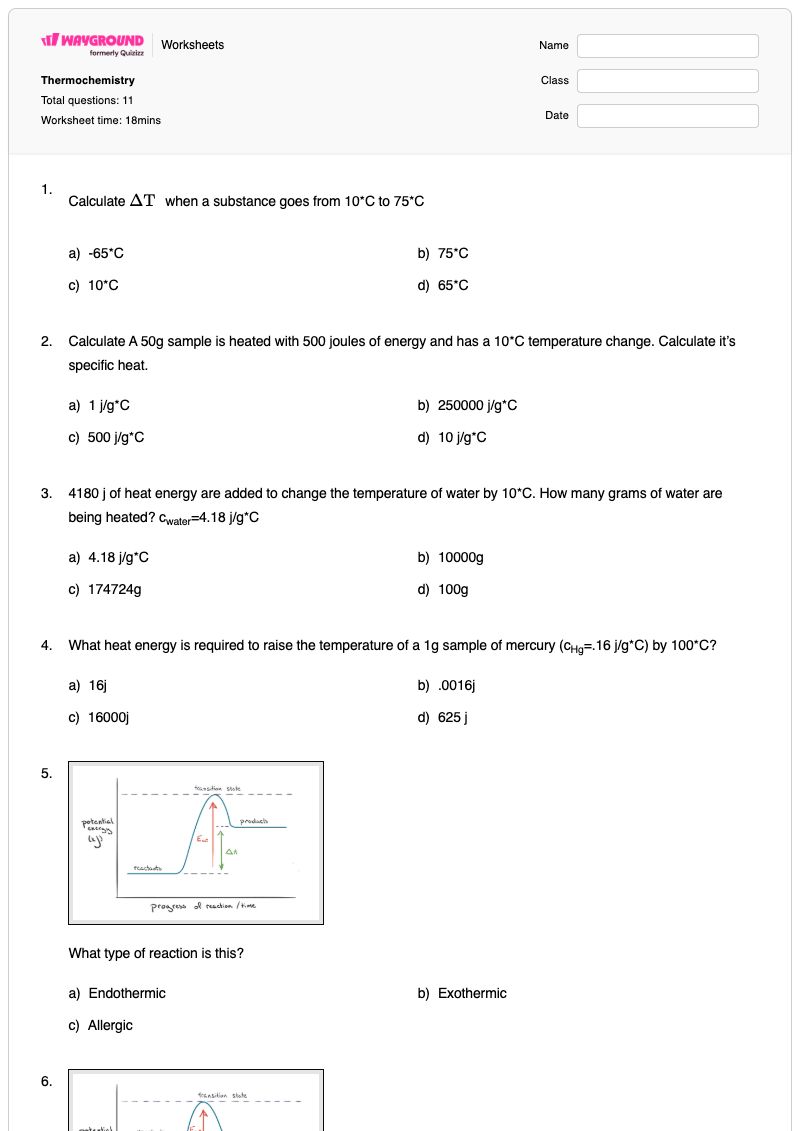
What type of reaction is this?
a)
Endothermic
b)
Exothermic
c)
Allergic
6.
What type of reaction is this?
a)
Endothermic
b)
Exothermic
c)
Allergic
7.
What does q stand for?
a)
Heat-Joules
b)
Mass-Grams
c)
Specific Heat-J/g*C
d)
Temperature Change-*C
8.
What does c stand for?
a)
Heat-Joules
b)
Mass-Grams
c)
Specific Heat-J/g*C
d)
Temperature Change-*C
9.
What does ΔT stand for?
a)
Heat-Joules
b)
Mass-Grams
c)
Specific Heat-J/g*C
d)
Temperature Change-*C
10.
What does m stand for?
a)
Heat-Joules
b)
Mass-Grams
c)
Specific Heat-J/g*C
d)
Temperature Change-*C
11.
When two samples of similar mass are subjected to the same heat energy, the sample with the SMALLER specific heat will have a _________ temperature change.
a)
SMALLER
b)
LARGER
c)
EQUAL
Answer Key
Thermochemistry
Total questions: 11
1.
d)
65*C
2.
a)
1 j/g*C
3.
d)
100g
4.
a)
16j
5.
a)
Endothermic
6.
b)
Exothermic
7.
a)
Heat-Joules
8.
c)
Specific Heat-J/g*C
9.
d)
Temperature Change-*C
10.
b)
Mass-Grams
11.
b)
LARGER
140 %
Browse by subjects
Browse by grades
Browse by format
FAQs
What does this Thermochemistry worksheet help students learn?
This Grade 10 worksheet uses 11 multiple-choice items to assess applying q = mcΔT to calculate temperature change, specific heat, mass, and heat energy. It also builds fluency with the meanings and units of q, m, c, and temperature change, distinguishes endothermic from exothermic reactions, and connects smaller specific heat with a larger temperature change under comparable conditions.
How can I use this Thermochemistry worksheet to teach heat calculations?
Introduce q, m, c, and temperature change before assigning the calculation items, then model how to identify the known values and select the appropriate form of q = mcΔT. After students solve the water and mercury examples, use the endothermic/exothermic and variable-meaning questions to discuss how energy transfer and specific heat affect temperature change.
What mistakes should I watch for on this Thermochemistry worksheet?
Watch for students subtracting temperatures in the wrong order, confusing specific heat with heat energy, or selecting an answer without checking the units. Students may also mix up q, m, c, and temperature change in the definition items, reverse the endothermic and exothermic labels, or assume that a smaller specific heat produces a smaller temperature change.
How do I assign and grade this Thermochemistry worksheet?
The worksheet is available as a printable PDF and as a digital quiz on Wayground, and it includes a complete answer key for all 11 multiple-choice questions. For printable submissions, you can scan student work with the Wayground for Teachers app to streamline grading.
How can I differentiate this Thermochemistry worksheet for my students?
Use the worksheet’s Advanced Settings to adjust font spacing or font size so the heat-calculation and variable-identification items are easier to read. You can also enable a dyslexia-friendly font or translate the worksheet into another language when those options better support access to the thermochemistry questions.
Where can I find more worksheets like this on Wayground?
Wayground offers a comprehensive collection of free printable worksheets and practice problems across subjects, with downloadable PDFs and answer keys to support essential skills and concepts. Browse more resources at https://wayground.com/en-us/worksheets.

 Worksheets


