
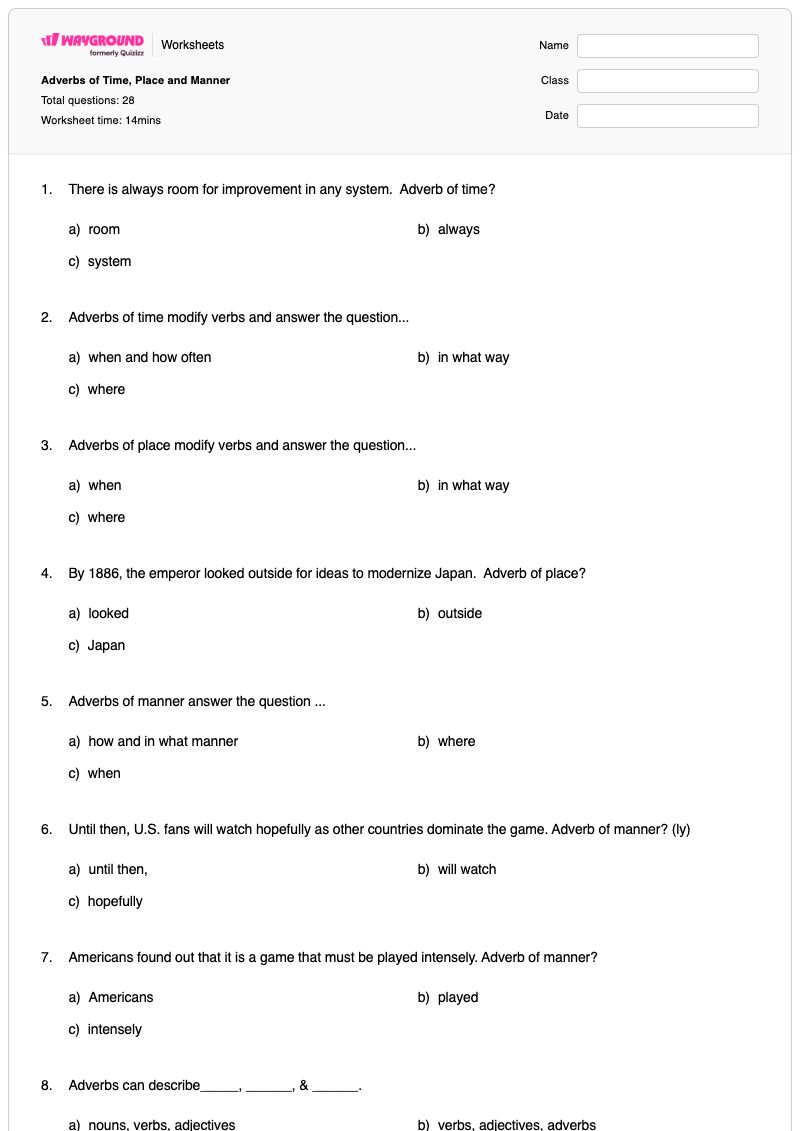

This Grade 6 English worksheet helps students distinguish among adverbs of time, place, and manner. Across 28 multiple-choice questions, students identify adverbs in sentences, match each type to the question it answers, and recognize that adverbs can modify verbs, adjectives, and other adverbs. Examples such as “always,” “outside,” “hopefully,” and “intensely” give students practice using meaning and sentence context to classify adverbs.
Use this free printable worksheet to reinforce adverb identification after direct instruction or to check students’ understanding of the three categories. The questions combine definition-based choices, sentence analysis, classification prompts, and a true-or-false item, making the worksheet useful for independent practice, review, or formative assessment. A complete answer key is included so teachers can quickly check student work and address confusion between when, where, and how an action occurs.
Worksheet settings
Font size
S
M
L
XL
Worksheets
Adverbs of Time, Place and Manner
Total questions: 28
Name
Class
Date
1.
There is always room for improvement in any system. Adverb of time?
a)
room
b)
always
c)
system
2.
Adverbs of time modify verbs and answer the question...
a)
when and how often
b)
in what way
c)
where
3.
Adverbs of place modify verbs and answer the question...
a)
when
b)
in what way
c)
where
4.
By 1886, the emperor looked outside for ideas to modernize Japan. Adverb of place?
a)
looked
b)
outside
c)
Japan
5.
Adverbs of manner answer the question ...
a)
how and in what manner
b)
where
c)
when
6.
Until then, U.S. fans will watch hopefully as other countries dominate the game. Adverb of manner? (ly)
a)
until then,
b)
will watch
c)
hopefully
7.
Americans found out that it is a game that must be played intensely. Adverb of manner?
a)
Americans
b)
played
c)
intensely
8.
Adverbs can describe_____, ______, & ______.
a)
nouns, verbs, adjectives
b)
verbs, adjectives, adverbs
c)
pronouns, verbs, adjectives
d)
verbs, adverbs, nouns
9.
Adverbs modify verbs, adjectives or other adverbs. They often tell when, how, where, or to what degree/extent.
a)
TRUE
b)
FALSE
10.
Tell when an action happens
a)
Adverb of Time
b)
Adverb of Place
c)
Adverb of Manner
d)
Adverb of Degree
11.
Identify the adverb of manner:
The girl ran quickly through the rain.
a)
ran
b)
quickly
c)
rain
12.
Identify the adverb of manner:
The dog howled sadly in the rain.
a)
howled
b)
dog
c)
sadly
13.
Identify the adverb of manner:
The cow slowly chewed the delicious, green clover.
a)
cow
b)
chewed
c)
slowly
14.
Tell what type of adjective the word in red is. Americans sometimes told stories about Johnny Appleseed.
a)
time
b)
place
c)
manner
15.
Tell what type of adjective the word in red is. John Chapman grew up in Massachusetts in the 1700's, but he didn't stay there.
a)
time
b)
place
c)
manner
16.
Tell what type of adjective the word in red is. He walked far on foot, through the country to the western frontier.
a)
time
b)
place
c)
manner
17.
Tell what type of adjective the word in red is. He started a farm and worked hard.
a)
time
b)
place
c)
manner
18.
Tell what type of adjective the word in red is. Generously, he gave seeds and seedlings to the settlers.
a)
time
b)
place
c)
manner
19.
Tell what type of adjective the word in red is. Soon he realized that his mission was to encourage planting trees throughout the country.
a)
time
b)
place
c)
manner
20.
Identify the adverb of time:
I have netball practice tomorrow.
a)
netball
b)
tomorrow
c)
have
21.
Identify the adverb of time:
I am going ice skating tonight.
a)
going
b)
tonight
c)
am
22.
Identify the adverb of time:
I brush my hair daily.
a)
brush
b)
daily
c)
I
23.
Identify the adverb of place:
I looked everywhere for my lost book.
a)
everywhere
b)
lost
c)
looked
24.
Identify the adverb of place:
My dog is in the garden downstairs.
a)
is
b)
downstairs
c)
garden
25.
Identify the adverb of place:
Jono must be hiding somewhere.
a)
hiding
b)
somewhere
c)
must
26.
Identify the adverb of place:
The teacher asked the children to move elsewhere.
a)
move
b)
asked
c)
elsewhere
27.
Identify the adverb of place:
Here is the pen you were looking for.
a)
is
b)
here
c)
looking
28.
Identify the kind of the underlined adverb in each sentence.
He lives nearby.
a)
Time
b)
Place
c)
Degree
d)
Manner
Answer Key
Adverbs of Time, Place and Manner
Total questions: 28
1.
b) always
2.
a) when and how often
3.
c) where
4.
b) outside
5.
a) how and in what manner
6.
c) hopefully
7.
c) intensely
8.
b)
verbs, adjectives, adverbs
9.
a)
TRUE
10.
a)
Adverb of Time
11.
b)
quickly
12.
c)
sadly
13.
c)
slowly
14.
a) time
15.
b) place
16.
b) place
17.
c) manner
18.
c) manner
19.
a) time
20.
b)
tomorrow
21.
b)
tonight
22.
b)
daily
23.
a)
everywhere
24.
b)
downstairs
25.
b)
somewhere
26.
c)
elsewhere
27.
b)
here
28.
b)
Place
140 %
Browse by subjects
Browse by grades
Browse by format
FAQs
What does the Adverbs of Time, Place and Manner worksheet cover?
This Grade 6 English worksheet focuses on identifying and classifying adverbs of time, place, and manner through 28 multiple-choice questions. Students use sentence context to find adverbs such as “always,” “outside,” “hopefully,” and “intensely,” connect each category to its guiding question—when, where, or how—and review what adverbs can modify.
How can I use this worksheet to teach adverbs of time, place, and manner?
Introduce the three categories by modeling the questions each one answers: when or how often for time, where for place, and how or in what manner for manner. Then have students complete the multiple-choice items and explain why a selected word fits its category, such as why “outside” signals place or “intensely” signals manner. Use their explanations to reinforce that adverbs may modify verbs, adjectives, or other adverbs.
What mistakes should I watch for when students complete this adverbs worksheet?
Students may choose the verb or a nearby noun instead of the adverb, as in selecting “looked” or “Japan” rather than “outside.” They may also confuse the category questions, labeling a manner adverb such as “quickly” or “sadly” as time or place, or overlook frequency words such as “always” when identifying adverbs of time. Review whether students are using the word’s meaning and role in the sentence, not just its position or spelling.
How do I assign and grade this adverbs worksheet?
The Adverbs of Time, Place and Manner worksheet is available as a printable PDF and as a digital quiz on Wayground. It includes a complete answer key for the 28 multiple-choice questions, and printable submissions can be graded by scanning student work with the Wayground for Teachers app. The PDF option also supports schools that want to reduce screen time.
How can I differentiate this adverbs worksheet for my students?
Use the worksheet’s Advanced Settings to adjust font spacing and font size so the multiple-choice prompts and answer options are easier to read. You can also enable a dyslexia-friendly font or translate the worksheet into another language. These changes can make the adverb examples and category choices more accessible without changing the practice target.
Where can I find more free worksheets like this on Wayground?
Wayground offers a comprehensive collection of free printable worksheets and practice problems across subjects, with downloadable PDFs and answer keys to help students master essential skills and concepts. Browse more resources at https://wayground.com/en-us/worksheets.