Time to Tell Time is a Grade 3 mathematics worksheet with 17 multiple-choice questions focused on reading and interpreting clock times. Students identify the number of hours in a day, distinguish the roles of the clock hands, recognize o’clock, half-past, and “twenty to” expressions, interpret A.M. and P.M., and select the closest matching time for a clock display. The worksheet also includes items that connect clock reading to daily routines and a two-hour elapsed-time problem.
This free printable worksheet with an answer key gives teachers a focused way to check foundational time skills through varied question formats. Students read clock faces, compare numerical choices, match written times to visual displays, and apply time knowledge to determine when an activity ends. It can support guided practice, independent review, or a quick formative assessment after classroom instruction on telling time.
Worksheet settings
Font size
S
M
L
XL
Worksheets
time to tell time
Total questions: 17
Name
Class
Date
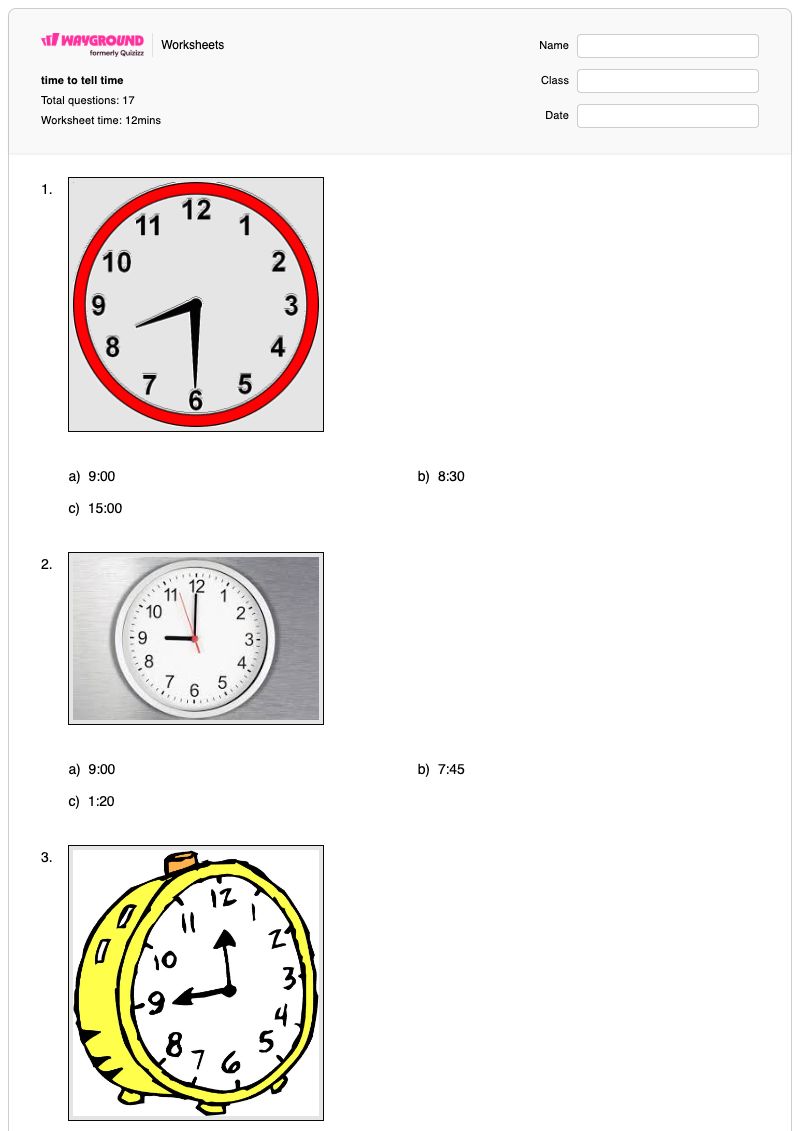
1.
a)
9:00
b)
8:30
c)
15:00
2.
a)
9:00
b)
7:45
c)
1:20
3.
How many hours are in one day?
a)
12 hours
b)
24 hours
c)
27 hours
d)
10 hours
4.
Which hand of the clock tell the hour?
a)
long
b)
short
c)
number
5.
What's the time now?
a)
one twelve.
b)
It's one o'clock.
c)
one pm.
d)
One o' clock.
6.
What's the time now?
a)
It's five o' clock.
b)
It's 12 o'clock.
c)
It's four o'clock.
d)
It's four thirty.
7.
What does the big hand on the clock tell us?
a)
The hour
b)
The minutes
8.
What word USUALLY means at night?
a)
Day-time
b)
P.M.
c)
Afternoon
d)
A.M.
9.
What time is it?
a)
12:00
b)
6:00
10.
what time is it?
a)
it's two o'clock
b)
it's twenty to three
c)
it's three o'clock
11.
it's......
a)
half past five
b)
half past seven
c)
seven o'clock
12.
what time do you get up?
a)
I get up by 7 o'clock
b)
I wake up
c)
I eat breakfast
13.
Which is closest to the time shown on this clock?
a)
8:33
b)
5:40
c)
8:25
d)
8:28
14.
Which is closest to the time shown on this clock?
a)
7:02
b)
6:10
c)
2:35
d)
7:10
15.
Which clock shows the time below?
a)
b)
c)
d)
16.
Which clock shows the time below?
a)
b)
c)
d)
17.
Lenny began walking one afternoon at the time shown on the clock.
He finished walking two hours later. What time did Lenny finish walking?
a)
1:38
b)
2:38
c)
3:38
d)
4:38
Answer Key
time to tell time
Total questions: 17
1.
b)
8:30
2.
a)
9:00
3.
b) 24 hours
4.
a)
long
5.
b)
It's one o'clock.
6.
c)
It's four o'clock.
7.
b) The minutes
8.
b) P.M.
9.
b) 6:00
10.
b)
it's twenty to three
11.
b)
half past seven
12.
a)
I get up by 7 o'clock
13.
d)
8:28
14.
d)
7:10
15.
d)
16.
c)
17.
c)
3:38
140 %
Browse by subjects
Browse by grades
Browse by format
FAQs
What does the Time to Tell Time worksheet cover?
This Grade 3 mathematics worksheet uses 17 multiple-choice questions to practise reading clock faces and interpreting time language. Students work with o’clock, half-past, and “twenty to” expressions, A.M. and P.M., closest-time choices, clock-to-time matching, daily routines, and a problem that asks them to add two hours to a starting time.
How can I use this worksheet to teach telling time?
Introduce the worksheet by modelling how to inspect both the clock face and the answer choices before selecting a time. Discuss the hand-identification and time-language questions together, then have students explain why a display represents an o’clock, half-past, or “twenty to” time. Finish by using the walking problem to connect clock reading with adding elapsed time.
What mistakes should I watch for when students complete this time worksheet?
Students may read only one clock hand, confuse o’clock with half-past or “twenty to,” or treat A.M. and P.M. as interchangeable. In the closest-time questions, they may choose a visually similar number without comparing the minutes carefully. For the final word problem, check that students add two hours to the starting time rather than changing the minutes.
How do I assign and grade this worksheet?
The worksheet is available as a printable PDF and as a digital quiz on Wayground, and it includes a complete answer key for all 17 multiple-choice questions. For printable submissions, you can scan student work with the Wayground for Teachers app to support grading.
How can I differentiate this clock-reading worksheet for my students?
Use the worksheet’s Advanced Settings to adjust font spacing or choose a larger font size so the clock-reading questions and answer choices are easier to follow. You can also enable a dyslexia-friendly font or translate the worksheet into another language when that would help students access the time vocabulary.
Where can I find more worksheets like this on Wayground?
Wayground offers a comprehensive collection of free printable worksheets and practice problems across subjects, with downloadable PDFs and answer keys to help students master essential skills and concepts. Browse more resources at https://wayground.com/en-us/worksheets.

 Worksheets


