Weather Instruments and Types of Storms is a free printable Grade 6 science worksheet with 12 multiple-choice questions. Students identify the instruments used to measure wind direction, wind speed, air pressure, and humidity, and recognize how satellite images help meteorologists observe weather systems. They also identify pictured tornadoes and hurricanes, recall the five hurricane categories on the Saffir-Simpson Scale, and name the eye of a hurricane.
The worksheet builds connections between weather measurements and storm science. Students apply their understanding of high- and low-pressure systems, select the weather conditions associated with each, and identify the combination of air conditions that can produce tornadoes. A complete answer key is included, making this free printable worksheet useful for Grade 6 science practice, review, or an assessment of weather-instrument and storm-concept vocabulary.
Worksheet settings
Font size
S
M
L
XL
Worksheets
Weather Instruments and Types of Storms
Total questions: 12
Name
Class
Date
1.
To measure wind direction, what weather instrument do I need to use?
a)
Anemometer
b)
Wind
Speedometer
c)
Barometer
d)
Wind Vane
2.
An anemometer measures
a)
Amount of precipitation
b)
Air pressure
c)
Wind speed
d)
Humidity
3.
A barometer measures
a)
Humidity
b)
Air pressure
c)
Temperature
d)
Wind speed
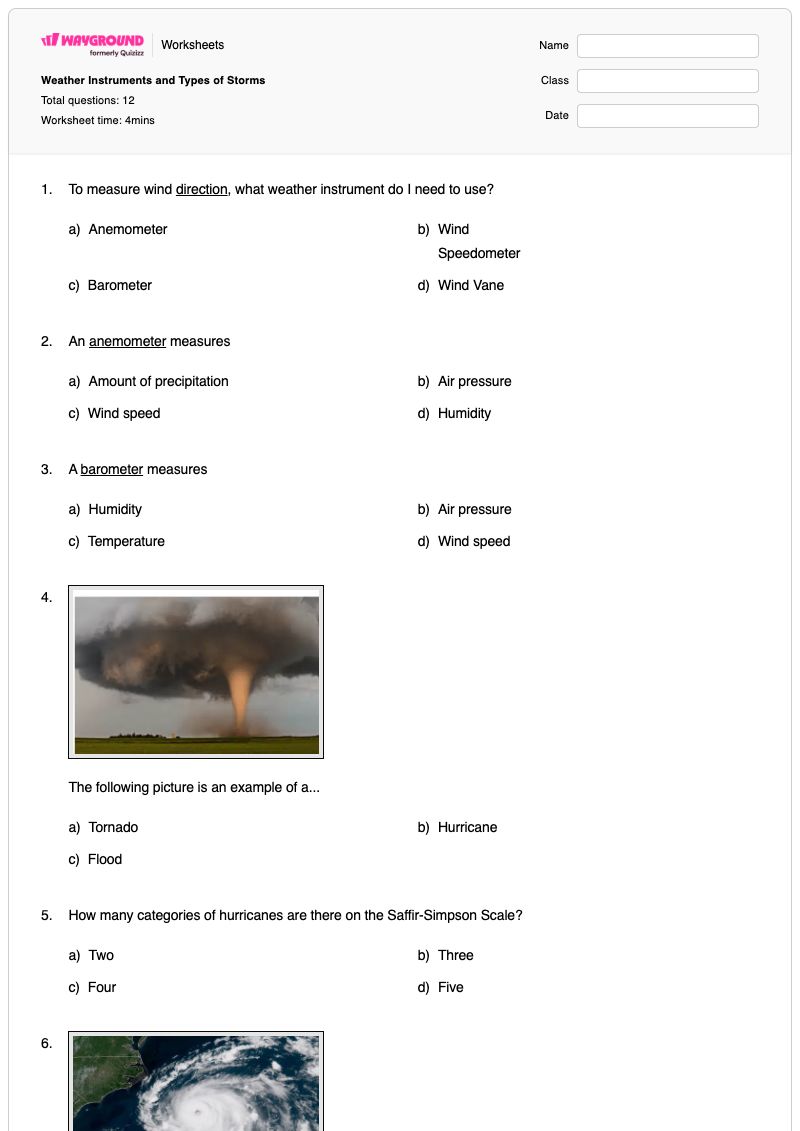
4.
The following picture is an example of a...
a)
Tornado
b)
Hurricane
c)
Flood
5.
How many categories of hurricanes are there on the Saffir-Simpson Scale?
a)
Two
b)
Three
c)
Four
d)
Five
6.
The following picture is an example of a...
a)
Tornado
b)
Hurricane
c)
Flood
7.
The calm area in the center of a hurricane is called the _____.
a)
draft
b)
funnel
c)
eye
d)
squall
8.
Aisley wants to measure the amount of moisture in the air. She does not want the water in the air to frizz her hair. What instrument should she use?
a)
Rain Gauge
b)
Barometer
c)
Hygrometer
9.
Images from this help meteorologists see weather systems that are far away (from space), show cloud cover over an area, and much more.
a)
Satellite
b)
Doppler Radar
c)
Psychrometer
10.
Low pressure systems produce...
a)
clear, sunny weather
b)
cloudy weather with possible storms
11.
High pressure systems produce...
a)
clear, sunny weather
b)
cloudy weather with possible storms
12.
What combinations of air cause tornadoes to form?
a)
Hot
b)
Cold/dry and warm/wet
c)
Cold/wet and warm/dry
d)
Cold
Answer Key
Weather Instruments and Types of Storms
Total questions: 12
1.
d)
Wind Vane
2.
c)
Wind speed
3.
b)
Air pressure
4.
a)
Tornado
5.
d)
Five
6.
b)
Hurricane
7.
c)
eye
8.
c)
Hygrometer
9.
a)
Satellite
10.
b)
cloudy weather with possible storms
11.
a)
clear, sunny weather
12.
b)
Cold/dry and warm/wet
140 %
Browse by subjects
Browse by grades
Browse by format
FAQs
What does the Weather Instruments and Types of Storms worksheet cover?
This Grade 6 science worksheet uses 12 multiple-choice questions to assess weather instruments and storm concepts. Students match instruments such as a wind vane, anemometer, barometer, hygrometer, and satellite imagery to their functions, then apply storm knowledge by identifying tornadoes and hurricanes, interpreting pressure systems, and recognizing tornado-forming air conditions.
How can I use this worksheet to teach weather instruments and types of storms?
Introduce the worksheet by having students sort the instruments by what they measure: wind direction, wind speed, air pressure, or humidity. Then use the storm questions to discuss the hurricane’s eye, the five Saffir-Simpson categories, how high- and low-pressure systems affect weather, and why cold/dry and warm/wet air combinations can produce tornadoes.
What mistakes should I watch for on this weather worksheet?
Watch for students confusing a wind vane, which measures wind direction, with an anemometer, which measures wind speed, or choosing a barometer for humidity instead of air pressure. Students may also mix up the hurricane’s eye with a tornado funnel, reverse the weather associated with high and low pressure, or overlook that the worksheet identifies five Saffir-Simpson hurricane categories.
How do I assign and grade this Weather Instruments and Types of Storms worksheet?
Wayground provides this worksheet as a printable PDF and as a digital quiz, and it includes a complete answer key for all 12 multiple-choice questions. For printable submissions, you can grade student work by scanning it with the Wayground for Teachers app.
How can I differentiate this weather instruments and storms worksheet for my students?
Use the worksheet’s Advanced Settings to adjust font spacing and font size for the 12 multiple-choice items, or enable a dyslexia-friendly font. You can also translate the worksheet into another language so students can focus on distinguishing instruments, pressure systems, and storm types while reading support is reduced.
Where can I find more free worksheets like this on Wayground?
Wayground offers a comprehensive collection of free printable worksheets and practice problems across subjects, with downloadable PDFs and answer keys to support essential skills and concepts. Browse more resources at https://wayground.com/en-us/worksheets.

 Worksheets
