

Wayground
2.7 DNA Replication, Transcription, and Translation Quiz - Printable Biology Worksheets - Wayground

2.7 DNA Replication, Transcription, and Translation Quiz

23 questions

12th - 12th Grade

Biology

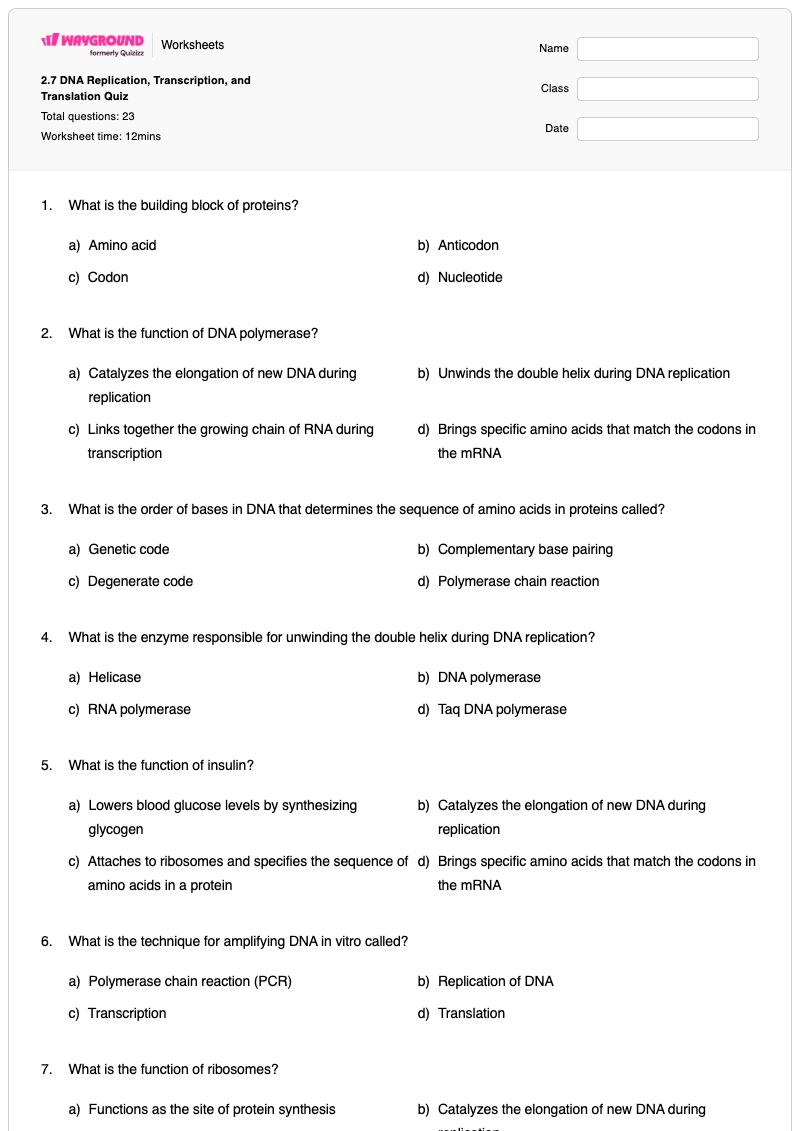
2.7 DNA Replication, Transcription, and Translation Quiz is a Grade 12 biology worksheet with 23 multiple-choice questions. It reviews how DNA stores and copies genetic information, including complementary base pairing, the genetic code, DNA polymerase, helicase, and polymerase chain reaction (PCR). Students also distinguish transcription from translation and identify the roles of mRNA, tRNA, ribosomes, codons, anticodons, and amino acids in protein synthesis. The quiz includes related biology applications such as insulin’s role in lowering blood glucose by synthesizing glycogen. This free printable worksheet with an answer key is useful for checking students’ understanding after instruction on gene expression and DNA processes. Its selected-response format asks students to match biological terms, enzymes, molecules, and processes with their functions, helping teachers identify whether students can distinguish closely related vocabulary such as DNA polymerase and RNA polymerase or transcription and translation. It can support independent practice, review, or an assessment in a Grade 12 biology unit.

Worksheet settings

Font size

S
M
L
XL
Worksheets

2.7 DNA Replication, Transcription, and Translation Quiz

Total questions: 23

Name
Class
Date
1.

What is the building block of proteins?

a)

Amino acid

b)

Anticodon

c)

Codon

d)

Nucleotide

2.

What is the function of DNA polymerase?

a)

Catalyzes the elongation of new DNA during replication

b)

Unwinds the double helix during DNA replication

c)

Links together the growing chain of RNA during transcription

d)

Brings specific amino acids that match the codons in the mRNA

3.

What is the order of bases in DNA that determines the sequence of amino acids in proteins called?

a)

Genetic code

b)

Complementary base pairing

c)

Degenerate code

d)

Polymerase chain reaction

4.

What is the enzyme responsible for unwinding the double helix during DNA replication?

a)

Helicase

b)

DNA polymerase

c)

RNA polymerase

d)

Taq DNA polymerase

5.

What is the function of insulin?

a)

Lowers blood glucose levels by synthesizing glycogen

b)

Catalyzes the elongation of new DNA during replication

c)

Attaches to ribosomes and specifies the sequence of amino acids in a protein

d)

Brings specific amino acids that match the codons in the mRNA

6.

What is the technique for amplifying DNA in vitro called?

a)

Polymerase chain reaction (PCR)

b)

Replication of DNA

c)

Transcription

d)

Translation

7.

What is the function of ribosomes?

a)

Functions as the site of protein synthesis

b)

Catalyzes the elongation of new DNA during replication

c)

Unwinds the double helix during DNA replication

d)

Links together the growing chain of RNA during transcription

8.

What is the process of making a copy of a DNA molecule called?

a)

Replication of DNA

b)

Transcription

c)

Translation

d)

Polymerase chain reaction (PCR)

9.

What is the enzyme that links together the growing chain of RNA during transcription?

a)

RNA polymerase

b)

DNA polymerase

c)

Helicase

d)

Taq DNA polymerase

10.

What is the type of RNA that attaches to ribosomes and specifies the sequence of amino acids in a protein?

a)

Messenger RNA (mRNA)

b)

Transfer RNA (tRNA)

c)

Anticodon

d)

Nucleotide

11.

What is the process of converting the DNA sequence of bases into mRNA called?

a)

Transcription

b)

Translation

c)

Replication of DNA

d)

Polymerase chain reaction (PCR)

12.

What is the process of decoding the sequence of bases on mRNA into an amino acid sequence called?

a)

Translation

b)

Transcription

c)

Replication of DNA

d)

Polymerase chain reaction (PCR)

13.

What is the RNA molecule that brings specific amino acids that match the codons in the mRNA called?

a)

Transfer RNA (tRNA)

b)

Messenger RNA (mRNA)

c)

Anticodon

d)

Nucleotide

14.

What is the standard arrangement of bases in nucleotides in relation to their opposite pairing called?

a)

Complementary base pairing

b)

Genetic code

c)

Degenerate code

d)

Polymerase chain reaction (PCR)

15.

What is an anticodon?

a)

An anticodon is a region on the mRNA molecule that codes for the start codon.

b)

An anticodon is a sequence of three nucleotides on a transfer RNA (tRNA) molecule that is complementary to a specific codon on the messenger RNA (mRNA) during protein synthesis.

c)

An anticodon is a sequence of three nucleotides on a transfer RNA (tRNA) molecule that is complementary to a specific codon on the messenger RNA (mRNA) during DNA replication.

d)

An anticodon is a type of protein that helps in the folding of tRNA molecules.

16.

What is a codon?

a)

A codon is a sequence of amino acids.

b)

A codon is a sequence of three nucleotides.

c)

A codon is a sequence of four nucleotides.

d)

A codon is a sequence of two nucleotides.

17.

What is degenerate code?

a)

Code that is highly efficient and optimized

b)

Redundant or unnecessary sections of code

c)

Code that is error-free and bug-free

d)

Code that is well-documented and easy to understand

18.

What type of chemical bond has a hydrogen atom of one molecule is attached to an electronegative atom of another molecule?

a)

Metallic bond

b)

Covalent bond

c)

Ionic bond

d)

Hydrogen bond

19.

What are nucleotides?

a)

Nucleotides are the building blocks of DNA and RNA.

b)

Nucleotides are small molecules that make up lipids.

c)

Nucleotides are the basic units of carbohydrates.

d)

Nucleotides are proteins found in the cell membrane.

20.

What are polypeptides?

a)

Long chains of nucleotides

b)

Short chains of fatty acids

c)

Complex carbohydrates

d)

Chains of amino acids

21.

What is it called when several ribosomes that are attached to the same mRNA at one time?

a)

oligosome

b)

unisome

c)

polysome

d)

monosome

22.

What is meant by semi-conservative replication?

a)

Each new DNA molecule consists of one original strand and one newly synthesized strand.

b)

Each new DNA molecule consists of one original strand and one strand from another DNA molecule.

c)

Each new DNA molecule consists of two newly synthesized strands.

d)

Each new DNA molecule consists of two original strands.

23.

What is Taq DNA polymerase?

a)

Taq DNA polymerase is a cold-sensitive enzyme used in PCR.

b)

Taq DNA polymerase is a type of RNA polymerase.

c)

Taq DNA polymerase is an enzyme used in DNA sequencing.

d)

Taq DNA polymerase is a heat-stable enzyme used in PCR.

Answer Key

2.7 DNA Replication, Transcription, and Translation Quiz

Total questions: 23

1.
a)

Amino acid

2.
a)

Catalyzes the elongation of new DNA during replication

3.
a)

Genetic code

4.
a)

Helicase

5.
a)

Lowers blood glucose levels by synthesizing glycogen

6.
a)

Polymerase chain reaction (PCR)

7.
a)

Functions as the site of protein synthesis

8.
a)

Replication of DNA

9.
a)

RNA polymerase

10.
a)

Messenger RNA (mRNA)

11.
a)

Transcription

12.
a)

Translation

13.
a)

Transfer RNA (tRNA)

14.
a)

Complementary base pairing

15.
b)

An anticodon is a sequence of three nucleotides on a transfer RNA (tRNA) molecule that is complementary to a specific codon on the messenger RNA (mRNA) during protein synthesis.

16.
b)

A codon is a sequence of three nucleotides.

17.
b)

Redundant or unnecessary sections of code

18.
d)

Hydrogen bond

19.
a)

Nucleotides are the building blocks of DNA and RNA.

20.
d)

Chains of amino acids

21.
c)

polysome

22.
a)

Each new DNA molecule consists of one original strand and one newly synthesized strand.

23.
d)

Taq DNA polymerase is a heat-stable enzyme used in PCR.

FAQs

What does the 2.7 DNA Replication, Transcription, and Translation Quiz cover?

This Grade 12 biology worksheet uses 23 multiple-choice questions to assess DNA replication, transcription, translation, complementary base pairing, the genetic code, PCR, and protein-synthesis vocabulary. Students identify the functions of enzymes such as helicase, DNA polymerase, and RNA polymerase and distinguish the roles of mRNA, tRNA, ribosomes, codons, anticodons, and amino acids. Completing these items builds accuracy in connecting each molecule or process to its role in storing, copying, and expressing genetic information.

How can I use this worksheet to teach DNA replication, transcription, and translation?

Introduce the worksheet after students have mapped the flow from DNA to RNA to protein and reviewed the vocabulary for each process. Have students explain why each selected answer is correct, especially when comparing helicase with DNA polymerase, transcription with translation, and mRNA with tRNA. Use the questions they miss to revisit the relevant stage of genetic information transfer or enzyme function.

What mistakes should I watch for when students complete this DNA processes quiz?

Students may confuse the enzymes and their functions, such as choosing DNA polymerase for unwinding DNA instead of helicase or selecting RNA polymerase for DNA replication. They may also reverse transcription and translation, confuse mRNA with tRNA, or treat an anticodon as a codon rather than a complementary three-nucleotide sequence on tRNA. Watch for confusion between PCR and the process of replicating DNA in cells, since both answer choices refer to DNA amplification or copying.

How do I assign and grade this DNA replication, transcription, and translation worksheet?

The worksheet is available as a printable PDF and as a digital quiz on Wayground, and it includes a complete answer key for all 23 multiple-choice questions. You can grade printable submissions by scanning student work with the Wayground for Teachers app, or assign the digital version for online responses and results. The printable option can also support schools that are reducing screen time.

How can I differentiate this DNA replication and protein synthesis worksheet for my students?

Use the worksheet’s Advanced Settings to adjust font spacing and font size so the multiple-choice questions and answer choices are easier to read. You can also apply a dyslexia-friendly font or translate the worksheet into another language, which may help students work with specialized terms such as transcription, anticodon, and complementary base pairing.

Where can I find more worksheets like this on Wayground?

Wayground offers a comprehensive collection of free printable worksheets and practice problems across all subjects, with downloadable PDFs and answer keys to help students master essential skills and concepts. Browse more resources at https://wayground.com/en-us/worksheets.