
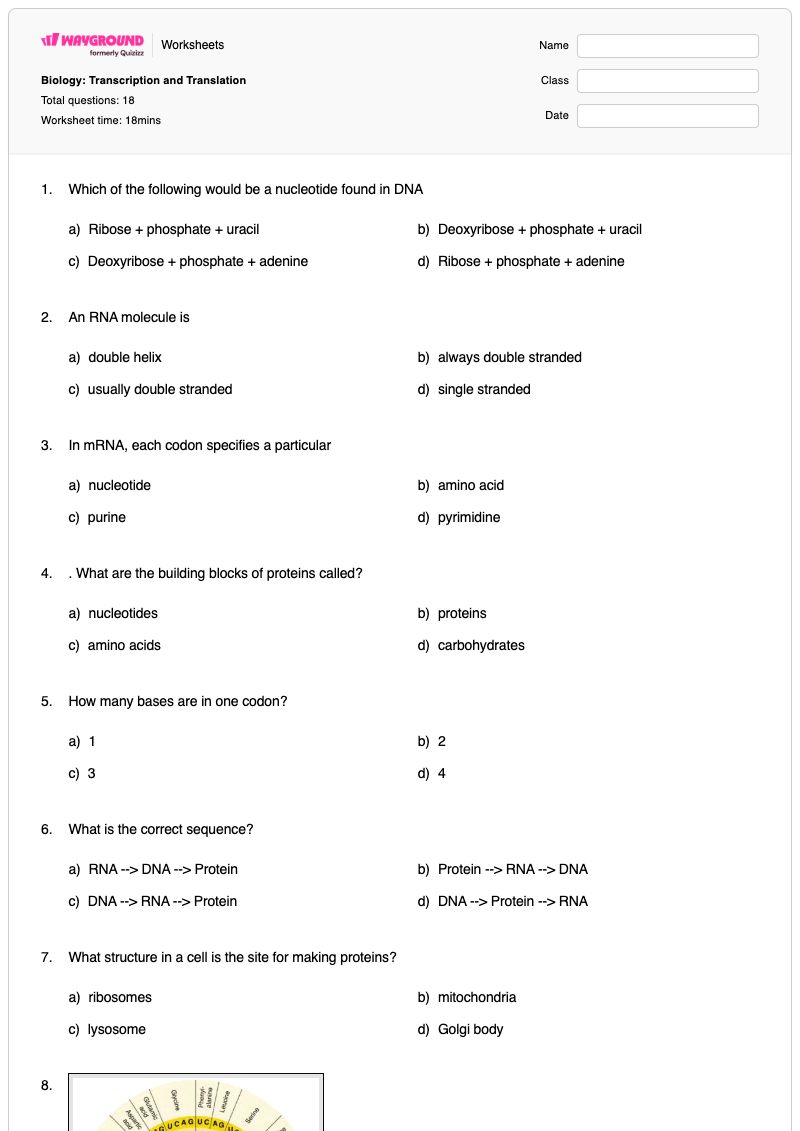

WorksheetsBiology: Transcription and Translation
Total questions: 18
Answer KeyBiology: Transcription and Translation
Total questions: 18
amino acids
transcription
transcription and translation
AUG CAA UGA

18 questions
9th - 12th Grade
Biology
Biology: Transcription and Translation is a Grade 9–12 worksheet that checks students’ understanding of how genetic information moves from DNA to RNA to protein. Its 18 multiple-choice questions cover DNA and RNA nucleotide components, RNA structure, codons, amino acids, ribosomes, tRNA, and the roles and locations of transcription and translation. Students also identify complementary RNA bases and determine how many amino acids are represented by a nucleotide sequence. This free printable worksheet helps students connect key vocabulary and processes within protein synthesis rather than memorizing isolated definitions. It is useful for introducing the central dogma, reviewing transcription and translation after instruction, or checking whether students can apply codon and base-pairing knowledge to short sequences. A complete answer key is included for efficient review and grading.
Worksheet settings
Font size
Worksheets
Answer Keyamino acids
transcription
transcription and translation
AUG CAA UGA
This 18-question multiple-choice worksheet covers how DNA is transcribed into mRNA and how mRNA is translated into a protein. Students identify nucleotide components, codon length and meaning, amino acids, ribosomes, tRNA, the locations of transcription and translation, and complementary RNA bases in a sequence. These items build understanding of the DNA → RNA → protein pathway and the molecular roles within it.
Use the worksheet after introducing DNA, RNA, codons, and amino acids so students can connect the vocabulary to the protein-synthesis sequence. Have students explain why each answer fits, especially for items about transcription versus translation, the role of tRNA, and RNA base pairing. For the sequence questions, model reading a codon as three bases and then ask students to describe how codons determine amino acids.
Students may confuse deoxyribose with ribose, select uracil as a DNA base, or treat RNA as double stranded. Watch for reversals between transcription and translation, such as identifying transcription as the process that assembles amino acids or placing transcription at the ribosome instead of the nucleus. In the sequence items, students may pair DNA bases directly with DNA bases, overlook that a codon has three bases, or count nucleotides rather than codons when determining the number of amino acids.
Wayground provides this worksheet as a printable PDF and as a digital quiz, with a complete answer key for all 18 multiple-choice questions. Assign the PDF for written practice or use the digital quiz for online responses and grading. Printable submissions can also be graded by scanning student work with the Wayground for Teachers app.
Use the worksheet’s Advanced Settings to adjust font spacing or increase the font size so the multiple-choice options and nucleotide sequences are easier to read. You can also apply a dyslexia-friendly font or translate the worksheet into another language. These changes can make the codon, base-pairing, and protein-synthesis questions more accessible without changing the practice content.
Wayground offers a broad collection of free printable worksheets and practice problems across subjects, with downloadable PDFs and answer keys to support essential skills and concepts. Browse more resources at https://wayground.com/en-us/worksheets.