

Wayground
U6 CP DNA to RNA to Proteins - Printable Biology Worksheets - Wayground

U6 CP DNA to RNA to Proteins

19 questions

9th - 9th Grade

Biology

U6 CP DNA to RNA to Proteins is a Grade 9 biology worksheet that traces how genetic information is copied and expressed. Across 19 items, students match DNA replication enzymes and strand processes, sequence the steps of replication, identify chromosome structure, and connect transcription and translation vocabulary such as mRNA, tRNA, rRNA, promoters, templates, codons, and anticodons. They also apply base-pairing rules to DNA and mRNA sequences. The worksheet extends this work into mutation analysis. Students identify point and chromosomal mutation types, then match substitutions, insertions, and deletions with effects such as silent, missense, nonsense, and frameshift changes. With 15 matching items, two drag-and-drop sequencing or completion items, and two multiple-choice questions, it provides focused practice in interpreting molecular biology relationships rather than recalling isolated definitions. This free printable worksheet includes a complete answer key and is designed for Grade 9 biology review, guided practice, or assessment.

Worksheet settings

Font size

S
M
L
XL
Worksheets

U6 CP DNA to RNA to Proteins

Total questions: 19

Name
Class
Date
1.
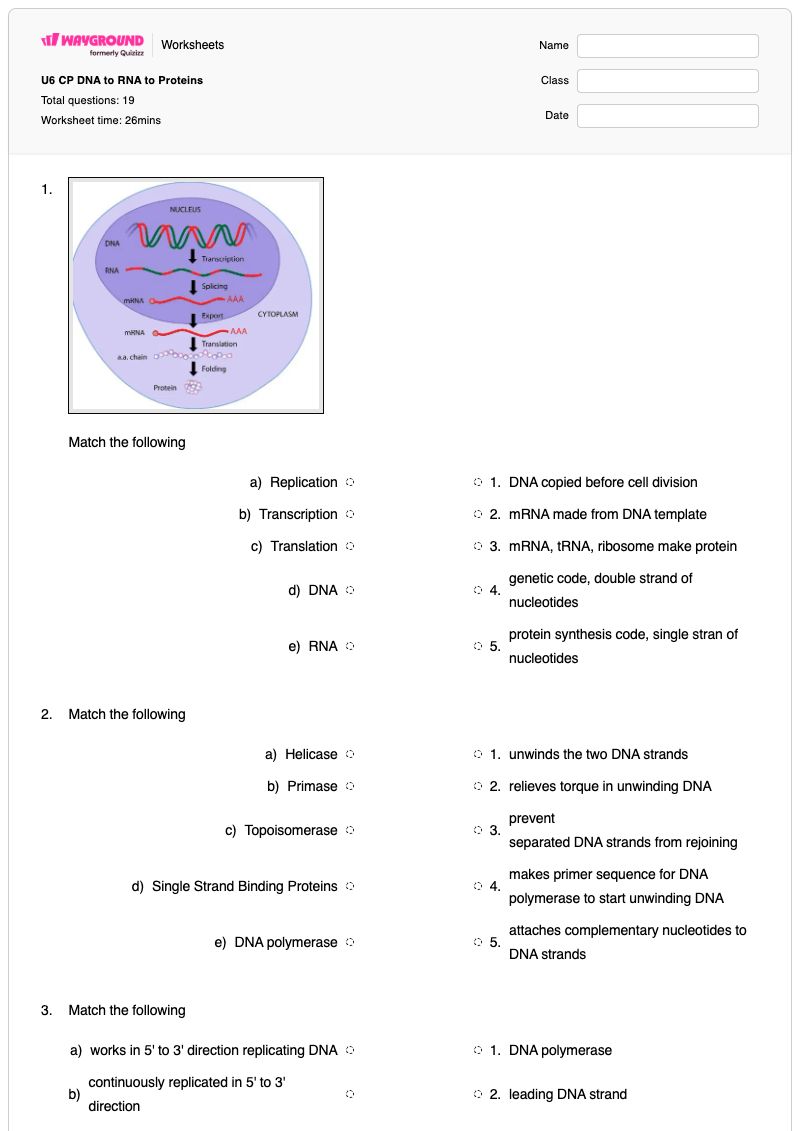
Question Image

Match the following

Replication

DNA copied before cell division

Transcription

mRNA made from DNA template

Translation

mRNA, tRNA, ribosome make protein

DNA

genetic code, double strand of nucleotides

RNA

protein synthesis code, single stran of nucleotides

2.

Match the following

Helicase

unwinds the two DNA strands

Primase

relieves torque in unwinding DNA

Topoisomerase

prevent

separated DNA strands from rejoining

Single Strand Binding Proteins

makes primer sequence for DNA polymerase to start unwinding DNA

DNA polymerase

attaches complementary nucleotides to DNA strands

3.

Match the following

works in 5' to 3' direction replicating DNA

DNA polymerase

continuously replicated in 5' to 3' direction

leading DNA strand

replicated in sections in 3' to 5' direction

lagging DNA strand

sections of lagging DNA strand

Okazaki fragments

joins DNA strands

ligase

4.

1st:​ ​ ​ (a)   2nd:​ ​ (b)   3rd:​ (c)   ​ 4th ​​ (d)   5th​ (e)  

Choose from the below words
helicase unwinds the helix
SSB proteins prevent joining
Primase makes primer/starting point
Polymerase assembles new DNA strand
ligase seals segments
5.

​ (a)   are made of ​ (b)   tightly wrapped around proteins called ​ (c)   forming a nucleosome. Chromosomes are only visible during ​ (d)   and are decondensed inside the ​ (e)   for most of the cell cycle.

Choose from the below words
Chromosomes
DNA
histones
cell replication
nucleus
6.
Question Image

Match the following

RNA Transcription

DNA to mRNA

RNA Translation

mRNA code builds protein

mRNA

carries code from DNA in nucleus to ribosome

tRNA

brings amino acid to mRNA

rRNA

part of ribosomal structure

7.

Match the following

promoter

DNA location where RNA polymerase starts transcription

template

3' to 5' strand that is transcribed

non-template

5' to 3' strand, not transcribed

Initiation

Elongation

Termination

sequence of transcription & translation

introns removed and exons spliced together

mRNA processing before leaves nucleus

8.

DNA is replicated semi-conservatively so a new strand pairs with each original strand. Which nucleotide base pairs with which? (DNA to DNA)

Adenine

Thymine

T

A

Guanine

Cytosine

G

C

9.

mRNA is a single strand of nucleotides paired with the DNA template strand. Which mRNA base pairs with which DNA base?

DNA

Adenine

RNA

Uracil

DNA

Thymine

RNA

Adenine

DNA

Cytosine

RNA

Guanine

DNA

Guanine

RNA

Cytosine

10.

Match the mRNA to the DNA

DNA = ATG

UAC

DNA = GAG

CUC

DNA = ACA

UGU

DNA = ACG

UGC

11.

Match the tRNA anticodon to the mRNA codon

AUG

UAC

ACU

UGA

AGC

UCG

UAG

AUC

12.
Question Image

Match the amino acid to the mRNA codon to make a polypeptide chain for a protein. (WE DON"' USE tRNA anticodons!!!)

AUG

methionine (start)

ACU

threonine

AGU

serine

UAG

stop

13.

Point mutations involve 1 nucleotide.

The wild type/normal strand is above and the strand with mutation is below.

Compare the base sequences and identify the type of point mutation.

…TAGCCAGATA…

…TAGCGCAGATA…

insertion

TAGCCAGATA…

…TAGCAGATA…

deletion

…TAGCCAGATA…

…TAGCCAGTTA…

substitution

14.

Match the following chromosomal mutations.

deletion - piece removed

amplification - piece duplicated

inversion - piece flipped

insertion - piece added to different chromosome

translocation - 2 pieces swapped between chromosomes

15.

Match the following mutations with their effect.

silent

(substitution)

different codon is for same amino acid, so no effect

missense

(substitution)

different codon changes amino acid, so some effect

nonsense

(substitution)

different codon causes early STOP, so polypeptide cut short

insertion

(frameshift)

extra codon alters subsequent 3-code sequences, so different chain produced

deletion

(frameshift)

deleted codon alters subsequent 3-code sequencesso different chain produced

16.
Question Image

Match the following

A

Parent

B

helicase

C

single strand binding proteins

D

DNA polymerase

F

leading strand

17.
Question Image

Match the following

E

primase

G

DNA polymerase

(on left side of image)

H

Okazaki fragment

I

DNA polymerase

(on right side of image)

J

ligase

18.

What can we do to avoid developing genetic mutations?

a)

protect our cells from UV radiation

b)

eat a healthy diet with antioxidants

c)

avoid mutagenic chemicals & ion radiation

d)

all these answers are correct

19.

Why are developing babies and young children more at risk from exposure to mutagens?

a)

because they have a high rate of DNA replication during development

b)

because they are small in size

c)

because they don't understand danger

Answer Key

U6 CP DNA to RNA to Proteins

Total questions: 19

1.

Replication

 - 

DNA copied before cell division

, 

Transcription

 - 

mRNA made from DNA template

, 

Translation

 - 

mRNA, tRNA, ribosome make protein

, 

DNA

 - 

genetic code, double strand of nucleotides

, 

RNA

 - 

protein synthesis code, single stran of nucleotides

2.

Helicase

 - 

unwinds the two DNA strands

, 

Topoisomerase

 - 

relieves torque in unwinding DNA

, 

Single Strand Binding Proteins

 - 

prevent

separated DNA strands from rejoining

, 

Primase

 - 

makes primer sequence for DNA polymerase to start unwinding DNA

, 

DNA polymerase

 - 

attaches complementary nucleotides to DNA strands

3.

works in 5' to 3' direction replicating DNA

 - 

DNA polymerase

, 

continuously replicated in 5' to 3' direction

 - 

leading DNA strand

, 

replicated in sections in 3' to 5' direction

 - 

lagging DNA strand

, 

sections of lagging DNA strand

 - 

Okazaki fragments

, 

joins DNA strands

 - 

ligase

4.
helicase unwinds the helix, SSB proteins prevent joining, Primase makes primer/starting point, Polymerase assembles new DNA strand, ligase seals segments
5.
Chromosomes, DNA, histones, cell replication, nucleus
6.

RNA Transcription

 - 

DNA to mRNA

, 

RNA Translation

 - 

mRNA code builds protein

, 

mRNA

 - 

carries code from DNA in nucleus to ribosome

, 

tRNA

 - 

brings amino acid to mRNA

, 

rRNA

 - 

part of ribosomal structure

7.

promoter

 - 

DNA location where RNA polymerase starts transcription

, 

template

 - 

3' to 5' strand that is transcribed

, 

non-template

 - 

5' to 3' strand, not transcribed

, 

Initiation

Elongation

Termination

 - 

sequence of transcription & translation

, 

introns removed and exons spliced together

 - 

mRNA processing before leaves nucleus

8.

Adenine

 - 

Thymine

, 

T

 - 

A

, 

Guanine

 - 

Cytosine

, 

G

 - 

C

9.

DNA

Adenine

 - 

RNA

Uracil

, 

DNA

Thymine

 - 

RNA

Adenine

, 

DNA

Cytosine

 - 

RNA

Guanine

, 

DNA

Guanine

 - 

RNA

Cytosine

10.

DNA = ATG

 - 

UAC

, 

DNA = GAG

 - 

CUC

, 

DNA = ACA

 - 

UGU

, 

DNA = ACG

 - 

UGC

11.

AUG

 - 

UAC

, 

ACU

 - 

UGA

, 

AGC

 - 

UCG

, 

UAG

 - 

AUC

12.

AUG

 - 

methionine (start)

, 

ACU

 - 

threonine

, 

AGU

 - 

serine

, 

UAG

 - 

stop

13.

…TAGCCAGATA…

…TAGCGCAGATA…

 - 

insertion

, 

TAGCCAGATA…

…TAGCAGATA…

 - 

deletion

, 

…TAGCCAGATA…

…TAGCCAGTTA…

 - 

substitution

14.
 - 

deletion - piece removed

,  - 

amplification - piece duplicated

,  - 

inversion - piece flipped

,  - 

insertion - piece added to different chromosome

,  - 

translocation - 2 pieces swapped between chromosomes

15.

silent

(substitution)

 - 

different codon is for same amino acid, so no effect

, 

missense

(substitution)

 - 

different codon changes amino acid, so some effect

, 

nonsense

(substitution)

 - 

different codon causes early STOP, so polypeptide cut short

, 

insertion

(frameshift)

 - 

extra codon alters subsequent 3-code sequences, so different chain produced

, 

deletion

(frameshift)

 - 

deleted codon alters subsequent 3-code sequencesso different chain produced

16.

A

 - 

Parent

, 

B

 - 

helicase

, 

C

 - 

single strand binding proteins

, 

D

 - 

DNA polymerase

, 

F

 - 

leading strand

17.

E

 - 

primase

, 

G

 - 

DNA polymerase

(on left side of image)

, 

H

 - 

Okazaki fragment

, 

I

 - 

DNA polymerase

(on right side of image)

, 

J

 - 

ligase

18.
d)

all these answers are correct

19.
a)

because they have a high rate of DNA replication during development

FAQs

What does the U6 CP DNA to RNA to Proteins worksheet cover?

This Grade 9 biology worksheet uses matching, drag-and-drop, and multiple-choice items to practise DNA replication, transcription, translation, and mutation analysis. Students organize replication steps, distinguish DNA and RNA roles, apply DNA-to-DNA and DNA-to-mRNA base pairing, match codons and anticodons, and classify mutation types and effects.

How can I use this worksheet to teach DNA replication and protein synthesis?

Use the matching items to introduce key vocabulary and enzyme roles, then have students sequence the drag-and-drop replication steps before moving to transcription and translation. Model one DNA-template-to-mRNA example and one codon-to-amino-acid example, asking students to explain whether they are working with DNA, mRNA, or tRNA. Finish with the mutation items so students connect sequence changes to possible effects.

What mistakes should I watch for when students complete this DNA to RNA to Proteins worksheet?

Watch for students reversing the order of the replication enzymes or confusing the continuous and section-based replication descriptions. In the base-pairing items, students may use DNA pairing rules when converting DNA to mRNA, or confuse an mRNA codon with a tRNA anticodon. They may also classify every substitution the same way instead of distinguishing silent, missense, and nonsense effects from insertion and deletion frameshifts.

How do I assign and grade this DNA replication and protein synthesis worksheet?

Wayground provides this worksheet as a printable PDF and as a digital quiz, with a complete answer key for all 19 items. You can print it for written practice or assign the digital version, and printable submissions can be graded by scanning student work with the Wayground for Teachers app. The printable format can also support schools that are reducing screen time.

What mutation skills does this worksheet assess?

The mutation section asks students to compare altered nucleotide sequences, identify point and chromosomal mutation types, and connect substitutions, insertions, and deletions with their effects. This gives students practice distinguishing mutation categories from the molecular consequences those changes can have, rather than simply memorizing mutation terms.

Where can I find more worksheets like this on Wayground?

Wayground offers a broad collection of free printable worksheets and practice problems across subjects, with downloadable PDFs and answer keys to support essential skills and concepts. Browse more resources at https://wayground.com/en-us/worksheets.