
Wayground
Tree Diagrams, Compound Events and Outcomes - Printable Mathematics Worksheets year 7 - Wayground

Tree Diagrams, Compound Events and Outcomes

21 questions

7th - 7th Grade

Mathematics

Tree Diagrams, Compound Events and Outcomes is a Grade 7 mathematics worksheet with 21 multiple-choice questions. It helps students identify tree diagrams, list sample spaces, count outcomes for combined choices such as clothing or food-and-drink selections, and determine the total outcomes produced by experiments involving dice, coins, colors, and categories. Students also apply outcome counts to probability situations. The worksheet includes questions on compound probabilities, including selections with and without replacement, as well as identifying whether events are independent or dependent. Students must interpret ordered outcomes, calculate probabilities for sequential selections, and distinguish when replacing an item keeps events independent. This free printable worksheet is suitable for guided practice, independent review, or formative assessment, and it includes a complete answer key for checking student work.

Worksheet settings

Font size

S
M
L
XL
Worksheets

Tree Diagrams, Compound Events and Outcomes

Total questions: 21

Name
Class
Date
1.
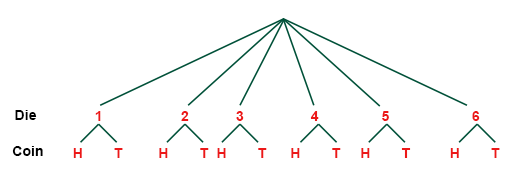
The tree diagram shows the outcomes of rolling a die and flipping a coin.  
How many total outcomes are there?  
a)
6
b)
12
c)
24
d)
36
2.

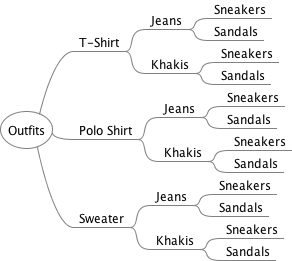
You have a 3 tops, 2 pants and 2 shoes. How many total outfit options are represented?

a)

12 outfits

b)

22 outfits

c)

3 outfits

d)

7 outfits

3.
The cafeteria is serving three kinds of sandwiches:  tuna (T), chicken, (C), and peanut butter (P).  They are also serving a choice of two drinks:  milk (M) or water (W).  Which shows the complete set of possible combinations?
a)
TW, CW, PW
b)
TW, TM, TC, CW, PW
c)
TW, TM, CW, CM, PW, PM
d)
TCP, MW
4.

A Tree Diagram is

a)

A written list of all possible outcomes

b)

A description of all possible outcomes

c)

A drawing with branches of all possible outcomes

5.

A tree diagram is useful in determining the __________of a probability experiment.

a)

result

b)

possible outcomes

c)

event

d)

none of the above

6.

What is the sample space when you roll a die and then flip a coin?

a)

1H, 2H, 3H, 4H, 5H, 6H, 1T, 2T, 3T, 4T, 5T, 6T

b)

2

c)

1,2,3,4,5,6,H,T

7.
A box contains 5 purple marbles, 3 green marbles and 2 orange marbles. Draws are made without replacement. P(orange,green)
a)
1/15
b)
2/15
c)
3/31
d)
1/5
8.
A jar contains 4 white chips, 5 purple chips, and 1 black chip. Chips are selected randomly one at a time, and are not replaced. P(purple then black)
a)
1/18
b)
2/5
c)
3/7
d)
4/9
9.
Bag A contains 9 red marbles and 3 green marbles. Bag B contains 9 black marbles and 6 orange marbles. Find the probability of selecting one green marble from bag A and one black marble from bag B.  P(green, black)
a)
3/20
b)
1/4
c)
3/31
d)
2/27
10.
A basket contains four apples and six peaches. You randomly select one piece of fruit and eat it. Then you randomly select another piece of fruit. Both pieces of fruit are apples. P(apple, apple)
a)
2/15
b)
3/17
c)
1/19
d)
6/21
11.
a)
1/4
b)
1/8
c)
1/2
d)
1/6
12.
a)
1/2
b)
1/8
c)
1/3
d)
1/12
13.
a)
1/8
b)
1/2
c)
1/24
d)
1/16
14.
What is the total number of outcomes for picking a cat or dog and choosing the colors black, brown or spotted?
a)
2
b)
4
c)
6
d)
8
15.

You draw a marble from a bag that has 4 red, 2 blue, and 3 green, you also flip a fair coin. What is the probability you will draw a blue marble and flip a heads?

a)

1/9

b)

3/9

c)

3/6

d)

5/6

16.

Determine if the events are independent or dependent.

a)

Independent

b)

Dependent

17.

Determine if the events are independent or dependent.

a)

Independent

b)

Dependent

18.
Is the event INDEPENDENT or DEPENDENT?
You have a jar with 24 pieces of chocolate candy and 14 pieces of orange candy.  We take one piece of candy at random from the jar, put it back, and then take a second piece of candy at random from the jar.
a)
Independent
b)
Dependent
19.

Is the event INDEPENDENT or DEPENDENT?

Amy plays card games. She picks a card at random. Then without putting the first card back, she picks a second card at random.

a)

Independent

b)

Dependent

20.
Is the event INDEPENDENT or DEPENDENT?
The spinner is spun twice.  What is the probability that it lands on red first and then blue?
a)
Independent
b)
Dependent
21.

Which event is not a dependent event?

a)

Picking 2 students to be the line leader and the door holder from a group of 20 students

b)

Picking 2 marbles from a bag without replacing the first marble

c)

Picking 2 crayons from a box without putting any back

d)

Picking an earring, replacing it, then picking a 2nd earring

Answer Key

Tree Diagrams, Compound Events and Outcomes

Total questions: 21

1.
b) 12
2.
a)

12 outfits

3.
c) TW, TM, CW, CM, PW, PM
4.
c)

A drawing with branches of all possible outcomes

5.
b)

possible outcomes

6.
a)

1H, 2H, 3H, 4H, 5H, 6H, 1T, 2T, 3T, 4T, 5T, 6T

7.
a) 1/15
8.
a) 1/18
9.
a) 3/20
10.
a) 2/15
11.
b) 1/8
12.
d) 1/12
13.
d) 1/16
14.
c) 6
15.
a)

1/9

16.
a)

Independent

17.
b)

Dependent

18.
a) Independent
19.
b)

Dependent

20.
a) Independent
21.
d)

Picking an earring, replacing it, then picking a 2nd earring

FAQs

What does the Tree Diagrams, Compound Events and Outcomes worksheet cover?

This Grade 7 mathematics worksheet uses 21 multiple-choice questions to build students’ ability to represent compound events with tree diagrams, list complete sample spaces, and count possible outcomes. It also asks students to calculate probabilities for combined and sequential events, including selections with and without replacement, and classify events as independent or dependent.

How can I use this worksheet to teach tree diagrams and compound-event probability?

Introduce the worksheet by modeling one experiment, such as rolling a die and flipping a coin, and show how each branch creates an ordered outcome in the sample space. Then have students use the multiple-choice items to move from counting combinations, such as outfits or sandwich-and-drink choices, to calculating sequential probabilities and deciding whether replacement changes event dependence. Ask students to explain why every outcome must be included before they select an answer.

What mistakes should I watch for when students complete this worksheet?

Students may count only the first event instead of combining both stages, omit ordered outcomes such as 1H and 1T, or choose an incomplete sample space. In probability items, watch for students using the original total after an item is not replaced, multiplying incorrectly across separate bags, or labeling a with-replacement selection as dependent. They may also confuse a tree diagram with a written list rather than recognizing it as a branch-based representation.

How do I assign and grade this Tree Diagrams, Compound Events and Outcomes worksheet?

The worksheet is available as a printable PDF and as a digital quiz on Wayground, so you can use the 21 multiple-choice questions for paper practice or online assessment. It includes a complete answer key for grading responses, and printable submissions can be graded by scanning student work with the Wayground for Teachers app. The printable option can also support schools that are reducing screen time.

How can I differentiate this tree diagrams and probability worksheet for my students?

In the worksheet’s Advanced Settings, adjust font spacing or increase the font size so the multiple-choice options, probability notation, and outcome lists are easier to follow. You can also select a dyslexia-friendly font or translate the worksheet into another language. These changes apply to the worksheet file while preserving its tree-diagram, sample-space, and compound-probability question format.

Where can I find more worksheets like this on Wayground?

Wayground offers a comprehensive collection of free printable worksheets and practice problems across all subjects, with downloadable PDFs and answer keys to support mastery of essential skills and concepts. Browse more resources at https://wayground.com/en-us/worksheets.