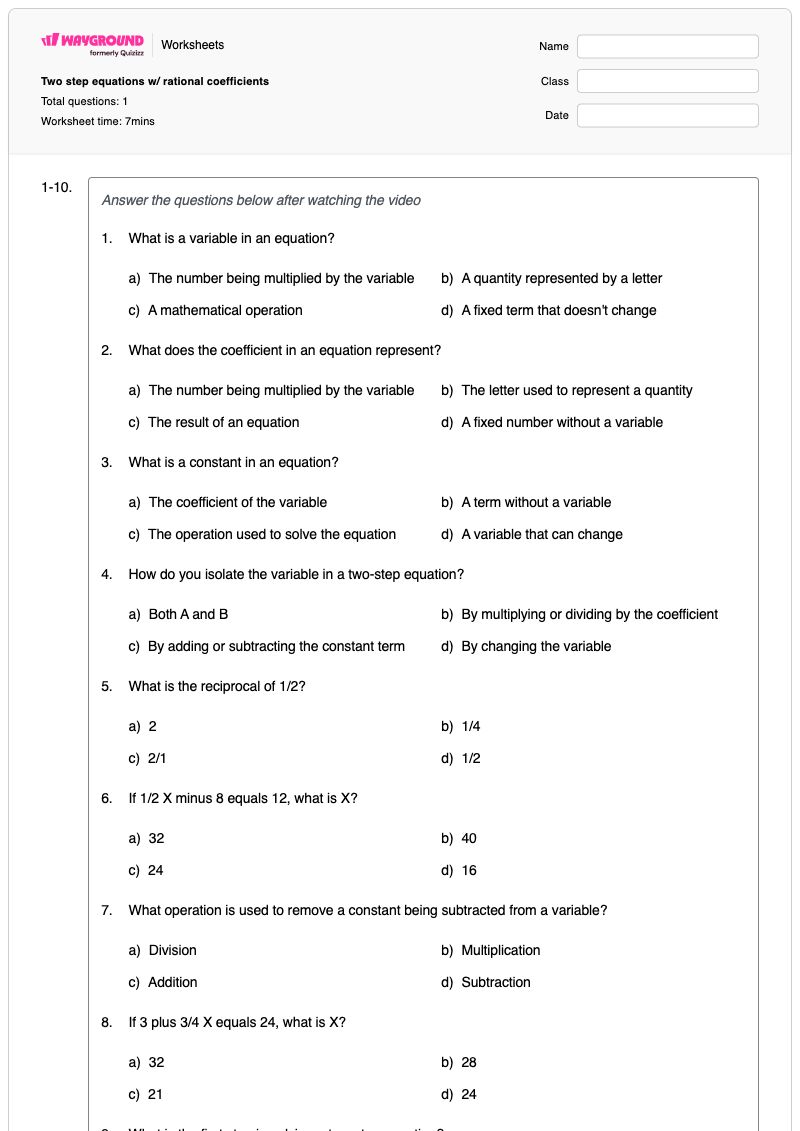
Two step equations w/ rational coefficients is a Grade 7 mathematics worksheet that builds foundational skill with two-step equations involving fractional coefficients. Students identify variables, coefficients, and constants; recognize reciprocals; choose the inverse operation needed to remove a constant; and determine the first step for isolating a variable. The worksheet includes one comprehension-video item and 10 multiple-choice questions, including equations such as 1/2x − 8 = 12 and 3 + 3/4x = 24.
The questions move from vocabulary and solving procedures to applying those procedures and interpreting a variable in a simple cost context. Students use multiplication or division to remove a rational coefficient and select solutions to equations, reinforcing how inverse operations work together in a two-step process. This free printable worksheet includes a complete answer key and can support guided practice, independent review, or a quick formative check of Grade 7 equation-solving readiness.
Worksheet settings
Font size
S
M
L
XL
Worksheets
Two step equations w/ rational coefficients
Total questions: 1
Name
Class
Date
1-10.
Answer the questions below after watching the video
1.
What is a variable in an equation?
a)
The number being multiplied by the variable
b)
A quantity represented by a letter
c)
A mathematical operation
d)
A fixed term that doesn't change
2.
What does the coefficient in an equation represent?
a)
The number being multiplied by the variable
b)
The letter used to represent a quantity
c)
The result of an equation
d)
A fixed number without a variable
3.
What is a constant in an equation?
a)
The coefficient of the variable
b)
A term without a variable
c)
The operation used to solve the equation
d)
A variable that can change
4.
How do you isolate the variable in a two-step equation?
a)
Both A and B
b)
By multiplying or dividing by the coefficient
c)
By adding or subtracting the constant term
d)
By changing the variable
5.
What is the reciprocal of 1/2?
a)
2
b)
1/4
c)
2/1
d)
1/2
6.
If 1/2 X minus 8 equals 12, what is X?
a)
32
b)
40
c)
24
d)
16
7.
What operation is used to remove a constant being subtracted from a variable?
a)
Division
b)
Multiplication
c)
Addition
d)
Subtraction
8.
If 3 plus 3/4 X equals 24, what is X?
a)
32
b)
28
c)
21
d)
24
9.
What is the first step in solving a two-step equation?
a)
Simplify the equation
b)
Remove the coefficient
c)
Remove the constant term
d)
Isolate the variable
10.
In the equation 5D + 5.75 = 20.75, what does D represent?
a)
The total cost
b)
The cost of one drink
c)
The cost of popcorn
d)
The number of drinks
Answer Key
Two step equations w/ rational coefficients
Total questions: 1
1-10.
1.
b)
A quantity represented by a letter
2.
a)
The number being multiplied by the variable
3.
b)
A term without a variable
4.
a)
Both A and B
5.
a)
2
6.
b)
40
7.
c)
Addition
8.
b)
28
9.
c)
Remove the constant term
10.
b)
The cost of one drink
140 %
Browse by subjects
Browse by grades
Browse by format
FAQs
What does this worksheet cover, and how does it help students solve two-step equations with rational coefficients?
This Grade 7 worksheet uses one comprehension-video item and 10 multiple-choice questions to develop two-step equation skills with fractional coefficients. Students identify variables, coefficients, and constants, find reciprocals, choose inverse operations, and solve equations such as 1/2x − 8 = 12 and 3 + 3/4x = 24. The items connect equation vocabulary to the steps needed to isolate the variable.
How can I use this worksheet to teach solving two-step equations with rational coefficients?
Begin by reviewing the worksheet’s vocabulary items for variable, coefficient, and constant, then model removing the constant before undoing the rational coefficient. Use the reciprocal question to connect division by a fraction with multiplication by its reciprocal, and have students explain why addition removes a subtracted constant. Finish with the equation and cost-context questions so students apply the procedure and interpret what the variable represents.
What mistakes should I watch for when students complete this two-step equations worksheet?
Watch for students confusing a coefficient with a constant or treating the variable as an operation rather than a quantity represented by a letter. In the equation items, students may remove the coefficient before the constant, use subtraction to undo a subtraction, or apply the wrong reciprocal when working with 1/2 and 3/4. The cost-context item also checks whether students understand that D represents the cost of one drink, not the total cost or number of drinks.
How do I assign and grade this worksheet?
You can assign this worksheet as a printable PDF or as a digital quiz on Wayground. It includes a complete answer key for the comprehension-video item and the 10 multiple-choice questions, and printable student work can be graded by scanning it with the Wayground for Teachers app. The PDF option also supports classrooms that are reducing screen time.
How can I differentiate this worksheet for my students?
Use the worksheet’s Advanced Settings to adjust font size or spacing so the vocabulary and equation choices are easier to read. You can also enable a dyslexia-friendly font for the multiple-choice items or translate the worksheet into another language for students who need language support. These adjustments apply to the worksheet file while preserving its focus on two-step equations with rational coefficients.
Where can I find more worksheets like this on Wayground?
Wayground offers a broad collection of free printable worksheets and practice problems across subjects, with downloadable PDFs and answer keys to help students master essential skills and concepts. Browse more resources at https://wayground.com/en-us/worksheets.


 Worksheets