Chem Unit ??? LO #? Measurements and Conversion Factors
12 questions
9th - 12th Grade
Science
Chem Unit ??? LO #? Measurements and Conversion Factors is a free printable science worksheet for Grades 9–12. It includes 12 questions—11 multiple-choice items and one multiple-select item—that build students’ understanding of conversion factors, metric and SI units, and the relationships needed to convert measurements such as hours to minutes, centimeters to meters, milliliters to liters, grams to kilograms, yards to feet, and yards to meters.
Students identify appropriate conversion factors and conversion setups, distinguish SI units for mass, volume, and length, recognize the metric system as a base-10 measurement system, and define a conversion factor as a ratio used to change units. The worksheet is useful for introducing or reviewing dimensional-analysis concepts before students perform more extended calculations. It is available as a free printable worksheet with a complete answer key for efficient checking.
Worksheet settings
Font size
S
M
L
XL
Worksheets
Chem Unit ??? LO #? Measurements and Conversion Factors
Total questions: 12
Name
Class
Date
1.
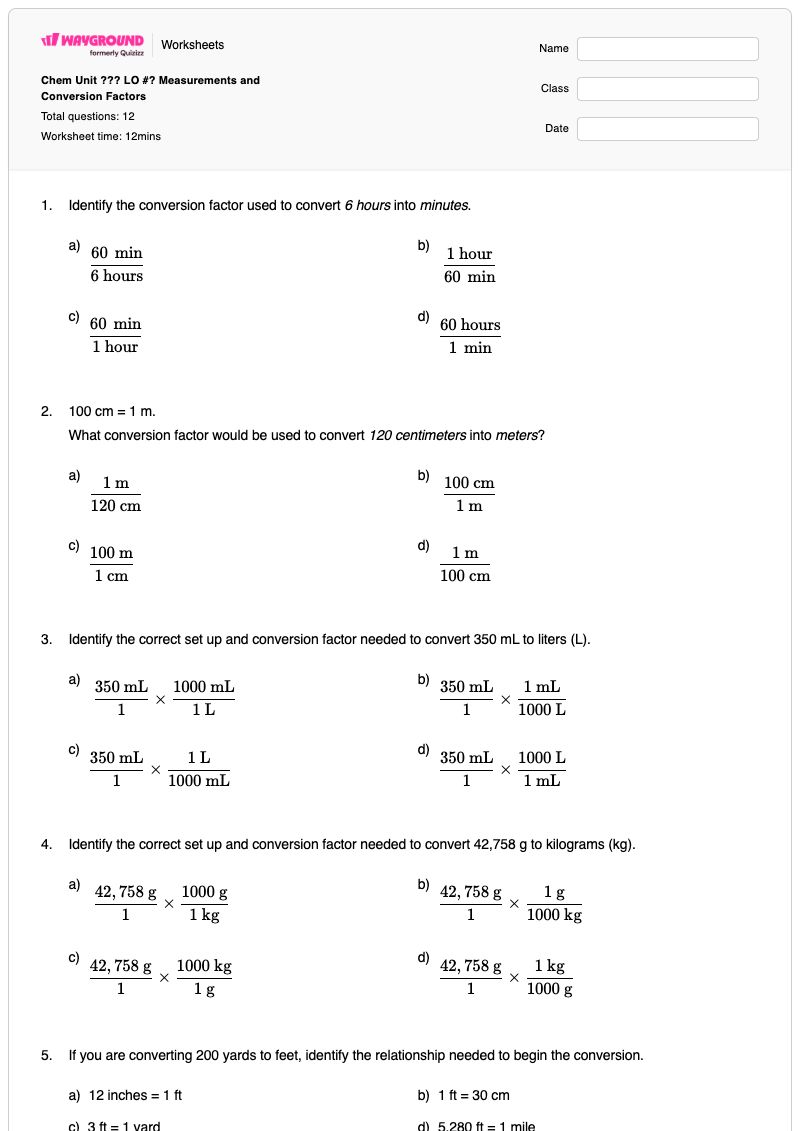
Identify the conversion factor used to convert 6 hours into minutes.
a)
6hours60min
b)
60min1hour
c)
1hour60min
d)
1min60hours
2.
100 cm = 1 m.
What conversion factor would be used to convert 120 centimeters into meters?
a)
120cm1m
b)
1m100cm
c)
1cm100m
d)
100cm1m
3.
Identify the correct set up and conversion factor needed to convert 350 mL to liters (L).
a)
1350mL×1L1000mL
b)
1350mL×1000L1mL
c)
1350mL×1000mL1L
d)
1350mL×1mL1000L
4.
Identify the correct set up and conversion factor needed to convert 42,758 g to kilograms (kg).
a)
142,758g×1kg1000g
b)
142,758g×1000kg1g
c)
142,758g×1g1000kg
d)
142,758g×1000g1kg
5.
If you are converting 200 yards to feet, identify the relationship needed to begin the conversion.
a)
12 inches = 1 ft
b)
1 ft = 30 cm
c)
3 ft = 1 yard
d)
5,280 ft = 1 mile
6.
If you are converting 4,672 mL to fluid ounces, identify the relationship needed to begin the conversion.
a)
1 L = 1.06 quart
b)
1 L = 0.264 gallons
c)
1 L = 1,000 mL
d)
1 mL = 0.034 fluid ounces
7.
If you are converting 44 yards to meters, identify the relationship needed to begin the conversion.
a)
1 yard = 3 ft
b)
1 cm = 0.39 in
c)
1 mile = 1.61 km
d)
1 m = 1.09 yards
8.
Identify the SI (metric system) unit of measurement for mass.
a)
Grams
b)
Liters
c)
Pounds
d)
Ounces
9.
Identify the SI unit (metric system) of measurement for volume.
a)
Liters
b)
Ounces
c)
Pounds
d)
Cups
10.
Identify the SI unit (metric system) of measurement for length.
a)
Liters
b)
Meters
c)
Pounds
d)
Ounces
11.
Standard measurement system based on the number 10
a)
Metric System
b)
Imperial System of Measurement
c)
Density
d)
Weight
12.
Define: Conversion Factor
a)
A ratio used to convert from one unit of measurement to another.
b)
A ratio used in math that tells you how many "things" you measured.
c)
A ratio that allows you to measure more accurately.
d)
A ratio that tells you how many inches are in one foot.
Answer Key
Chem Unit ??? LO #? Measurements and Conversion Factors
Total questions: 12
1.
c)
1hour60min
2.
d)
100cm1m
3.
c)
1350mL×1000mL1L
4.
d)
142,758g×1000g1kg
5.
c)
3 ft = 1 yard
6.
d)
1 mL = 0.034 fluid ounces
7.
d)
1 m = 1.09 yards
8.
a)
Grams
9.
a)
Liters
10.
b)
Meters
11.
a) Metric System
12.
a)
A ratio used to convert from one unit of measurement to another.
140 %
Browse by subjects
Browse by grades
Browse by format
FAQs
What does this measurements and conversion factors worksheet cover?
This Grade 9–12 science worksheet uses 11 multiple-choice questions and one multiple-select question to practice selecting conversion factors and identifying the correct setup for unit conversions. Students work with relationships such as 100 centimeters = 1 meter, 1,000 milliliters = 1 liter, 3 feet = 1 yard, and 1 meter = 1.09 yards, while also identifying grams, liters, and meters as SI units for mass, volume, and length.
How can I use this worksheet to teach conversion factors and SI units?
Introduce the worksheet by modeling how the starting unit determines the conversion relationship—for example, use 100 centimeters = 1 meter when converting centimeters to meters. Then have students explain why a relationship such as 3 feet = 1 yard is relevant to converting yards to feet, and use the final items to review SI units, the metric system, and the definition of a conversion factor. Discuss each distractor after students respond so they connect the selected relationship to the direction of conversion.
What mistakes should I watch for when students complete this worksheet?
Students may choose a familiar relationship that does not connect the given and target units, such as selecting 1,000 milliliters = 1 liter when the target is fluid ounces. They may also reverse the needed relationship, confuse SI units for mass, volume, and length, or select an imperial unit such as pounds or ounces instead of the metric unit requested. On the multiple-select item, check that students identify the specific relationship that begins the yards-to-feet conversion: 3 feet = 1 yard.
How do I assign and grade this measurements and conversion factors worksheet?
Wayground provides this worksheet as a printable PDF and as a digital quiz, with a complete answer key for checking the 12 responses. You can grade printable submissions by scanning student work with the Wayground for Teachers app, or use the digital quiz to collect responses electronically. The printable format can also support classes or schools that are reducing screen time.
How can I differentiate this worksheet for my students?
In the worksheet’s Advanced Settings, adjust font spacing or choose a larger font size to make the conversion-factor options and SI-unit choices easier to scan. You can also enable a dyslexia-friendly font or translate the worksheet into another language while keeping the measurement-conversion questions and answer choices intact.
Where can I find more worksheets like this on Wayground?
Wayground offers a comprehensive collection of free printable worksheets and practice problems across subjects, with downloadable PDFs and answer keys to help students master essential skills and concepts. Browse more resources at https://wayground.com/en-us/worksheets.

 Worksheets