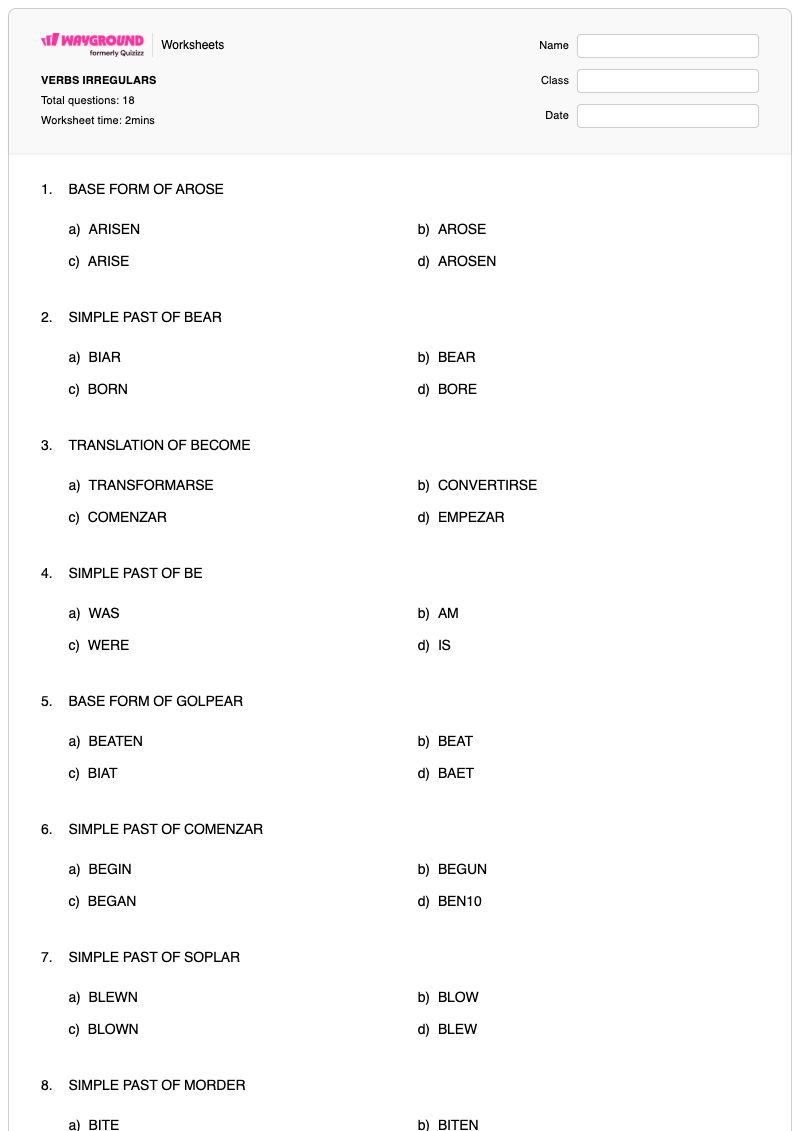
VERBS IRREGULARS is a free printable English worksheet for Grades 6–7 that builds recognition of irregular verb forms. Students work with 18 questions—16 multiple-choice and 2 multiple-select—to identify base forms such as arise, beat, and bleed; choose simple past forms such as bore, began, blew, and brought; and match selected English verbs with their Spanish translations. The multiple-select items require students to recognize more than one correct form, including was/were for be and buy/bought for the related forms of buy.
This worksheet gives students focused practice distinguishing base verbs from simple past verbs instead of relying only on regular -ed patterns. It also checks whether they can connect forms such as bind and bound or bet and bet, where the base and past forms may look similar or identical. Use it for Grade 6 or Grade 7 independent practice, review, or a quick formative check. The worksheet is free to print and includes a complete answer key for efficient checking.
Worksheet settings
Font size
S
M
L
XL
Worksheets
VERBS IRREGULARS
Total questions: 18
Name
Class
Date
1.
BASE FORM OF AROSE
a)
ARISEN
b)
AROSE
c)
ARISE
d)
AROSEN
2.
SIMPLE PAST OF BEAR
a)
BIAR
b)
BEAR
c)
BORN
d)
BORE
3.
TRANSLATION OF BECOME
a)
TRANSFORMARSE
b)
CONVERTIRSE
c)
COMENZAR
d)
EMPEZAR
4.
SIMPLE PAST OF BE
a)
WAS
b)
AM
c)
WERE
d)
IS
5.
BASE FORM OF GOLPEAR
a)
BEATEN
b)
BEAT
c)
BIAT
d)
BAET
6.
SIMPLE PAST OF COMENZAR
a)
BEGIN
b)
BEGUN
c)
BEGAN
d)
BEN10
7.
SIMPLE PAST OF SOPLAR
a)
BLEWN
b)
BLOW
c)
BLOWN
d)
BLEW
8.
SIMPLE PAST OF MORDER
a)
BITE
b)
BITEN
c)
BITTEN
d)
BIT
9.
SIMPLE PAST AND BASE FORM OF COMPRAR
a)
BOUGHTT
b)
BUY
c)
BOUGHT
d)
BUYS
10.
TRANSLATE OF BIND
a)
AMARRAR, UNIR
b)
ATAR, CONSTRUIR
c)
LIGAR, TRAER
d)
QUEMAR, HACER
11.
SIMPLE PAST OF EXPLOTAR
a)
BURST
b)
BURSTS
c)
BURNT
d)
BUILT
12.
BASE FORM AND SIMPLE PAST OF APOSTAR
a)
BLED/BET
b)
BET/BIT
c)
BIT/BIT
d)
BET/BET
13.
BASE FORM OF BLED
a)
BLED
b)
BLEED
c)
BLEW
d)
BLEEW
14.
SIMPLE PAST OF BIND
a)
BOUND
b)
BIND
c)
BINDT
d)
BENT
15.
SIMPLE PAST OF BRING
a)
BRING
b)
BRIND
c)
BROUGHT
d)
BROUTHG
16.
PAST SIMPLE OF BREAK
a)
BROKEN
b)
BROKE
c)
BROK
d)
BREAK
17.
PAST SIMPLE AND BASE FORM OF CONSTRUIR
a)
BUILD / BUILT
b)
BUILT / BOUGHT
c)
BOUND / BUILD
d)
BURST / BUILT
18.
BASE FORM OF BLEW
a)
BLEWN
b)
BLOW
c)
BLEW
d)
BLOWN
Answer Key
VERBS IRREGULARS
Total questions: 18
1.
c)
ARISE
2.
d)
BORE
3.
b)
CONVERTIRSE
4.
a)
WAS
, c)
WERE
5.
b)
BEAT
6.
c)
BEGAN
7.
d)
BLEW
8.
d)
BIT
9.
b)
BUY
, c)
BOUGHT
10.
a)
AMARRAR, UNIR
11.
a)
BURST
12.
d)
BET/BET
13.
b)
BLEED
14.
a)
BOUND
15.
c)
BROUGHT
16.
b)
BROKE
17.
a)
BUILD / BUILT
18.
b)
BLOW
140 %
Browse by subjects
Browse by grades
Browse by format
FAQs
What does the VERBS IRREGULARS worksheet cover?
This Grade 6–7 English worksheet practices identifying irregular verbs in their base and simple past forms, along with translating selected verbs between English and Spanish. Its 18 items use 16 multiple-choice questions and 2 multiple-select questions, including form pairs such as arise/arose, begin/began, bind/bound, and buy/bought. Completing the items helps students distinguish irregular forms and recognize when more than one answer is correct, as with was and were for be.
How can I use this worksheet to teach irregular verb forms?
Introduce a small set of verbs from the worksheet by having students sort examples into base-form and simple-past columns, such as bleed/bled and bring/brought. Then have students complete the multiple-choice items and pause at the multiple-select questions to discuss why both was and were, or both buy and bought, are required. Use the Spanish translation items to reinforce the meaning of the verbs while students focus on their English forms.
What mistakes should I watch for on the irregular verbs worksheet?
Watch for students choosing the verb’s base form when a question asks for the simple past, such as selecting bind instead of bound or begin instead of began. Students may also select only one answer on the multiple-select items, missing that be has both was and were or that the worksheet asks for both buy and bought. The translation items may reveal confusion between similar meanings, while distractors such as blown versus blew can indicate confusion between a past form and another verb form.
How do I assign and grade the VERBS IRREGULARS worksheet?
The worksheet is available as a printable PDF and as a digital quiz on Wayground, so you can use the same irregular-verb practice in either format. It includes a complete answer key, and printable submissions can be graded by scanning student work with the Wayground for Teachers app. The printable version also gives schools an option for reducing screen time while students identify base forms, simple past forms, and translations.
How can I differentiate this irregular verbs worksheet for my students?
Use the worksheet’s Advanced Settings to adjust font spacing and font size so the verb-form and translation choices are easier to scan. You can also apply a dyslexia-friendly font or translate the worksheet into another language when appropriate for your learners. These file-level options can make the multiple-choice and multiple-select items more accessible without changing the irregular-verb practice.
Where can I find more worksheets like this on Wayground?
Wayground offers a broad collection of free printable worksheets and practice problems across subjects, with downloadable PDFs and answer keys to help students master essential skills and concepts. Browse more resources at https://wayground.com/en-us/worksheets.

 Worksheets