

Wayground
Identifying Subjects & Verbs Practice - Printable ELA Worksheets year 9 - Wayground

Identifying Subjects & Verbs Practice

Emily Walton

Created by Emily Walton

14 questions

9th - 10th Grade

ELA

Updated Oct 2026

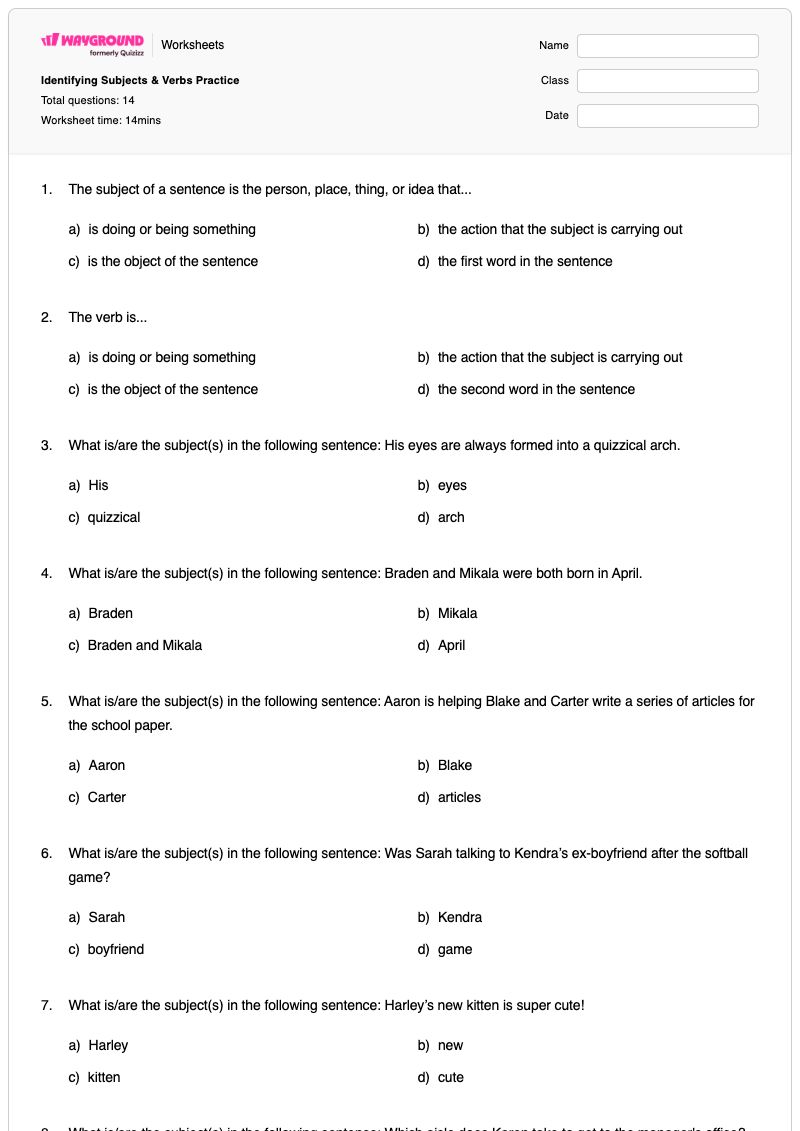
Identifying Subjects & Verbs Practice is a free printable English worksheet for Grades 9–10 that develops sentence-analysis skills. Students begin with multiple-choice questions defining the subject and verb, then identify subjects in six sentences, including compound subjects, possessive phrases, questions, and sentences with objects or prepositional phrases that may distract them. The worksheet includes 14 questions total: 8 multiple choice and 6 multiple select. The final six items ask students to identify helping and action verbs in verb phrases, such as “are formed,” “were born,” “is helping,” and “does take.” This format requires students to select every correct verb label rather than stopping after finding one word. The worksheet is useful for grammar review, independent practice, or a quick formative check of whether students can distinguish subjects from nearby nouns and verbs from distractor words. It is available as a free printable worksheet with a complete answer key.

Worksheet settings

Font size

S
M
L
XL
WaygroundWorksheets

Identifying Subjects & Verbs Practice

Total questions: 14

Name
Class
Date
1.

The subject of a sentence is the person, place, thing, or idea that...

a)

is doing or being something

b)

the action that the subject is carrying out

c)

is the object of the sentence

d)

the first word in the sentence

2.

The verb is...

a)

is doing or being something

b)

the action that the subject is carrying out

c)

is the object of the sentence

d)

the second word in the sentence

3.

What is/are the subject(s) in the following sentence: His eyes are always formed into a quizzical arch.

a)

His

b)

eyes

c)

quizzical

d)

arch

4.

What is/are the subject(s) in the following sentence: Braden and Mikala were both born in April.

a)

Braden

b)

Mikala

c)

Braden and Mikala

d)

April

5.

What is/are the subject(s) in the following sentence: Aaron is helping Blake and Carter write a series of articles for the school paper.

a)

Aaron

b)

Blake

c)

Carter

d)

articles

6.

What is/are the subject(s) in the following sentence: Was Sarah talking to Kendra’s ex-boyfriend after the softball game?

a)

Sarah

b)

Kendra

c)

boyfriend

d)

game

7.

What is/are the subject(s) in the following sentence: Harley’s new kitten is super cute!

a)

Harley

b)

new

c)

kitten

d)

cute

8.

What is/are the subject(s) in the following sentence: Which aisle does Karen take to get to the manager's office?

a)

aisle

b)

Karen

c)

manager's

d)

office

9.

What is/are the verb(s) in the following sentence: His eyes are always formed into a quizzical arch.

a)

Helping: are

b)

Helping: always

c)

Action: always

d)

Action: formed

10.

What is/are the verb(s) in the following sentence: Braden and Mikala were both born in April.

a)

Helping: were

b)

Helping: both

c)

Action: born

d)

Action: in

11.

What is/are the verb(s) in the following sentence: Aaron is helping Blake and Carter write a series of articles for the school paper.

a)

Helping: is

b)

Helping: for

c)

Action: helping

d)

Action: write

12.

What is/are the verb(s) in the following sentence: Was Sarah talking to Kendra’s ex-boyfriend after the softball game?

a)

Helping: Was

b)

Helping: to

c)

Action: talking

d)

Action: after

13.

What is/are the verb(s) in the following sentence: Harley’s new kitten is super cute!

a)

Helping: new

b)

Helping: is

c)

Action: is

d)

Action: super

14.

What is/are the verb(s) in the following sentence: Which aisle does Karen take to get to the manager's office?

a)

Helping: Which

b)

Helping: does

c)

Action: take

d)

Action: get

WaygroundAnswer Key

Identifying Subjects & Verbs Practice

Total questions: 14

1.
a)

is doing or being something

2.
b)

the action that the subject is carrying out

3.
b)

eyes

4.
c)

Braden and Mikala

5.
a)

Aaron

6.
a)

Sarah

7.
c)

kitten

8.
b)

Karen

9.
d)

Action: formed

, a)

Helping: are

10.
a)

Helping: were

, c)

Action: born

11.
c)

Action: helping

, a)

Helping: is

12.
c)

Action: talking

, a)

Helping: Was

13.
b)

Helping: is

14.
b)

Helping: does

, c)

Action: take

FAQs

What does the Identifying Subjects & Verbs Practice worksheet cover?

This Grade 9–10 English worksheet uses 8 multiple-choice and 6 multiple-select questions to help students identify sentence subjects and distinguish helping verbs from action verbs. Students analyze compound subjects such as “Braden and Mikala,” subjects in questions such as “Sarah,” and verb phrases such as “are formed” and “does take.” Selecting all applicable verb labels builds accuracy with multiword verb constructions and common distractors.

How can I use this worksheet to teach students to identify subjects and verbs?

Introduce the worksheet by modeling how to ask who or what the sentence is about, then show how the verb choices may include a helping verb and an action verb. Work through one subject item and one multiple-select verb item aloud, pointing out why words such as “always,” “to,” “after,” or “office” are distractors. Have students explain their choices for the compound subject and question sentences before completing the remaining items independently.

What mistakes should I watch for on this subjects and verbs worksheet?

Students may choose the first noun they see instead of the true subject, such as selecting “His” rather than “eyes” or “Harley” rather than “kitten.” They may also select only one verb in a verb phrase, miss helping verbs such as “are,” “were,” “is,” or “does,” or mistake words such as “always,” “both,” “to,” and “after” for verbs. In multiple-select questions, check that students identify every correct option rather than stopping after one selection.

How do I assign and grade this Identifying Subjects & Verbs worksheet?

Wayground provides this worksheet as a printable PDF and as a digital quiz, with a complete answer key for all 14 questions. You can assign the digital version through Wayground or print copies for students, then grade printable submissions by scanning student work with the Wayground for Teachers app. The printable format can also support schools that are reducing screen time.

How can I differentiate this subjects and verbs worksheet for my students?

Use the worksheet’s Advanced Settings to adjust font spacing and font size so the sentence examples and multiple-select choices are easier to track. You can also enable a dyslexia-friendly font or translate the worksheet into another language when appropriate. These options can make the subject-identification sentences and verb-label choices more accessible without changing the practice target.

Where can I find more worksheets like this on Wayground?

Wayground offers a comprehensive collection of free printable worksheets and practice problems across subjects, with downloadable PDFs and answer keys to help students master essential skills and concepts. Browse more resources at https://wayground.com/en-us/worksheets.