

Wayground
Vowel Consonant E in Multisyllabic Words - Printable English Worksheets kindergarten - Wayground

Vowel Consonant E in Multisyllabic Words

9 questions

5th - 5th Grade

English

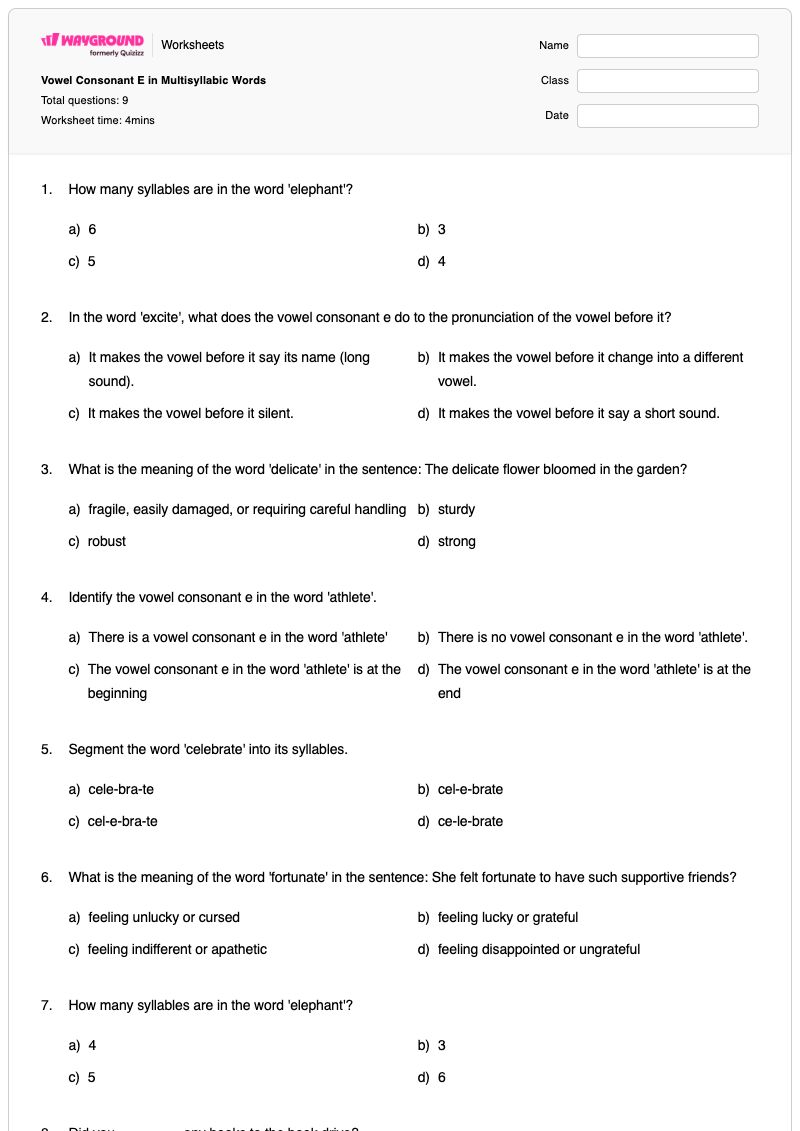
This Grade 5 English worksheet builds understanding of the vowel-consonant-e pattern in multisyllabic words. Across nine multiple-choice questions, students count and segment syllables, identify whether the pattern appears in words such as excite, athlete, and celebrate, and explain how a final e can make the preceding vowel say its long sound. The worksheet also connects word analysis to vocabulary use: students determine the meanings of delicate and fortunate from sentence context and select precise words such as contribute and scraped to complete sentences. It is a free printable worksheet with a complete answer key, suitable for independent practice, small-group instruction, review, or a quick check of students’ ability to analyze multisyllabic words and apply vocabulary in context.

Worksheet settings

Font size

S
M
L
XL
Worksheets

Vowel Consonant E in Multisyllabic Words

Total questions: 9

Name
Class
Date
1.

How many syllables are in the word 'elephant'?

a)

6

b)

3

c)

5

d)

4

2.

In the word 'excite', what does the vowel consonant e do to the pronunciation of the vowel before it?

a)

It makes the vowel before it say its name (long sound).

b)

It makes the vowel before it change into a different vowel.

c)

It makes the vowel before it silent.

d)

It makes the vowel before it say a short sound.

3.

What is the meaning of the word 'delicate' in the sentence: The delicate flower bloomed in the garden?

a)

fragile, easily damaged, or requiring careful handling

b)

sturdy

c)

robust

d)

strong

4.

Identify the vowel consonant e in the word 'athlete'.

a)

There is a vowel consonant e in the word 'athlete'

b)

There is no vowel consonant e in the word 'athlete'.

c)

The vowel consonant e in the word 'athlete' is at the beginning

d)

The vowel consonant e in the word 'athlete' is at the end

5.

Segment the word 'celebrate' into its syllables.

a)

cele-bra-te

b)

cel-e-brate

c)

cel-e-bra-te

d)

ce-le-brate

6.

What is the meaning of the word 'fortunate' in the sentence: She felt fortunate to have such supportive friends?

a)

feeling unlucky or cursed

b)

feeling lucky or grateful

c)

feeling indifferent or apathetic

d)

feeling disappointed or ungrateful

7.

How many syllables are in the word 'elephant'?

a)

4

b)

3

c)

5

d)

6

8.

Did you ________ any books to the book drive?

a)
contribute
b)

those

c)

survive

d)

blithe

9.

Sean ____ his elbow when he fell from his bike.

a)

ashamed

b)

scraped

c)

perish

d)

bravely

Answer Key

Vowel Consonant E in Multisyllabic Words

Total questions: 9

1.
b)

3

2.
a)

It makes the vowel before it say its name (long sound).

3.
a)

fragile, easily damaged, or requiring careful handling

4.
b)

There is no vowel consonant e in the word 'athlete'.

5.
b)

cel-e-brate

6.
b)

feeling lucky or grateful

7.
b)

3

8.
a) contribute
9.
b)

scraped

FAQs

What does this worksheet cover?

This Grade 5 worksheet uses nine multiple-choice questions to practice identifying and analyzing vowel-consonant-e patterns in multisyllabic words. Students count and segment syllables, determine whether the pattern appears in words such as excite, athlete, and celebrate, connect final e to a long-vowel pronunciation, and apply related vocabulary in sentence context.

How can I use this worksheet to teach vowel-consonant-e in multisyllabic words?

Introduce the pattern by modeling how the final e in excite affects the preceding vowel, then have students clap or mark syllables before completing the questions about elephant and celebrate. Discuss why athlete is included as a contrast case and ask students to explain their choices using both the word’s spelling and pronunciation. Finish by reviewing the context-clue items for delicate and fortunate and the sentence-completion vocabulary questions.

What mistakes should I watch for when students complete this worksheet?

Watch for students who count syllables by letters rather than spoken parts, especially in elephant and celebrate, or who divide celebrate incorrectly. Students may also assume every word ending in e contains the vowel-consonant-e pattern, even though this worksheet asks them to recognize that athlete does not. In the vocabulary items, check that students use sentence meaning rather than choosing a word that merely sounds familiar.

How do I assign and grade this worksheet?

This worksheet is available as a printable PDF and as a digital quiz on Wayground, and it includes a complete answer key for all nine multiple-choice questions. Printable submissions can be graded by scanning student work with the Wayground for Teachers app, while the digital quiz supports online completion and scoring.

How can I differentiate this vowel-consonant-e worksheet for my students?

Under the worksheet’s Advanced Settings, adjust font spacing or choose a larger font size so the multisyllabic words and answer choices are easier to track. You can also apply a dyslexia-friendly font or translate the worksheet into another language, while keeping the syllable-counting, pattern-identification, and vocabulary tasks intact.

Where can I find more worksheets like this on Wayground?

Wayground offers a comprehensive collection of free printable worksheets and practice problems across subjects, with downloadable PDFs and answer keys to help students master essential skills and concepts. Browse more resources at https://wayground.com/en-us/worksheets.