This Grade 5–8 science worksheet helps students interpret how water is distributed on Earth. Across 12 multiple-choice questions, students identify the proportions of salt water, fresh water, readily available water, glaciers and ice caps, and Earth’s water-covered surface. They also connect water to its storage locations, including oceans, aquifers, rivers, lakes, glaciers, and ice caps.
The worksheet builds comparison and classification skills by asking students to order major water stores from largest to smallest and distinguish fresh-water sources from salt-water sources. Two numbered identification questions extend the practice to recognizing the Pacific and Atlantic Oceans. This free printable worksheet is suitable for science lessons, review, or formative assessment in Grades 5–8 and includes a complete answer key for efficient checking.
Worksheet settings
Font size
S
M
L
XL
Worksheets
Distribution of Water on Earth
Total questions: 12
Name
Class
Date
1.
Only 3% of water on Earth is fresh water. About 2% of that water is not available for human consumption because
a)
It is frozen
b)
It is polluted
c)
It is salty
d)
It is in the aquifer
2.
What percent of Earth water is readily available for use?
a)
97%
b)
1%
c)
55%
d)
71%
3.
Where is most of Earth's water located?
a)
lakes
b)
ice caps
c)
rivers
d)
oceans
4.
How much of the Earth surface is covered by water?
a)
97%
b)
3%
c)
71%
d)
25%
5.
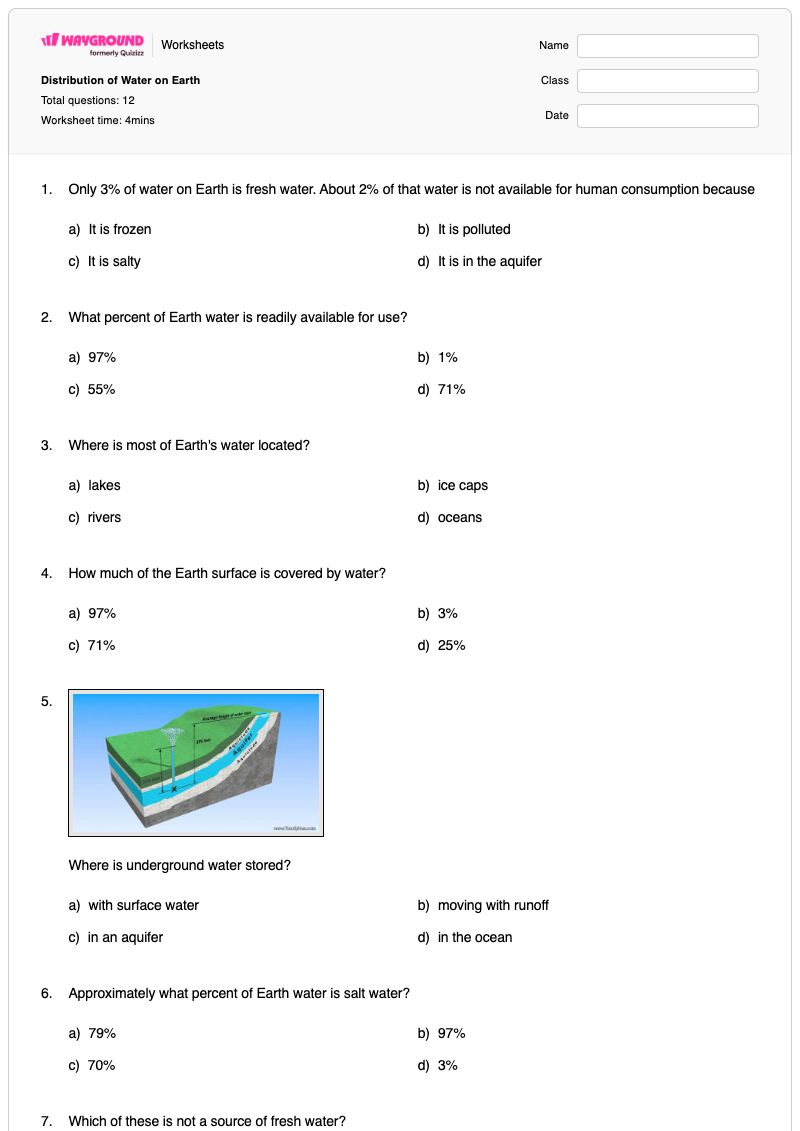
Where is underground water stored?
a)
with surface water
b)
moving with runoff
c)
in an aquifer
d)
in the ocean
6.
Approximately what percent of Earth water is salt water?
a)
79%
b)
97%
c)
70%
d)
3%
7.
Which of these is not a source of fresh water?
a)
ocean
b)
rivers
c)
lakes
d)
glaciers
8.
What percent of Earth water is found in glaciers and ice caps?
a)
2%
b)
3%
c)
71%
d)
97%
9.
Which is in correct order from largest to smallest
a)
oceans, lakes and rivers, glaciers, groundwater
b)
ground water, glaciers, ocean, rivers and lakes
c)
rivers and lakes, ocean, groundwater, glaciers
d)
ocean, glaciers, groundwater, rivers and lakes
10.
Which of these contain the greatest amount of fresh water?
a)
ocean
b)
rivers and lakes
c)
groundwater
d)
glaciers and ice caps
11.
Identify the Pacific Ocean
a)
1
b)
2
c)
3
d)
4
12.
Identify the Atlantic Ocean
a)
1
b)
2
c)
3
d)
4
Answer Key
Distribution of Water on Earth
Total questions: 12
1.
a)
It is frozen
2.
b)
1%
3.
d)
oceans
4.
c)
71%
5.
c)
in an aquifer
6.
b)
97%
7.
a)
ocean
8.
a)
2%
9.
d)
ocean, glaciers, groundwater, rivers and lakes
10.
d)
glaciers and ice caps
11.
a)
1
12.
b)
2
140 %
Browse by subjects
Browse by grades
Browse by format
FAQs
What does the Distribution of Water on Earth worksheet cover?
This worksheet covers Earth’s water distribution through 12 multiple-choice questions about percentages, water storage locations, fresh versus salt water, and the relative size of major water stores. Students also order oceans, glaciers, groundwater, rivers, and lakes from largest to smallest and identify the Pacific and Atlantic Oceans from numbered choices.
How can I use this worksheet to teach the distribution of water on Earth?
Introduce the worksheet by reviewing the distinction between salt water, fresh water, and fresh water that is readily available for use. As students answer the percentage and storage-location questions, ask them to explain why oceans contain most of Earth’s water while glaciers and ice caps contain the greatest share of fresh water; finish by discussing the ordering and numbered ocean-identification items.
What mistakes should I watch for when students complete this worksheet?
Students may confuse the 3% of Earth’s water that is fresh with the approximately 1% that is readily available, or select 3% instead of 2% for water in glaciers and ice caps. They may also mistake an aquifer for surface water, classify the ocean as a fresh-water source, reverse the largest-to-smallest order, or confuse the numbered Pacific and Atlantic Ocean identifications.
How do I assign and grade this worksheet?
Wayground provides this worksheet as a printable PDF and as a digital quiz, and it includes a complete answer key for all 12 multiple-choice questions. You can grade printable submissions by scanning student work with the Wayground for Teachers app, while the digital quiz supports online completion and grading.
How can I differentiate this water-distribution worksheet for my students?
Use the worksheet’s Advanced Settings to adjust font spacing and font size for the percentage, comparison, and numbered ocean-identification questions, or enable a dyslexia-friendly font to improve readability. You can also translate the worksheet into another language so students can access the water-distribution vocabulary and answer choices more independently.
Where can I find more worksheets like this on Wayground?
Wayground offers a broad collection of free printable worksheets and practice problems across subjects, with downloadable PDFs and answer keys to support essential skills and concepts. Browse more resources at https://wayground.com/en-us/worksheets.


 Worksheets

