

This Grade 5 science worksheet builds understanding of how water is distributed and used on Earth. Across 20 questions—19 multiple choice and 1 multiple select—students identify where most of Earth’s water is found, define groundwater, recognize water’s solid, liquid, and gas forms, and distinguish freshwater from saltwater. They also apply key facts about salinity, water percentages, freshwater sources, and the types of water found in oceans, rivers, lakes, and wells.
The worksheet extends content knowledge into practical reasoning. Students identify where most freshwater is stored, evaluate a water-conservation strategy, and interpret information about threats to groundwater. This free printable worksheet is designed for Grade 5 science instruction, independent practice, review, or assessment, and it includes a complete answer key to support efficient checking and feedback.
Worksheet settings
Font size
S
M
L
XL
Worksheets
Water on Earth
Total questions: 20
Name
Class
Date
1.
Where is mostof Earth’s water located?
a)
glaciers
b)
lakes
c)
oceans
d)
rivers
2.
What is groundwater?
a)
water that fills space between rocks of Earth
b)
water found within a lake or pond
c)
water that is evaporated from the surface of Earth
d)
water that is found in the ocean
3.
Water can exist on Earth as...
a)
solid ice
b)
liquid water
c)
the gas water vapor
d)
All of above
4.
What are the two kinds of water that exist on Earth?
a)
Freshwater
b)
Saltwater
c)
Sugarwater
d)
Bluewater
5.
Freshwater makes up how much of the Earth's water supply?
a)
97%
b)
75%
c)
25%
d)
3%
6.
Saltwater makes up how much of the Earth's water supply?
a)
97%
b)
75%
c)
25%
d)
3%
7.
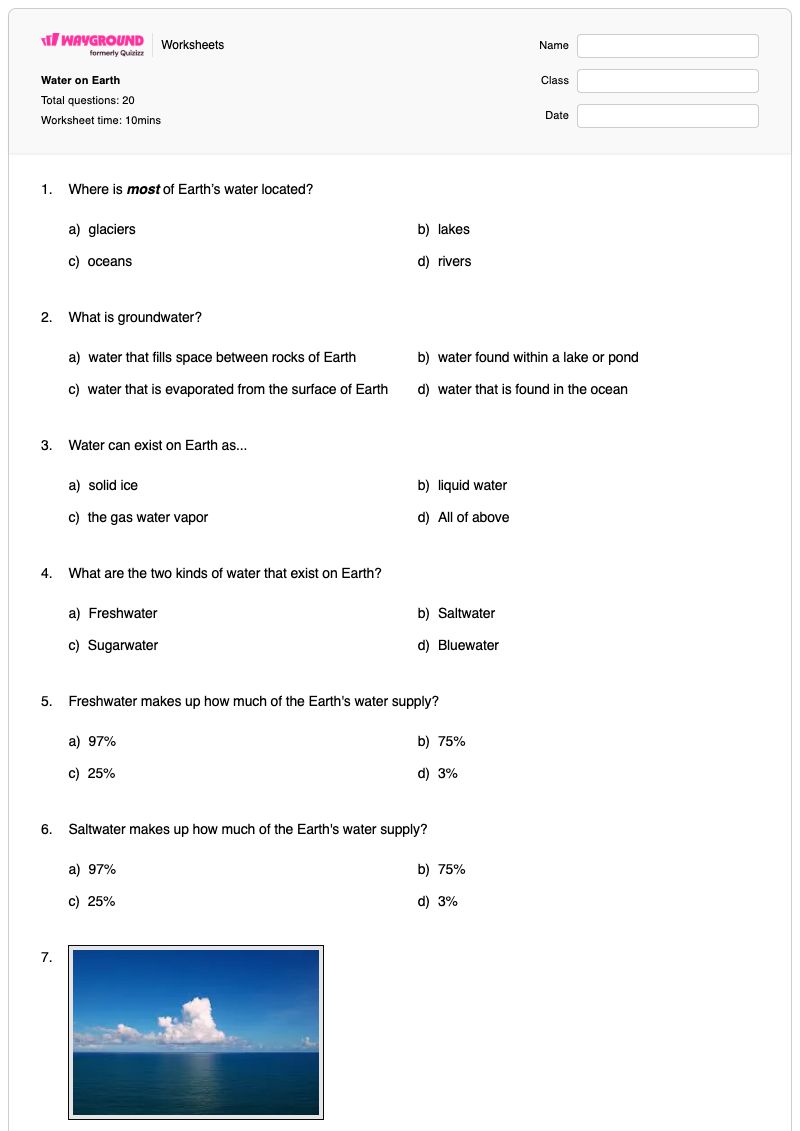
Oceans are
a)
Freshwater
b)
Saltwater
8.
Rivers are
a)
Freshwater
b)
Saltwater
9.
Lakes are
a)
Freshwater
b)
Saltwater
10.
Well water is
a)
Freshwater
b)
Saltwater
11.
Humans can only consume (drink)
a)
Freshwater
b)
Saltwater
12.
Salinity is the amount of salt in a body of water.
a)
True
b)
False
13.
Where is most of Earth's freshwater found?
a)
in the ground
b)
in the atmosphere
c)
in lakes and rivers
d)
in glaciers and icecaps
14.
The pie chart above shows all of the ways that a certain town uses the local water supply. Which idea below would likely have the greatest impact on conserving water?
a)
Washing only full loads of laundry
b)
Watering plants and lawns wisely
c)
Turning off faucets while brushing teeth
d)
Taking shorter baths
15.
The graph above shows the chemicals and/or pollutants that are polluting our groundwater. Use this graph above to answer the following question. As the United States' population continues to grow, what is likely to be the greatest threat to our groundwater?
a)
Fertilizer (nitrates)
b)
Sewage
c)
Chemical spills from petroleum
d)
Salinity (salt)
16.
Keeping the water running when you brush your teeth wastes a lot of water.
a)
True
b)
False
17.
Why do we need to conserve water?
a)
It is an unlimited resource.
b)
It is a limited resource.
c)
There is a lot of water.
d)
There is no need to conserve water.
18.
Why is clean water important?
a)
All life on Earth depends on clean water to live and grow.
b)
We need clean water for recreational activities.
c)
We need bodies of water for transportation
d)
We need water to regulate the temperature on Earth.
19.
Potable water means...
a)
Water which comes straight from a river or reservoir
b)
Water containing bacteria
c)
Water which is safe to drink
d)
Water which contains a high amount of salt
20.
Based on the pie chart above, which source of pollution listed below is responsible for adding the most pollution to the oceans?
a)
Offshore oil
b)
Industrial wastewater
c)
Maritime transportation
d)
Air pollutants
Answer Key
Water on Earth
Total questions: 20
1.
c)
oceans
2.
a)
water that fills space between rocks of Earth
3.
d)
All of above
4.
a)
Freshwater
, b)
Saltwater
5.
d)
3%
6.
a)
97%
7.
b)
Saltwater
8.
a)
Freshwater
9.
a)
Freshwater
10.
a)
Freshwater
11.
a)
Freshwater
12.
a)
True
13.
d)
in glaciers and icecaps
14.
b)
Watering plants and lawns wisely
15.
b)
Sewage
16.
a) True
17.
b) It is a limited resource.
18.
a) All life on Earth depends on clean water to live and grow.
19.
c)
Water which is safe to drink
20.
d)
Air pollutants
140 %
Browse by subjects
Browse by grades
Browse by format
FAQs
What does the Water on Earth worksheet cover?
This Grade 5 science worksheet uses 19 multiple-choice questions and 1 multiple-select question to assess Earth’s water distribution, groundwater, water’s three states, freshwater and saltwater, salinity, and water conservation. Students apply facts such as the proportions of freshwater and saltwater, classify oceans and inland water sources, identify where most freshwater is stored, and reason about threats to groundwater.
How can I use this worksheet to teach freshwater, saltwater, and groundwater?
Introduce the worksheet by having students sort examples such as oceans, rivers, lakes, wells, glaciers, and groundwater into categories, then discuss why the categories are not interchangeable. Use the percentage and classification questions to check understanding before asking students to explain how salinity affects whether water is freshwater or saltwater. Finish with the conservation and groundwater questions so students connect the vocabulary to real-world water-use decisions.
What mistakes should I watch for when students complete this worksheet?
Students may confuse the location of most of Earth’s water—oceans—with the location of most freshwater, which the worksheet identifies as glaciers and icecaps. They may also reverse the 97% saltwater and 3% freshwater figures, classify groundwater as water in a lake or ocean, or select only one answer on the multiple-select question about freshwater and saltwater. Review the distinction between salinity as the amount of salt in water and the types of water sources listed in the classification items.
How do I assign and grade the Water on Earth worksheet?
The Water on Earth worksheet is available as a printable PDF and as a digital quiz on Wayground, with a complete answer key for all 20 questions. You can assign the digital version for online practice or print it for paper-based work, then grade printable submissions by scanning student work with the Wayground for Teachers app.
How can I differentiate this Water on Earth worksheet for my students?
Use the worksheet’s Advanced Settings to adjust font spacing and font size so the multiple-choice and multiple-select items are easier to navigate. You can also enable a dyslexia-friendly font or translate the worksheet into another language when that better supports access to the water-distribution vocabulary and questions.
Where can I find more worksheets like this on Wayground?
Wayground offers a comprehensive collection of free printable worksheets and practice problems across subjects, with downloadable PDFs and answer keys to help students master essential skills and concepts. Browse more resources at https://wayground.com/en-us/worksheets.