

Wayground
Document Analysis and Interpretation in History - Printable Social studies Worksheets year 11 - Wayground

Document Analysis and Interpretation in History

Staci Walton

Created by Staci Walton

6 questions

11th Grade

Social studies

Updated Aug 2026

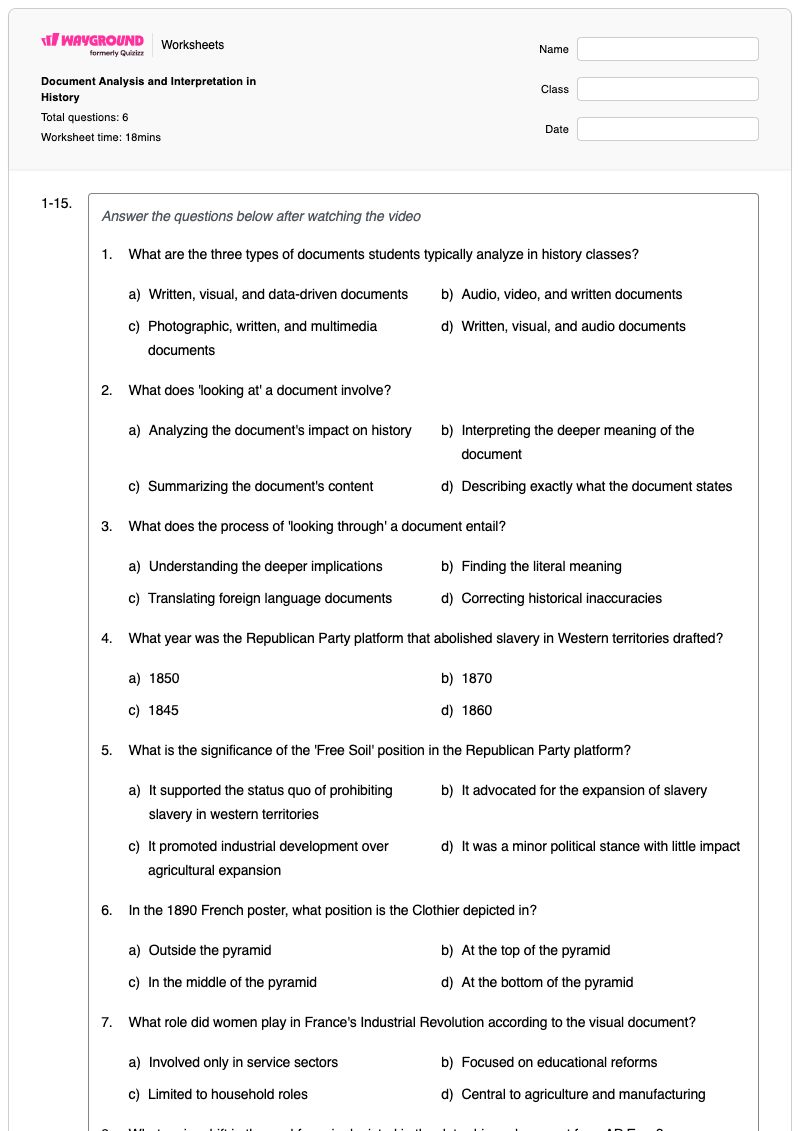
This Grade 11 Social Studies worksheet develops document analysis and interpretation skills through 21 questions. Students distinguish written, visual, and data-driven documents; differentiate describing what a document states from interpreting its deeper implications; and analyze examples including a Republican Party platform, a French industrial-era poster, and workforce data. The worksheet combines a comprehension-video item, multiple-choice questions, and a multiple-select question. Students also practice connecting document evidence to an essay prompt and using the SPY sourcing method—Summarize, Prompt, Why—to identify a document’s purpose and relevance. Questions address the Free Soil position, women’s roles in France’s Industrial Revolution, workforce shifts from agriculture to manufacturing, and the growth of service-sector employment. This free printable worksheet includes a complete answer key for independent practice, review, or assessment.

Worksheet settings

Font size

S
M
L
XL
WaygroundWorksheets

Document Analysis and Interpretation in History

Total questions: 6

Name
Class
Date

1-15.

Answer the questions below after watching the video

1.

What are the three types of documents students typically analyze in history classes?

a)

Written, visual, and data-driven documents

b)

Audio, video, and written documents

c)

Photographic, written, and multimedia documents

d)

Written, visual, and audio documents

2.

What does 'looking at' a document involve?

a)

Analyzing the document's impact on history

b)

Interpreting the deeper meaning of the document

c)

Summarizing the document's content

d)

Describing exactly what the document states

3.

What does the process of 'looking through' a document entail?

a)

Understanding the deeper implications

b)

Finding the literal meaning

c)

Translating foreign language documents

d)

Correcting historical inaccuracies

4.

What year was the Republican Party platform that abolished slavery in Western territories drafted?

a)

1850

b)

1870

c)

1845

d)

1860

5.

What is the significance of the 'Free Soil' position in the Republican Party platform?

a)

It supported the status quo of prohibiting slavery in western territories

b)

It advocated for the expansion of slavery

c)

It promoted industrial development over agricultural expansion

d)

It was a minor political stance with little impact

6.

In the 1890 French poster, what position is the Clothier depicted in?

a)

Outside the pyramid

b)

At the top of the pyramid

c)

In the middle of the pyramid

d)

At the bottom of the pyramid

7.

What role did women play in France's Industrial Revolution according to the visual document?

a)

Involved only in service sectors

b)

Focused on educational reforms

c)

Limited to household roles

d)

Central to agriculture and manufacturing

8.

What major shift in the workforce is depicted in the data-driven document from AP Euro?

a)

From manufacturing to agriculture

b)

From services to manufacturing

c)

From agriculture to manufacturing

d)

From manufacturing to services

9.

What does the increase in service sector jobs indicate about France's economy in the 20th century?

a)

Decrease in urban population

b)

Decline in technological advancements

c)

Increase in agricultural productivity

d)

Shift towards a knowledge-based economy

10.

What was the primary reason for the shift from agriculture to manufacturing in France's workforce?

a)

Lack of arable land

b)

Mechanization of agriculture reducing labor needs

c)

Increased export demands

d)

Government incentives for urban jobs

11.

How should students connect the content of a document to the essay prompt?

a)

By comparing it to another document

b)

By demonstrating how the document supports their argument

c)

By criticizing the document's perspective

d)

By summarizing the document

12.

Why is it crucial for students to connect document content to the essay prompt?

a)

To ensure clarity in their argument

b)

To meet word count requirements

c)

To improve their handwriting skills

d)

To demonstrate understanding of the document

13.

What does the SPY method stand for in document sourcing?

a)

Summarize, Prompt, Why

b)

Summarize, Prompt, Yield

c)

Study, Probe, Yield

d)

Summarize, Ponder, Yield

14.

What is the primary purpose of the Republican Party platform document according to the SPY method?

a)

To clarify the Free Soil position

b)

To support slavery

c)

To oppose political rivals

d)

To declare war

15.

How does the SPY method simplify the sourcing process?

a)

By eliminating the need for external research

b)

By automating the analysis through software

c)

By reducing the steps to a single critical question

d)

By focusing only on the document's date and author

16.
Which is NOT an acceptable sentence of Document Analysis

Which is NOT an acceptable sentence of Document Analysis

a)

The Purpose of Doc. D is to explain the effects of the Supreme Court decision in the Insular cases.

b)

The Author of Doc. D is Edward D. Whitney of the New York Times.

c)

This historical situation in which Doc. D is written are the debates surrounding the U.S. practice of Imperialism after the Spanish American War.

d)

Doc. D was originally intended to reach a widespread audience, namely the readers of the New York Times newspaper.

17.
Which is the correct rule for Document Analysis?

Which is the correct rule for Document Analysis?

a)

You need to analyze 3 separate Documents using 1 type of HAPP

b)

you need at least 1 phrase of analysis for each document you use in your essay

c)

You need to analyze 3 documents with each with all 4 of the types of analysis in HAPP

d)

document analysis is just for bonus points- it's not worth the time it takes for the small increase in score you'll get

18.

Which country was not part of the Axis Powers during World War 2?

a)

Germany

b)

Italy

c)

France

d)

Japan

19.

Which event marked the beginning of World War 2?

a)

The invasion of Poland by Germany

b)

The bombing of Pearl Harbor

c)

The signing of the Treaty of Versailles

d)

The Battle of Britain

20.


Which of the following are important to think about when analyzing a primary source? (3 answers!)

a)

How cool the primary source looks

b)

The author of the source

c)

The audience/purpose of the source

d)

The time period the source was written in

WaygroundAnswer Key

Document Analysis and Interpretation in History

Total questions: 6

1-15.
1.
a)

Written, visual, and data-driven documents

2.
d)

Describing exactly what the document states

3.
a)

Understanding the deeper implications

4.
d)

1860

5.
a)

It supported the status quo of prohibiting slavery in western territories

6.
b)

At the top of the pyramid

7.
d)

Central to agriculture and manufacturing

8.
c)

From agriculture to manufacturing

9.
d)

Shift towards a knowledge-based economy

10.
b)

Mechanization of agriculture reducing labor needs

11.
b)

By demonstrating how the document supports their argument

12.
a)

To ensure clarity in their argument

13.
a)

Summarize, Prompt, Why

14.
a)

To clarify the Free Soil position

15.
c)

By reducing the steps to a single critical question

16.
b)

The Author of Doc. D is Edward D. Whitney of the New York Times.

17.
a)

You need to analyze 3 separate Documents using 1 type of HAPP

18.
c)

France

19.
a)

The invasion of Poland by Germany

20.
b)

The author of the source

, c)

The audience/purpose of the source

, d)

The time period the source was written in

FAQs

What does this worksheet cover, and how does it build historical document-analysis skills?

This worksheet uses multiple-choice and multiple-select questions, along with a comprehension-video item, to practice analyzing written, visual, and data-driven historical documents. Students distinguish describing a document’s literal content from interpreting its deeper implications, identify information in a Republican Party platform, French poster, and workforce data, and connect document evidence to an essay prompt using the SPY method.

How can I use this worksheet to teach document analysis in history?

Introduce the distinction between “looking at” a document—describing exactly what it states—and “looking through” it to understand deeper implications before students begin the questions. Model the process with the Republican Party platform, then have students explain how the French poster and workforce data communicate historical information. Use the SPY questions and essay-prompt items to discuss how sourcing and evidence strengthen a historical argument.

What mistakes should I watch for when students complete this document-analysis worksheet?

Students may confuse describing a document’s stated content with interpreting its deeper meaning, or select a document type that is not written, visual, or data-driven. They may also reverse the workforce shift from agriculture to manufacturing or overlook that the SPY method stands for Summarize, Prompt, Why. When answering the essay-connection questions, watch for summaries that do not explain how the document supports an argument.

How do I assign and grade this worksheet?

Wayground provides this document-analysis worksheet as a printable PDF and as a digital quiz, and it includes a complete answer key for all question types. You can grade printable submissions by scanning student work with the Wayground for Teachers app, while the digital quiz supports online completion and grading.

How does this worksheet prepare students to use documents in an essay?

The worksheet asks students to connect a document’s content to an essay prompt by explaining how the document supports an argument, rather than merely summarizing it. Its SPY questions also help students identify a document’s purpose, such as clarifying the Free Soil position, and reduce sourcing to a focused critical question.

Where can I find more worksheets like this on Wayground?

Wayground offers a broad collection of free printable worksheets and practice problems across subjects, with downloadable PDFs and answer keys to help students master essential skills and concepts. Browse more resources at https://wayground.com/en-us/worksheets.