

Wayground
Causes of World War 1 - Printable Social Studies Worksheets year 10 - Wayground

Causes of World War 1

22 questions

10th - 10th Grade

Social Studies

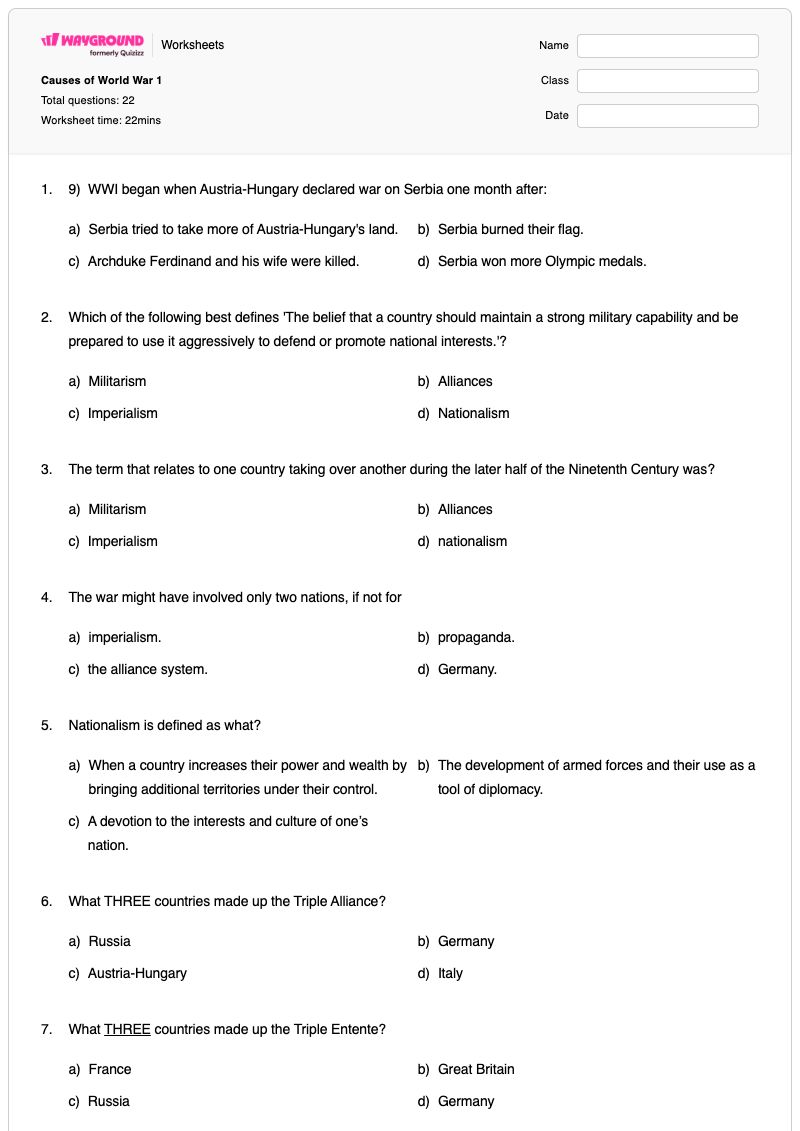
Causes of World War 1 is a Grade 10 social studies worksheet that helps students identify and explain the major factors behind the conflict. Students review militarism, alliances, imperialism, and nationalism, connect Archduke Ferdinand’s assassination to Austria-Hungary’s declaration of war on Serbia, and distinguish related terms such as neutrality and alliance. The worksheet contains 22 questions: 19 multiple-choice items and 3 multiple-select items. Students identify the members of the Triple Alliance and Triple Entente, recognize how alliance systems expanded the conflict, and apply vocabulary to examples such as competition for colonies. This free printable worksheet includes a complete answer key for efficient review, independent practice, or assessment.

Worksheet settings

Font size

S
M
L
XL
Worksheets

Causes of World War 1

Total questions: 22

Name
Class
Date
1.
9)  WWI began when Austria-Hungary declared war on Serbia one month after:
a)
Serbia tried to take more of Austria-Hungary's land.
b)
Serbia burned their flag.
c)
Archduke Ferdinand and his wife were killed.
d)
Serbia won more Olympic medals.
2.

Which of the following best defines 'The belief that a country should maintain a strong military capability and be prepared to use it aggressively to defend or promote national interests.'?

a)

Militarism

b)

Alliances

c)

Imperialism

d)

Nationalism

3.

The term that relates to one country taking over another during the later half of the Ninetenth Century was?

a)

Militarism

b)

Alliances

c)

Imperialism

d)

nationalism

4.
The war might have involved only two nations, if not for
a)
imperialism.
b)
propaganda.
c)
the alliance system.
d)
Germany.
5.

Nationalism is defined as what?

a)

When a country increases their power and wealth by bringing additional territories under their control.

b)

The development of armed forces and their use as a tool of diplomacy.

c)

A devotion to the interests and culture of one’s nation.

6.

What THREE countries made up the Triple Alliance?

a)

Russia

b)

Germany

c)

Austria-Hungary

d)

Italy

7.

What THREE countries made up the Triple Entente?

a)

France

b)

Great Britain

c)

Russia

d)

Germany

8.

Select all that apply: Which of the following are causes of World War I?

a)

Militarism

b)

Alliances

c)

Nationalism

d)

Imperialism

e)

Religion

9.

A union of two or more groups

a)

Militarism

b)

Alliance

c)

Imperialism

d)

Nationalism

10.

A position of not taking sides in a conflict

a)

Neutrality

b)

Propaganda

c)

Rationing

d)

Trench Warfare

11.

Which of the following is the best example of imperialism?

a)

France building a powerful navy

b)

England's alliance with France

c)

German schools teaching English

d)

England and Germany competing for colonies

12.

Another name for the Allied Powers was the ________________________.

a)

Quadruple Alliance

b)

Triple Alliance

c)

Triple Entente

d)

Democratic Alliance

13.

Great Britain, France, Russia and eventually the U.S. made up which alliance?

a)

Axis Powers

b)

Central Powers

c)

Western Powers

d)

Allied Powers

14.

A feeling of intense loyalty to a country or group

a)

Nationalism

b)

Militarism

c)

Propaganda

d)

Autocracy

15.
A policy in which a strong nation seeks to dominate other countries politically, economically, or socially.
a)
Armistice
b)
Militarism
c)
Nationalism
d)
Imperialism
16.

Why was Franz Ferdinand killed?

a)

Serbian nationalists hoped to provoke Russia into supporting Serbs in the Austro-Hungarian Empire.

b)

The Emperor of the Austro-Hungarian Empire disliked him and wanted him dead.

c)

The Ottoman Empire wanted revenge for Serbia achieving independence.

d)

Russians hoped that they could take over Austro-Hungarian territory through war.

17.

Which response best describes how imperialism helped expand and accelerate the war?

a)

Many of the warring countries wanted to gain economic and strategic advantages.

b)

Countries wanted to expand by taking territory from each other in different parts of Europe.

c)

The Alliance wanted to seize the territories and resources of the Entente.

d)

The Entente wanted to seize the territories and resources of the Alliance.

18.

How did industrialization affect the war?

a)

New industrial technologies improved diplomatic relations.

b)

New industrial technologies made it easier for people to flee the violence.

c)

New industrial technologies made war harder to reverse.

d)

New industrial technologies vastly improved healthcare for war victims.

19.

How did European powers’ experience with imperialism influence their attitude toward the war?

a)

It made them anxious.

b)

It made them apologetic.

c)

It intimidated them.

d)

It emboldened them.

20.

Why was the choice Austria gave Serbia so important?

a)

The many demands of Austria’s ultimatum were so harsh that war was really the only option.

b)

The Austro-Hungarian Empire set a realistic choice for Serbia.

c)

The choice was a lenient way to punish Serbia for Franz Ferdinand’s death.

d)

The choice meant Serbia would seek Germany’s help in a potential war.

21.

Why did Austria wait a month to issue the ultimatum?

a)

They wanted to make sure Germany could support them if a war started.

b)

The Emperor did not like Franz Ferdinand, so he did not care if he died.

c)

They wanted Russia to mobilize before issuing the ultimatum.

d)

They did not know how to react to Franz Ferdinand’s death.

22.

How might the First World War have happened by accident?

a)

The Russian and Austro-Hungarian Empires started the war over a misunderstanding.

b)

Franz Ferdinand was killed by mistake and the diplomatic escalation led to war.

c)

Countries were quick to adopt new communications technologies, making diplomacy more vulnerable to misinformation.

d)

Governments could not keep up diplomatic relations and communications at the pass the conflict was moving.

Answer Key

Causes of World War 1

Total questions: 22

1.
c) Archduke Ferdinand and his wife were killed.
2.
a)

Militarism

3.
c)

Imperialism

4.
c) the alliance system.
5.
c)

A devotion to the interests and culture of one’s nation.

6.
b)

Germany

, c)

Austria-Hungary

, d)

Italy

7.
a)

France

, b)

Great Britain

, c)

Russia

8.
a)

Militarism

, b)

Alliances

, c)

Nationalism

, d)

Imperialism

9.
b)

Alliance

10.
a)

Neutrality

11.
d)

England and Germany competing for colonies

12.
c)

Triple Entente

13.
d)

Allied Powers

14.
a)

Nationalism

15.
d) Imperialism
16.
a)

Serbian nationalists hoped to provoke Russia into supporting Serbs in the Austro-Hungarian Empire.

17.
a)

Many of the warring countries wanted to gain economic and strategic advantages.

18.
c)

New industrial technologies made war harder to reverse.

19.
d)

It emboldened them.

20.
a)

The many demands of Austria’s ultimatum were so harsh that war was really the only option.

21.
a)

They wanted to make sure Germany could support them if a war started.

22.
d)

Governments could not keep up diplomatic relations and communications at the pass the conflict was moving.

FAQs

What does the Causes of World War 1 worksheet cover?

This Grade 10 social studies worksheet uses 19 multiple-choice and 3 multiple-select questions to assess students’ understanding of militarism, alliances, imperialism, and nationalism as causes of World War I. It also asks students to identify the Triple Alliance and Triple Entente, connect Archduke Ferdinand’s assassination with the war’s outbreak, and distinguish terms such as neutrality and alliance.

How can I use this worksheet to teach the causes of World War I?

Introduce the four major causes—militarism, alliances, imperialism, and nationalism—before students complete the vocabulary and definition questions. Then use the Triple Alliance and Triple Entente items to have students map the alliance blocs and discuss how the alliance system could expand a conflict after Austria-Hungary declared war on Serbia.

What mistakes should I watch for when students complete this World War I worksheet?

Students may confuse militarism, imperialism, nationalism, and alliances because the terms describe related but different ideas. In the multiple-select items, watch for incomplete or incorrect membership in the Triple Alliance and Triple Entente, and for selecting religion as a cause when the worksheet identifies militarism, alliances, nationalism, and imperialism. Students may also overlook that Archduke Ferdinand’s assassination preceded Austria-Hungary’s declaration of war on Serbia.

How do I assign and grade this Causes of World War 1 worksheet?

Wayground provides this worksheet as a printable PDF and as a digital quiz, with a complete answer key for all 22 questions. You can review the multiple-choice and multiple-select responses using the key, and printable submissions can be graded by scanning student work with the Wayground for Teachers app.

How can I differentiate this World War I causes worksheet for my students?

Use the worksheet’s Advanced Settings to adjust font spacing and font size for the vocabulary definitions, alliance questions, and multiple-select items. You can also enable a dyslexia-friendly font or translate the worksheet into another language when students need a more accessible version of the same World War I practice.

Where can I find more worksheets like this on Wayground?

Wayground offers a comprehensive collection of free printable worksheets and practice problems across all subjects, with downloadable PDFs and answer keys to help students master essential skills and concepts. Browse more resources at https://wayground.com/en-us/worksheets.