

Wayground
How to Write a Check - Printable Mathematics Worksheets year 11 - Wayground

How to Write a Check

10 questions

11th - 11th Grade

Mathematics

Designed for Grade 11 mathematics, this free printable worksheet helps students build practical check-writing and transaction-recording skills. It uses 10 questions—9 multiple choice and 1 multiple select—to review what belongs in a check register, why payment records matter, how to identify the payee, and how to distinguish a debit from a running balance. Students also practice recognizing operational details of a check, including using a pen, understanding carbon copies, identifying the legal amount written in words, and recognizing the need for a signature. The questions connect each check component to accurate record keeping, helping students prepare checks and monitor account activity more carefully. The worksheet includes a complete answer key for efficient review, correction, or independent practice.

Worksheet settings

Font size

S
M
L
XL
Worksheets

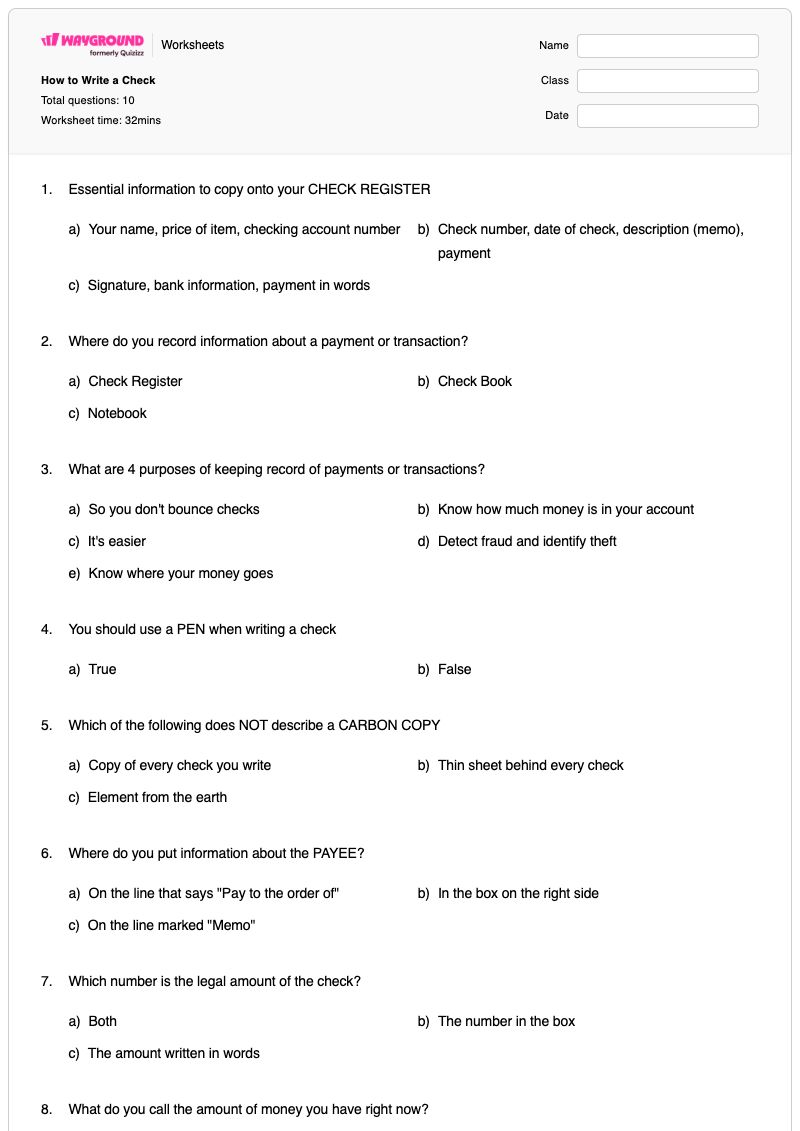
How to Write a Check

Total questions: 10

Name
Class
Date
1.

Essential information to copy onto your CHECK REGISTER

a)

Your name, price of item, checking account number

b)

Check number, date of check, description (memo), payment

c)

Signature, bank information, payment in words

2.

Where do you record information about a payment or transaction?

a)

Check Register

b)

Check Book

c)

Notebook

3.

What are 4 purposes of keeping record of payments or transactions?

a)

So you don't bounce checks

b)

Know how much money is in your account

c)

It's easier

d)

Detect fraud and identify theft

e)

Know where your money goes

4.

You should use a PEN when writing a check

a)

True

b)

False

5.

Which of the following does NOT describe a CARBON COPY

a)

Copy of every check you write

b)

Thin sheet behind every check

c)

Element from the earth

6.

Where do you put information about the PAYEE?

a)

On the line that says "Pay to the order of"

b)

In the box on the right side

c)

On the line marked "Memo"

7.

Which number is the legal amount of the check?

a)

Both

b)

The number in the box

c)

The amount written in words

8.

What do you call the amount of money you have right now?

a)

Running Balance

b)

Check Register

c)

Record of Payment

9.

A check will NOT be valid without a signature

a)

True

b)

False

10.

(-) payment or money leaving your account

a)

Debit

b)

Credit

c)

Running balance

Answer Key

How to Write a Check

Total questions: 10

1.
b)

Check number, date of check, description (memo), payment

2.
a)

Check Register

3.
a)

So you don't bounce checks

, b)

Know how much money is in your account

, d)

Detect fraud and identify theft

, e)

Know where your money goes

4.
a)

True

5.
c)

Element from the earth

6.
a)

On the line that says "Pay to the order of"

7.
c)

The amount written in words

8.
a)

Running Balance

9.
a)

True

10.
a)

Debit

FAQs

What does this worksheet cover about writing checks?

This Grade 11 mathematics worksheet teaches students to identify essential check and check-register information, including the check number, date, memo, payment, payee, signature, debit, and running balance. Its 9 multiple-choice and 1 multiple-select questions build accuracy by asking students to distinguish where information belongs and why payment records help prevent bounced checks, monitor balances, and detect fraud.

How can I use this worksheet to teach students how to write a check?

Introduce a sample check and check register, then have students locate the payee line, amount box, written amount, signature area, and memo before completing the questions. Use the items about carbon copies, pen use, and the check register to discuss how a completed check connects to ongoing transaction records. After students finish, ask them to explain why a payment is recorded as a debit and how it affects the running balance.

What mistakes should I watch for when students complete this check-writing worksheet?

Students may confuse the check register with the checkbook, place the payee in the memo line, or select the numeric amount instead of the amount written in words as the legal amount. Watch for errors on the multiple-select item, where students must identify all four purposes of recording transactions rather than choosing only one. Students may also overlook that a check requires a signature or that money leaving the account is a debit.

How do I assign and grade this check-writing worksheet?

You can assign this worksheet as a printable PDF or as a digital quiz on Wayground. The complete answer key supports quick grading of the 9 multiple-choice and 1 multiple-select items, and printable submissions can be graded by scanning student work with the Wayground for Teachers app. The printable format also gives schools an option for reducing screen time.

How can I differentiate this check-writing worksheet for my students?

In the worksheet’s Advanced Settings, adjust font spacing and font size to make the check-writing terms and answer choices easier to read. You can also select a dyslexia-friendly font or translate the worksheet into another language, helping students access items about the payee, written amount, debit, and running balance.

Where can I find more free worksheets like this on Wayground?

Wayground offers a comprehensive collection of free printable worksheets and practice problems across subjects, with downloadable PDFs and answer keys to help students master essential skills and concepts. Browse more resources at https://wayground.com/en-us/worksheets.