Writing Equations is a free printable mathematics worksheet for Grades 9–12 that develops students’ ability to represent relationships with equations. Across 20 questions—18 multiple choice, one fill-in-the-blank, and one multiple-select item—students identify rules from tables and number patterns, determine missing or next values, and choose equations that model data involving rates, comparisons, and changing quantities.
The worksheet connects visual and numerical patterns to algebraic notation through contexts such as typing speed, bubbles blown, ages, cars, and pepperonis. Students distinguish additive, subtractive, multiplicative, and divisive relationships, then translate verbal situations into equations such as w = 50m and 23 − n = 12. It includes a complete answer key, making it useful for independent practice, review, or a quick check of students’ equation-writing skills.
Worksheet settings
Font size
S
M
L
XL
Worksheets
Writing Equations
Total questions: 20
Name
Class
Date
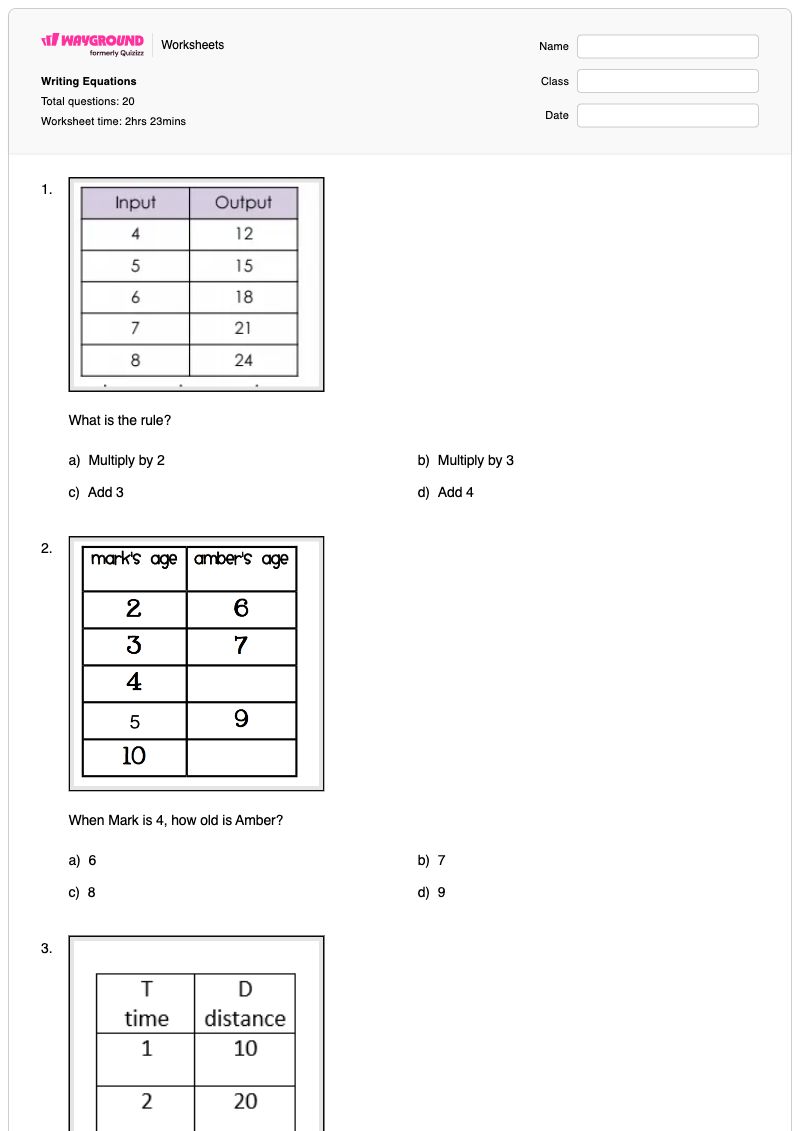
1.
What is the rule?
a)
Multiply by 2
b)
Multiply by 3
c)
Add 3
d)
Add 4
2.
When Mark is 4, how old is Amber?
a)
6
b)
7
c)
8
d)
9
3.
Write an equation that represents the relationship between the variables in the table.
a)
t=10d
b)
t=d-9
c)
t=10-d
d)
d=t+10
4.
Nancy can type 50 words per minute. Look at the table below to write an equation that matches the data.
a)
m=50 + w
b)
w= 50m
c)
w= 50 + m
d)
m= 50 - w
5.
What is the missing value of the table based on patterns?
a)
25
b)
50
c)
75
d)
27
6.
Look at the table below. Write an equation to match the pattern between m, minutes and bubbles blown, b.
a)
b = 12(m)
b)
b= m +12
c)
b = m ÷ 12
d)
none of these
7.
What is the pattern in the table below?
a)
multiplying the number of shots by 3
b)
adding 3 to the number of shots
c)
adding 1 to the number of shots
d)
dividing the number of shots by 3
8.
Which equation represents the relationship of the values in the table?
a)
y = x + 6
b)
y = 6 - x
c)
y = x + 3
d)
y = 3x
9.
Which expression best represents the relationship between cars and minutes?
a)
x + 4
b)
2x
c)
x + 5
d)
x - 5
10.
a)
the equation is 2y = x
b)
the equation is 2x = y
c)
the equation is x=y
d)
the equation is 1+x = y
11.
Choose the correct equation for the situation. Jane is 3 years older than Sam. If Jane 12, how old is Sam?
a)
j - 3 = 12
b)
s - 3 = 12
c)
s + 3 = 12
d)
j + 12 = 3
12.
How would you describe this pattern's rule? 65, 62, 59, 56, 53, 50
a)
Subtract 2
b)
Subtract 3
c)
Subtract 4
d)
Add 3
13.
How many counters would come next?
a)
5
b)
7
c)
9
d)
11
14.
If you extended the pattern, how many dots would come next?
a)
16
b)
20
c)
25
d)
30
15.
What is the rule in the pattern? 500, 100, 20, 4
a)
Subtract 200
b)
Divide 6
c)
Subtract 100
d)
Divide 5
16.
Edward's pizza had 23 pepperonis. Then he picked off n pepperonis. Now there are 12 pepperonis left. What algebraic equation shows this situation?
a)
12n = 23
b)
n + 23 = 12
c)
23 + 12 = n
d)
23 - n = 12
17.
What is the rule?
a)
Multiply by 2
b)
Multiply by 3
c)
Add 3
d)
Add 4
18.
Which equation describes this pattern?
a)
y = 4x - 2
b)
y = x + 2
c)
y=61x+4
d)
y = 6x -4
19.
Write an equation that describes the pattern in the table.
(a)
20.
Use the pattern and equation to complete the table.
a)
y = 5
b)
y = 4
c)
y = 6
d)
y = 7
Answer Key
Writing Equations
Total questions: 20
1.
b) Multiply by 3
2.
c) 8
3.
a)
t=10d
4.
b) w= 50m
5.
c) 75
6.
a) b = 12(m)
7.
a) multiplying the number of shots by 3
8.
d)
y = 3x
9.
c)
x + 5
10.
b) the equation is 2x = y
11.
c) s + 3 = 12
12.
b) Subtract 3
13.
c) 9
14.
c) 25
15.
d) Divide 5
16.
d)
23 - n = 12
17.
b) Multiply by 3
18.
d)
y = 6x -4
19.
p = q + 4
20.
d)
y = 7
, a)
y = 5
140 %
Browse by subjects
Browse by grades
Browse by format
FAQs
What does the Writing Equations worksheet cover?
This worksheet helps students write equations from tables, numerical and visual patterns, and short real-world situations. Its 20 items ask students to identify additive or multiplicative rules, find missing or next values, and select equations that represent relationships such as w = 50m, s + 3 = 12, and 23 − n = 12.
How can I use this worksheet to teach writing equations from patterns and tables?
Begin by modeling how to compare consecutive table values and decide whether a relationship uses addition, subtraction, multiplication, or division. Then have students explain why an equation such as b = 12m or y = 3x matches the data before completing the multiple-choice items independently. Use the word-problem questions about ages, typing speed, and pepperonis to connect the table rules to verbal algebraic relationships.
What mistakes should I watch for when students complete this equation-writing worksheet?
Students may confuse a constant difference with a constant factor, such as choosing “add 3” instead of “multiply by 3,” or overlook a division rule such as 500, 100, 20, 4. They may also reverse variables or signs when translating situations, selecting an equation that names the right numbers but does not match the relationship, as in the age and pepperoni items. Check that students use the table or wording to verify every selected equation.
How do I assign and grade the Writing Equations worksheet?
On Wayground, assign it as a printable PDF or as a digital quiz. The worksheet includes a complete answer key for checking the 18 multiple-choice, fill-in-the-blank, and multiple-select responses, and printable submissions can be graded by scanning student work with the Wayground for Teachers app. The printable format can also support schools that are reducing screen time.
How can I differentiate this worksheet for my students?
For the table, pattern, and word-problem items in this worksheet, use Advanced Settings to adjust font spacing and font size so equations and answer choices are easier to read. You can also apply a dyslexia-friendly font or translate the worksheet into another language when that better supports access to the equation-writing tasks.
Where can I find more free worksheets like this on Wayground?
Wayground offers a broad collection of free printable worksheets and practice problems across subjects, with downloadable PDFs and answer keys to help students master essential skills and concepts. Browse more worksheets at https://wayground.com/en-us/worksheets.


 Worksheets


