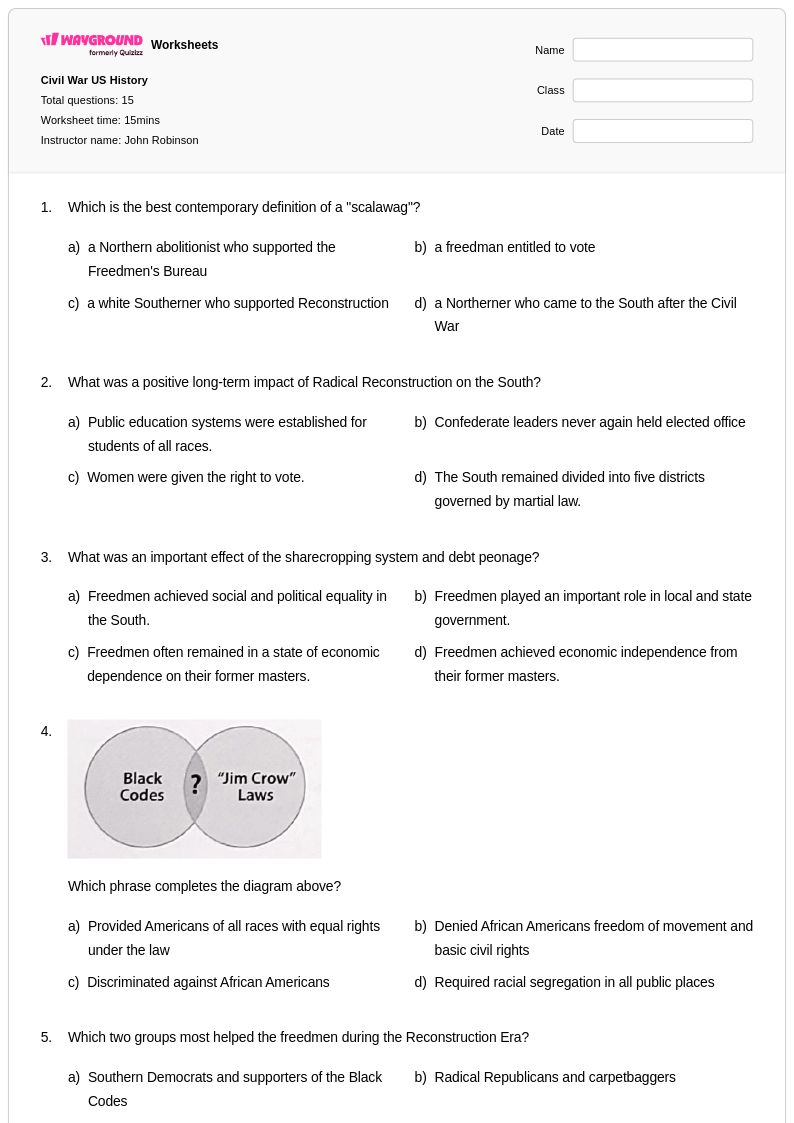
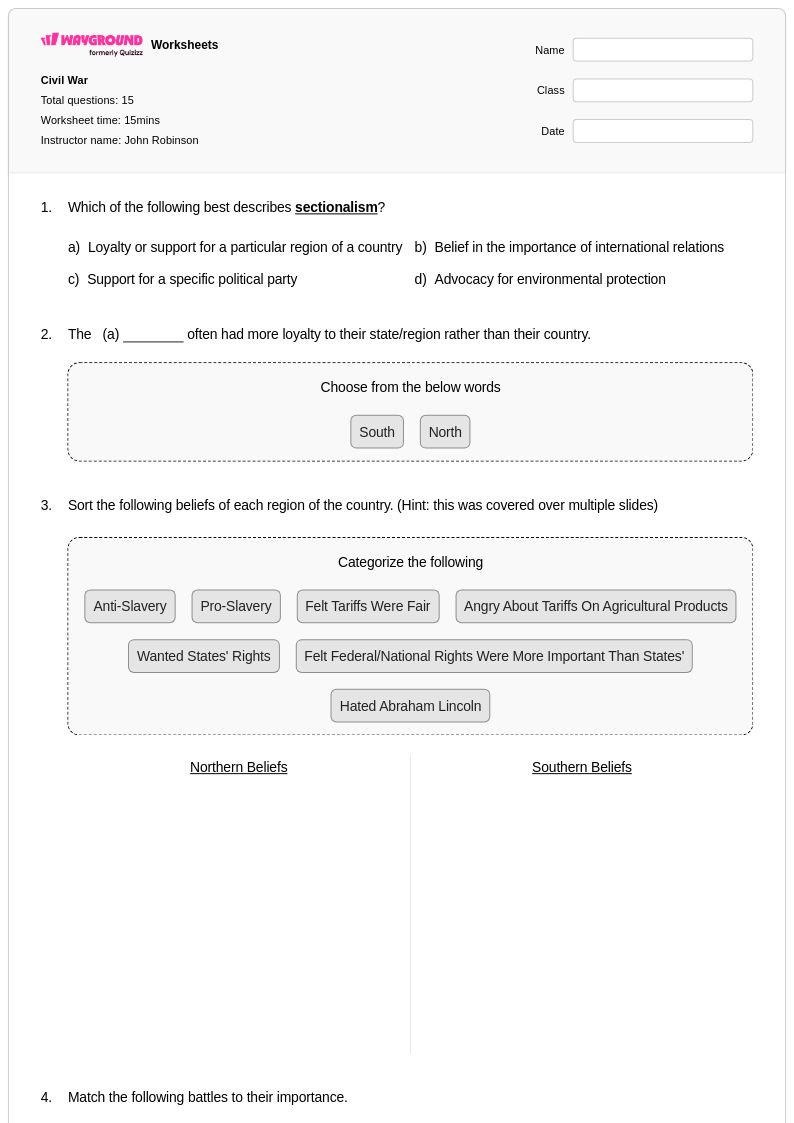
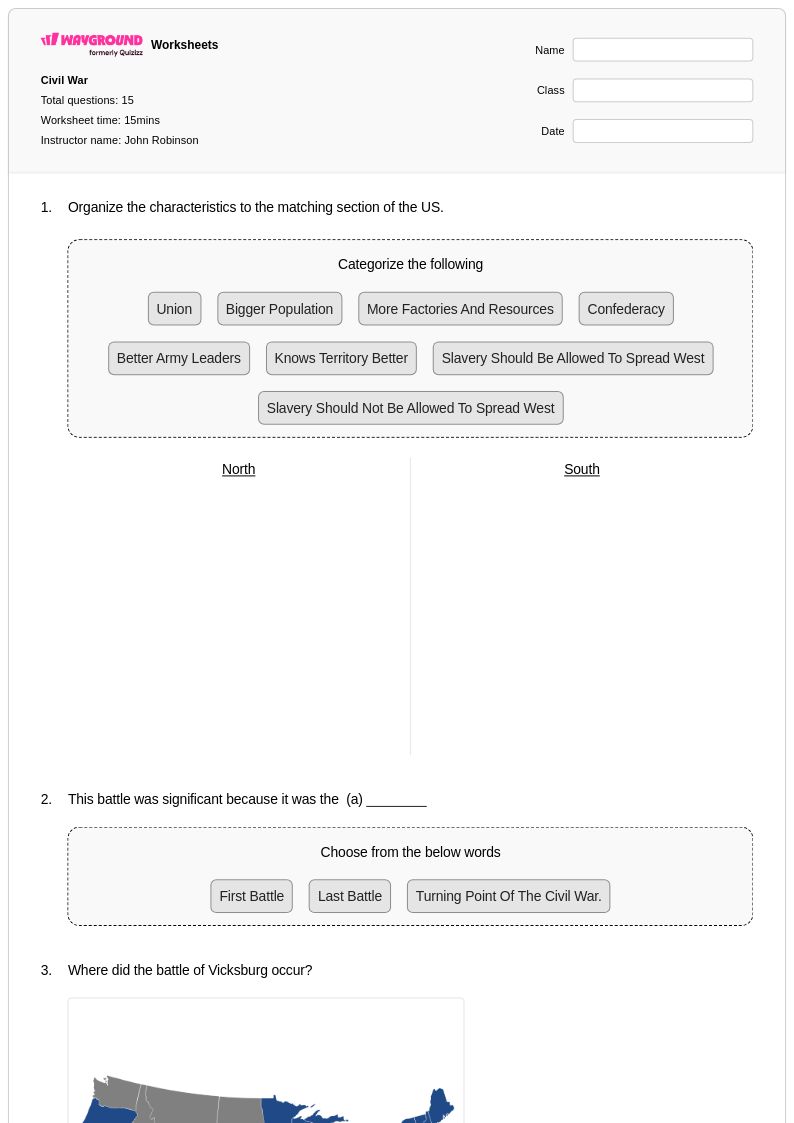
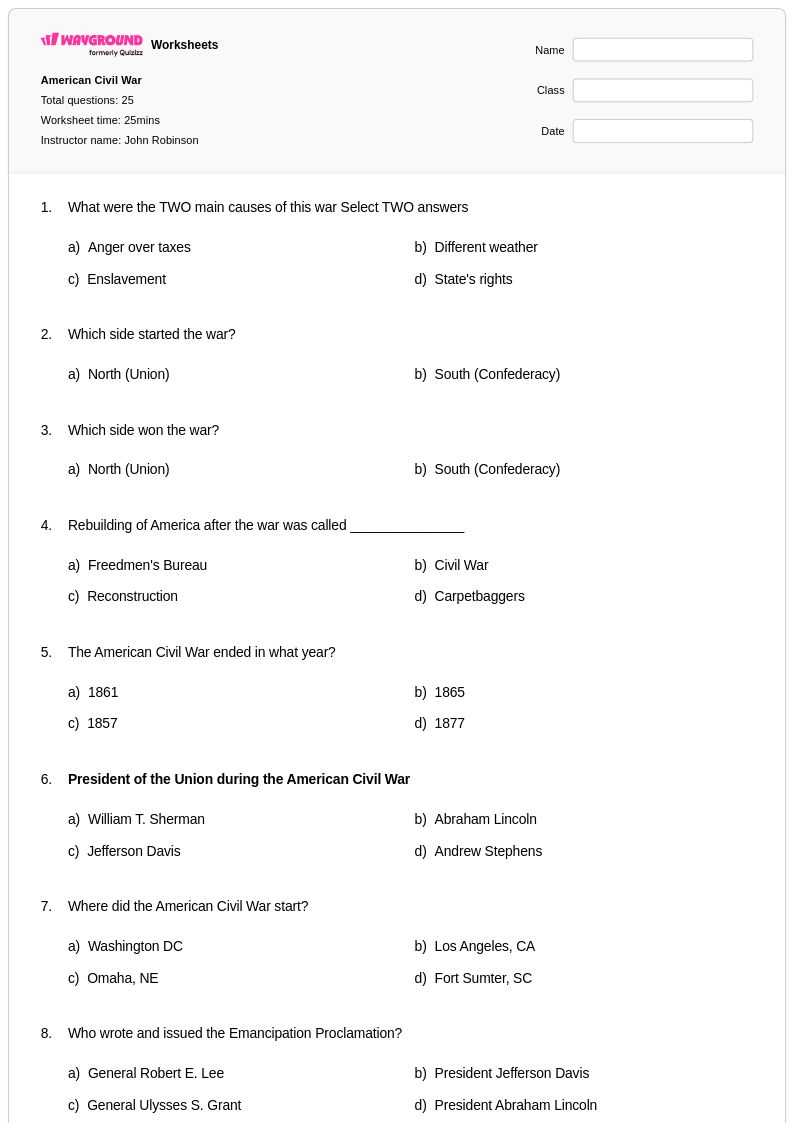
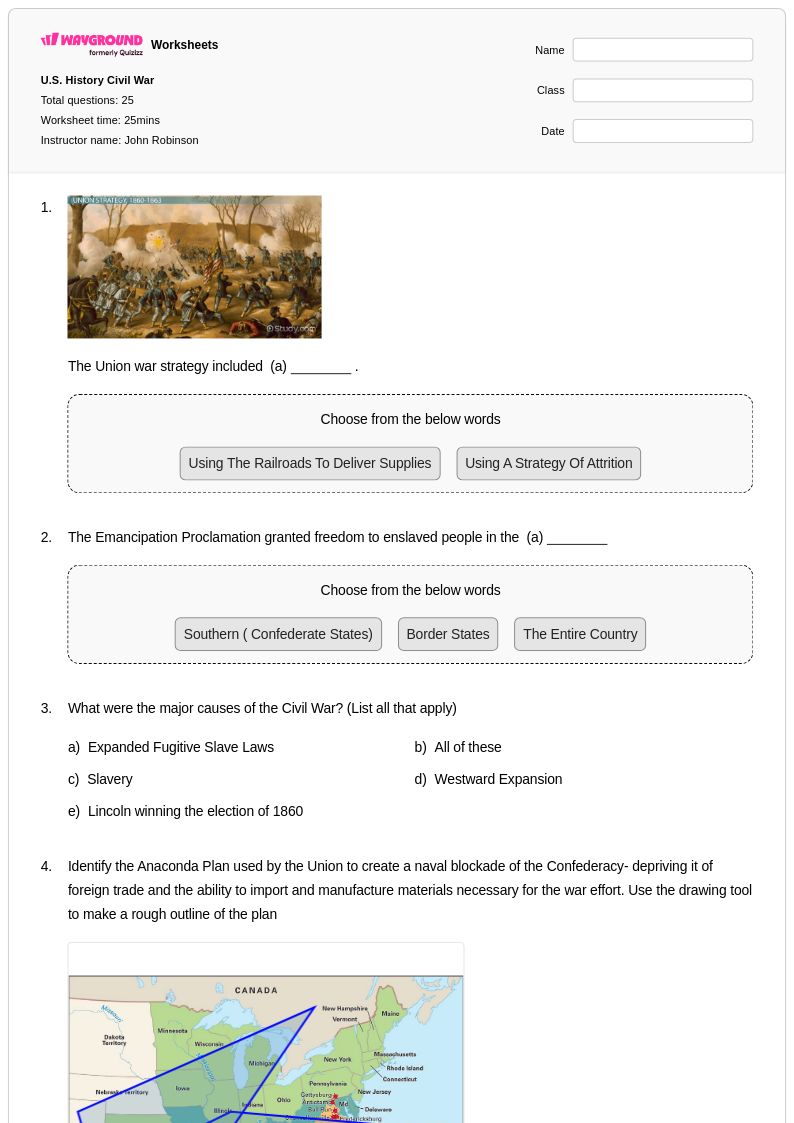
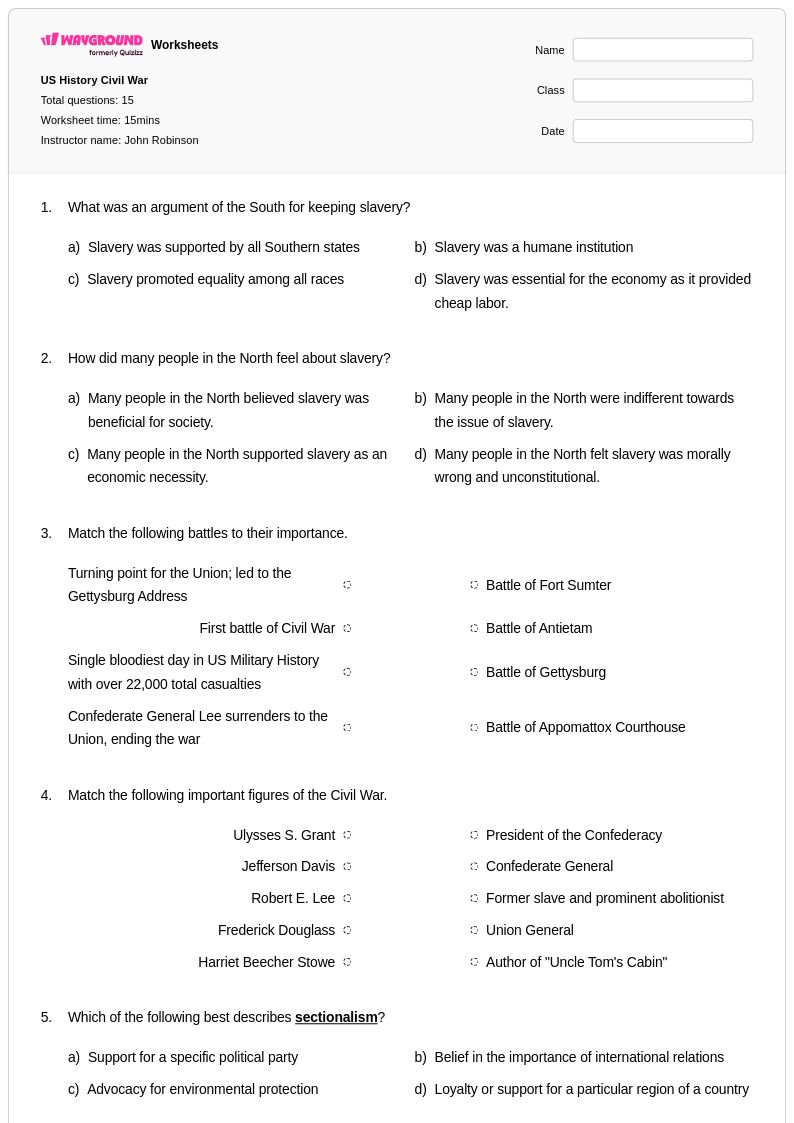
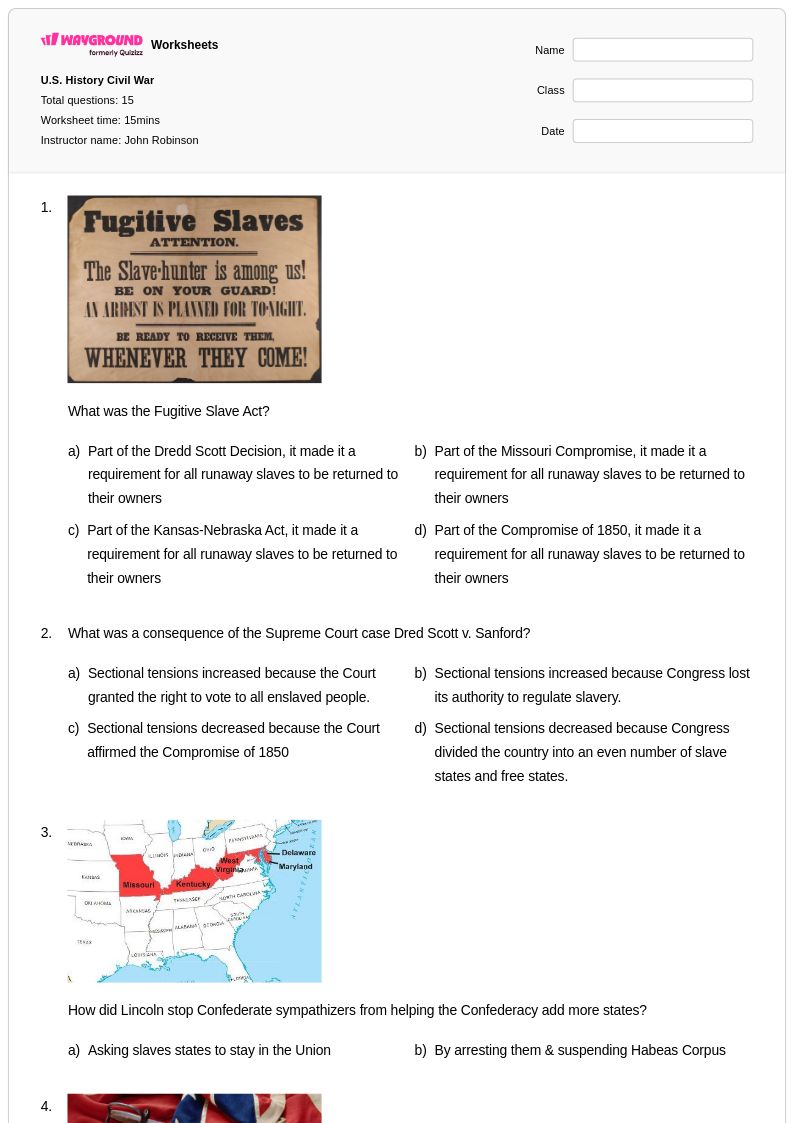
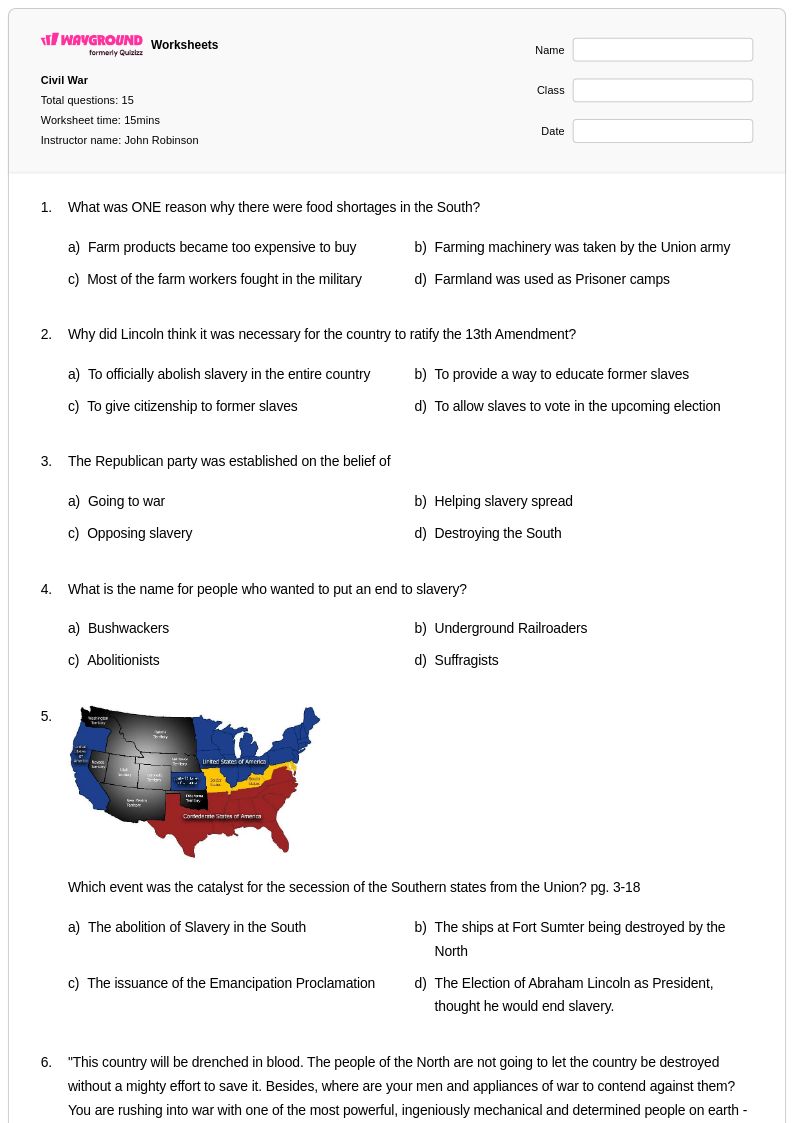
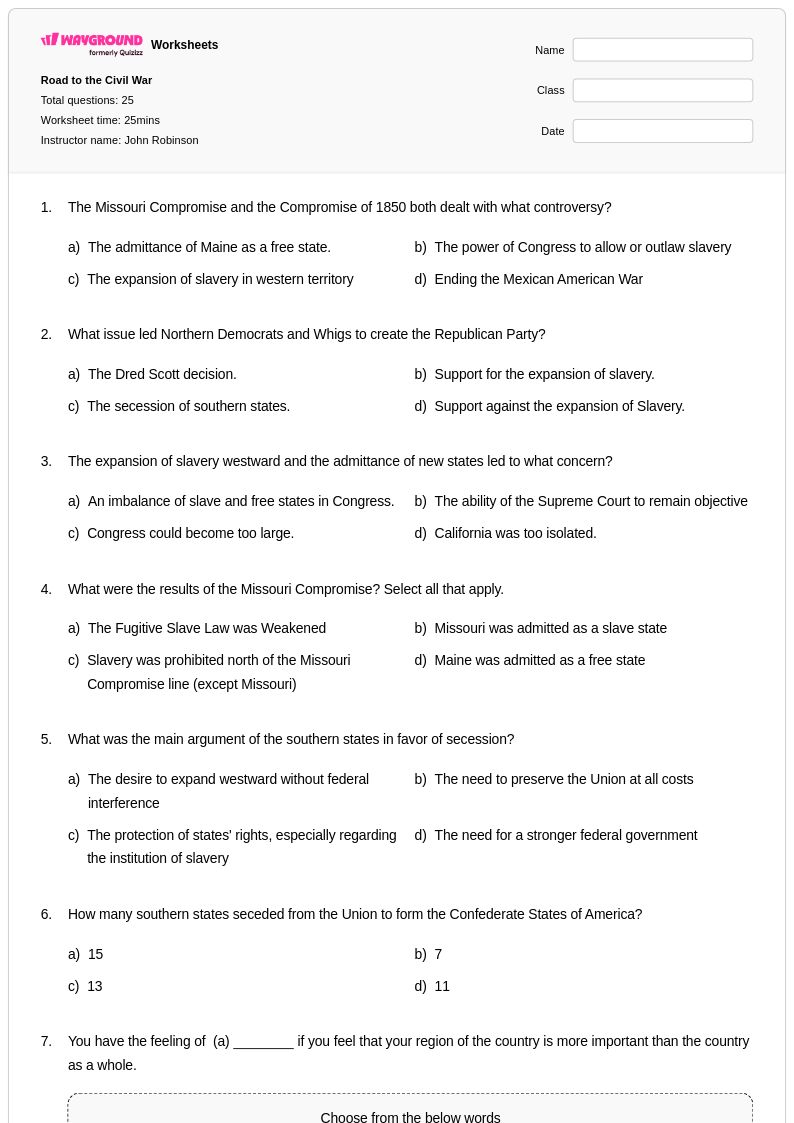
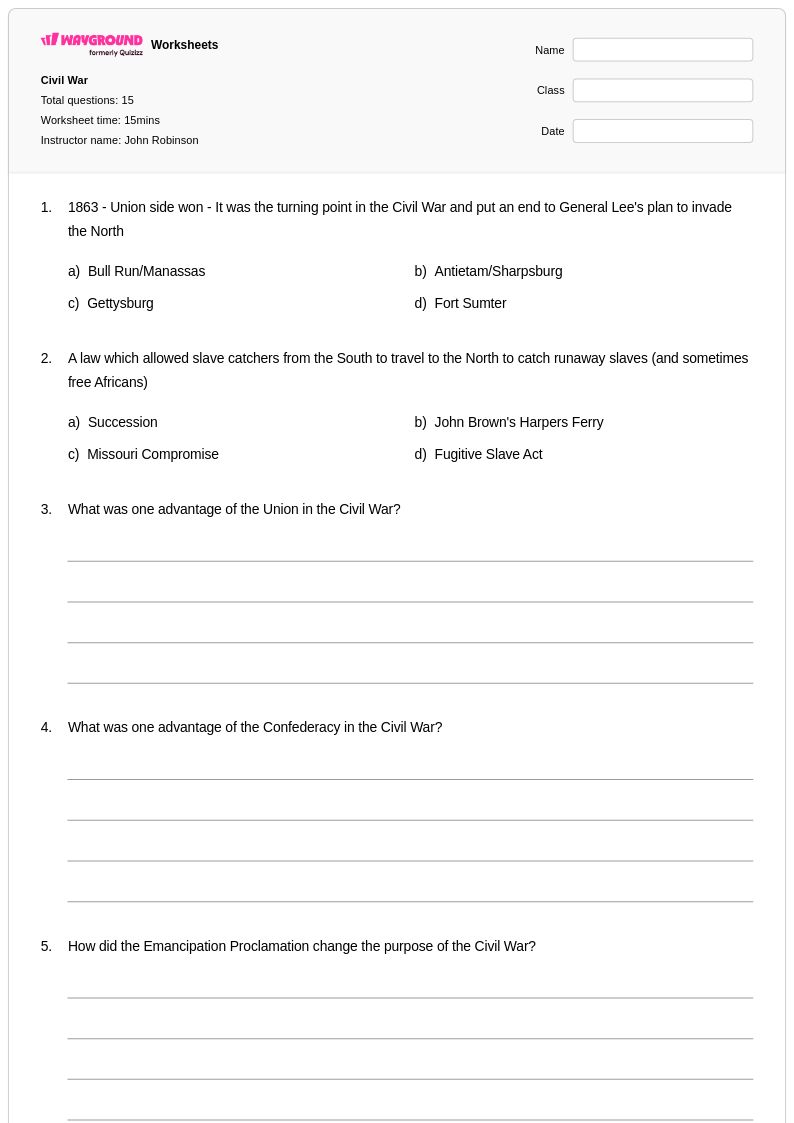
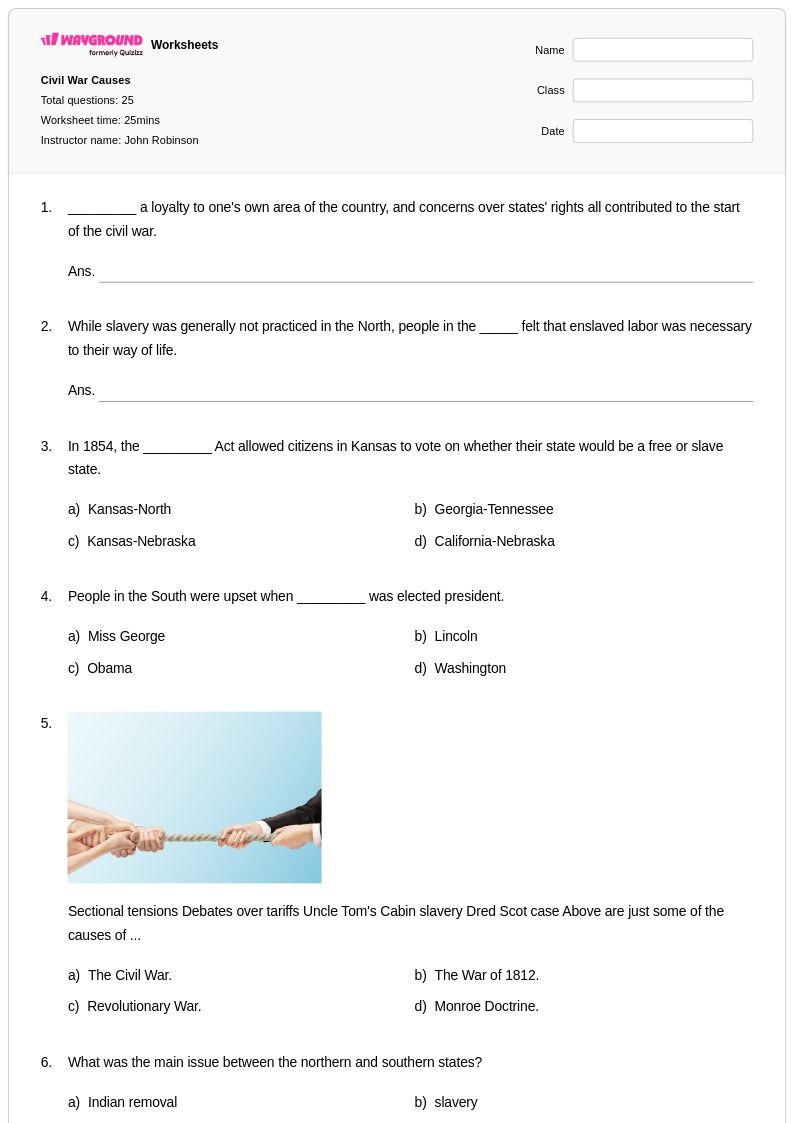
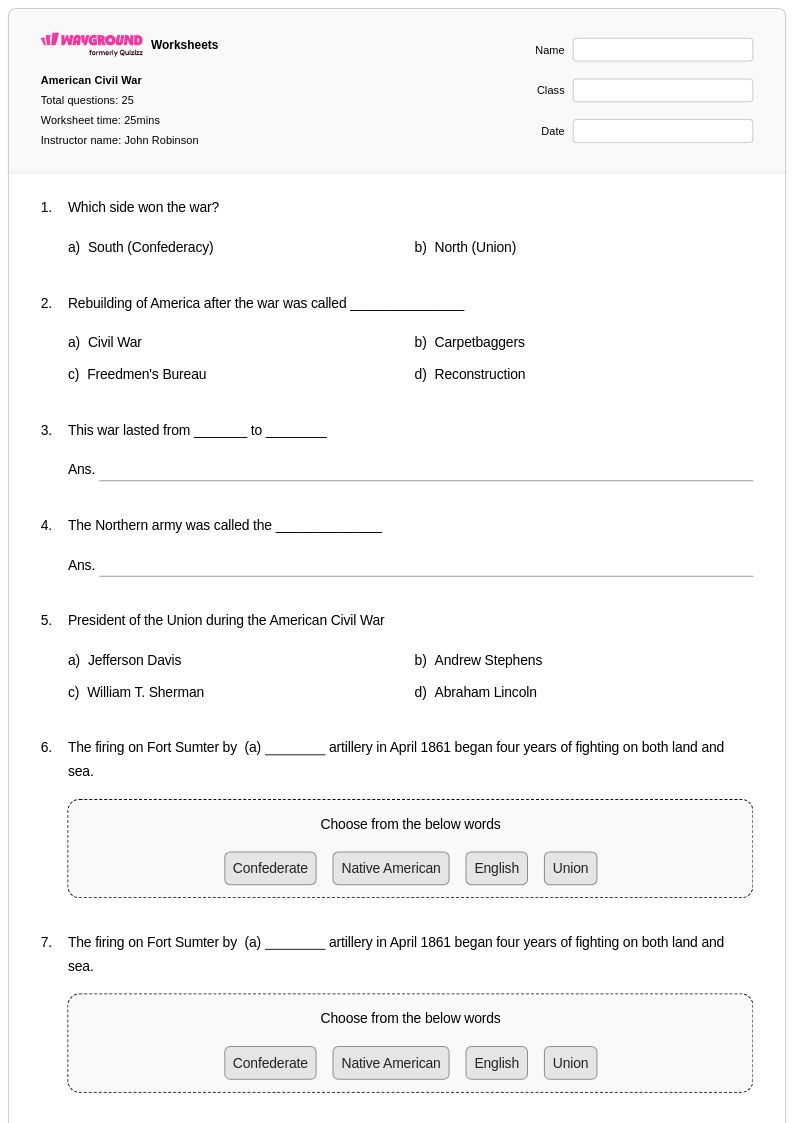
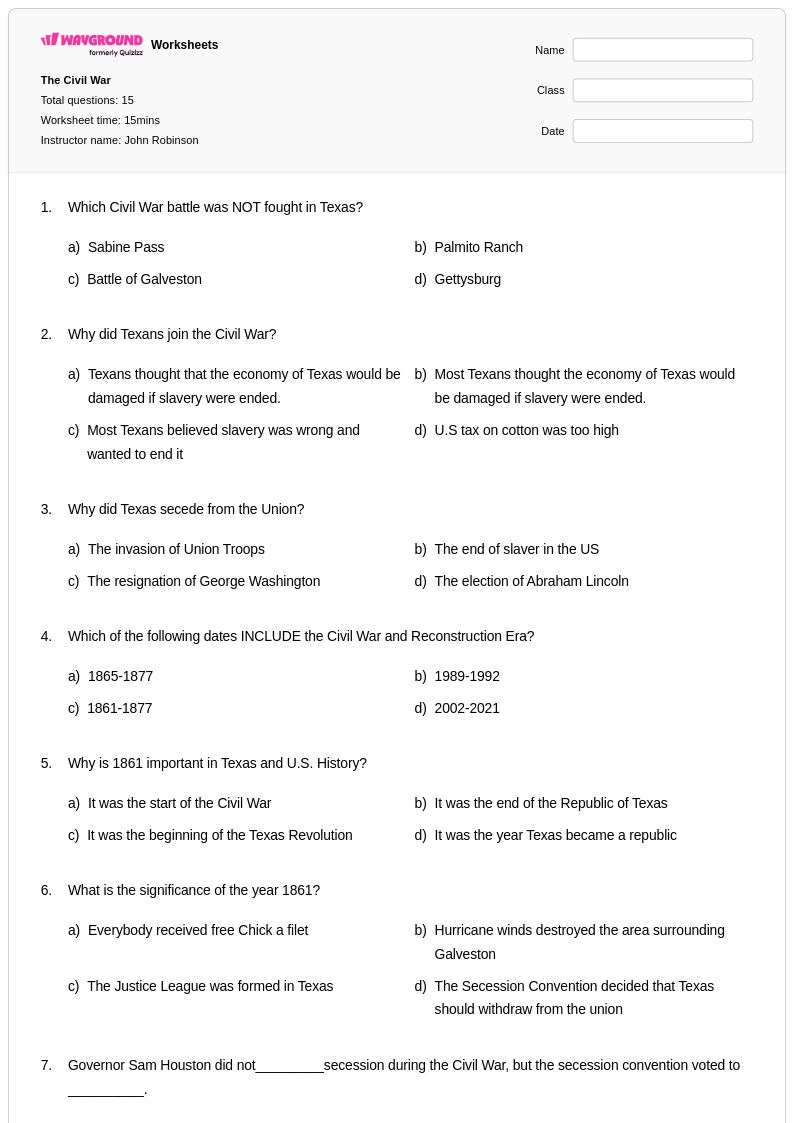
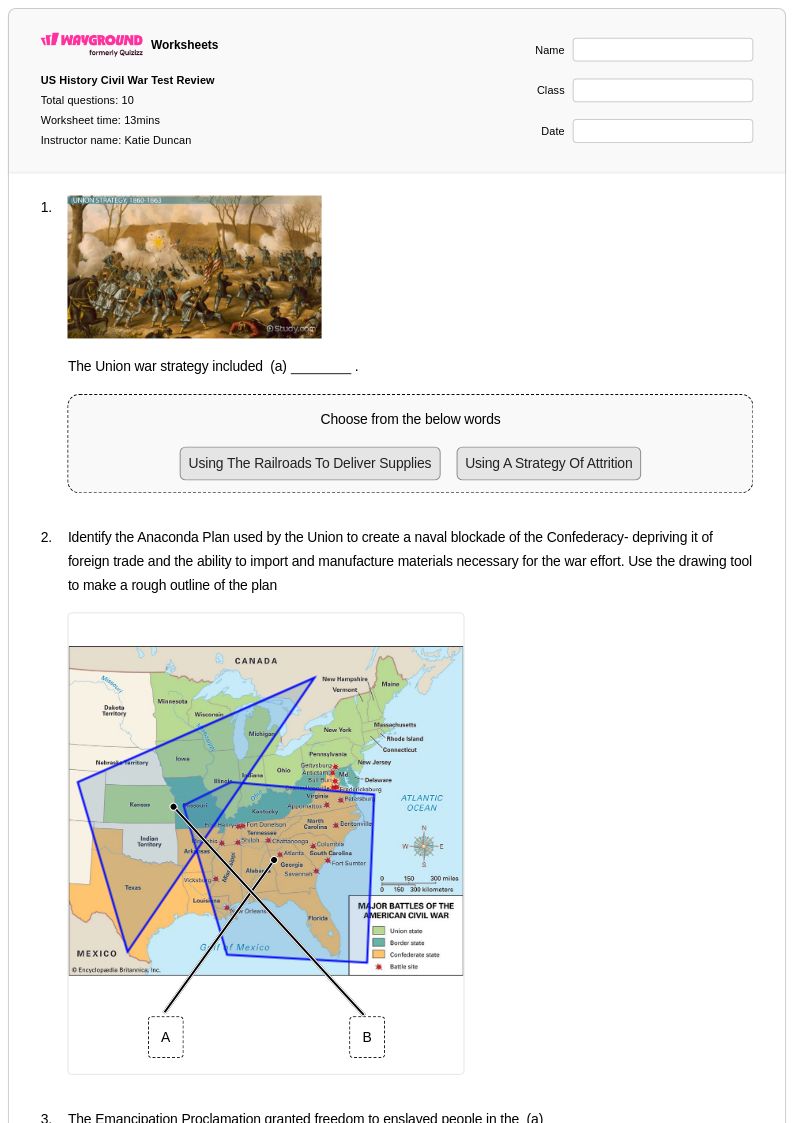
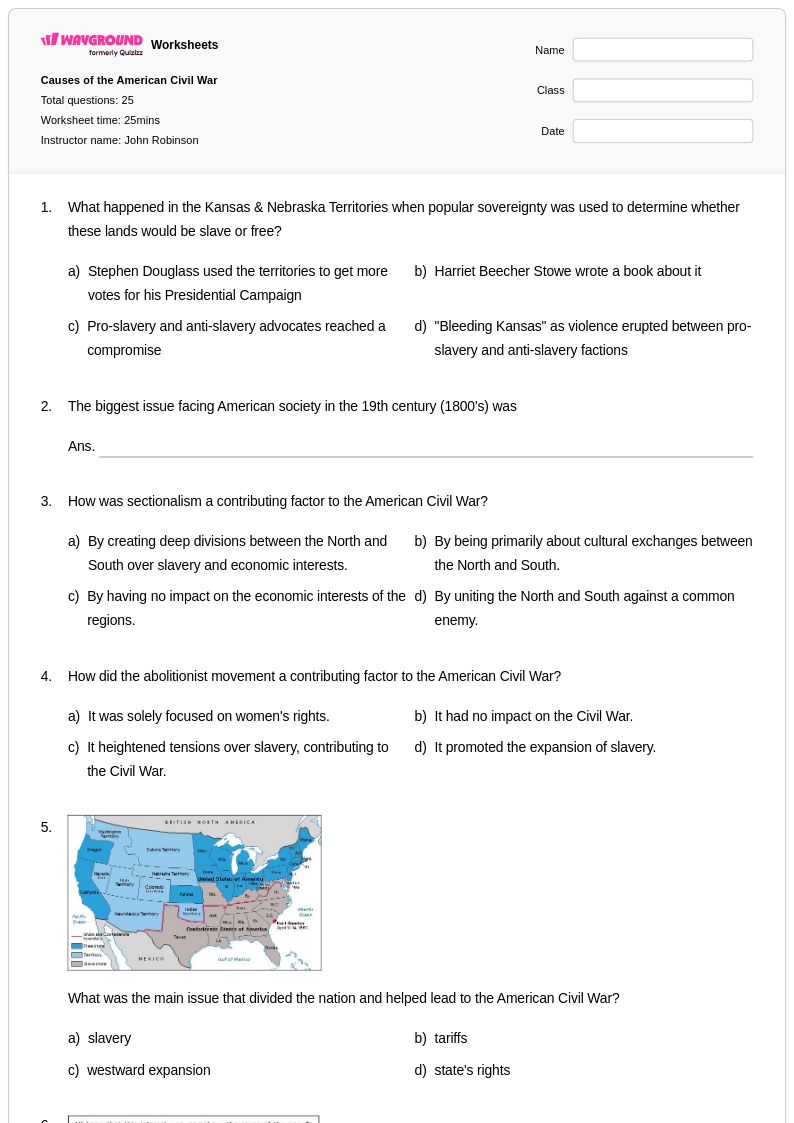
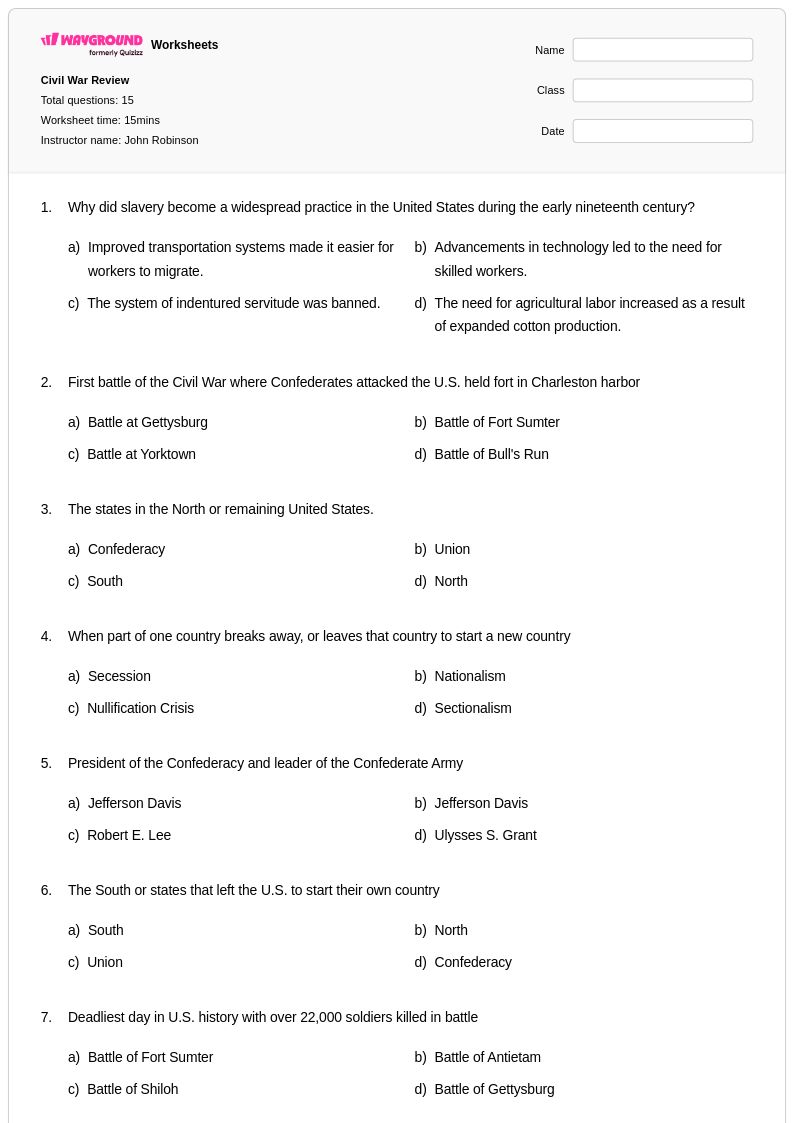
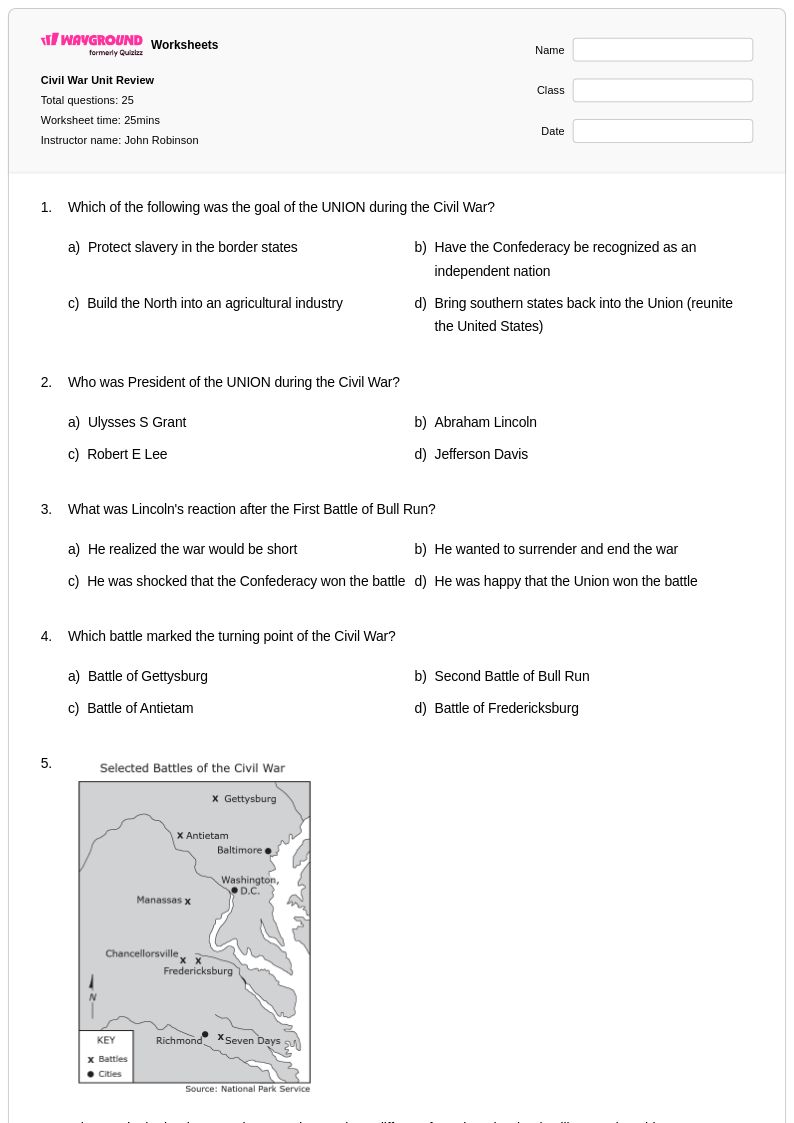
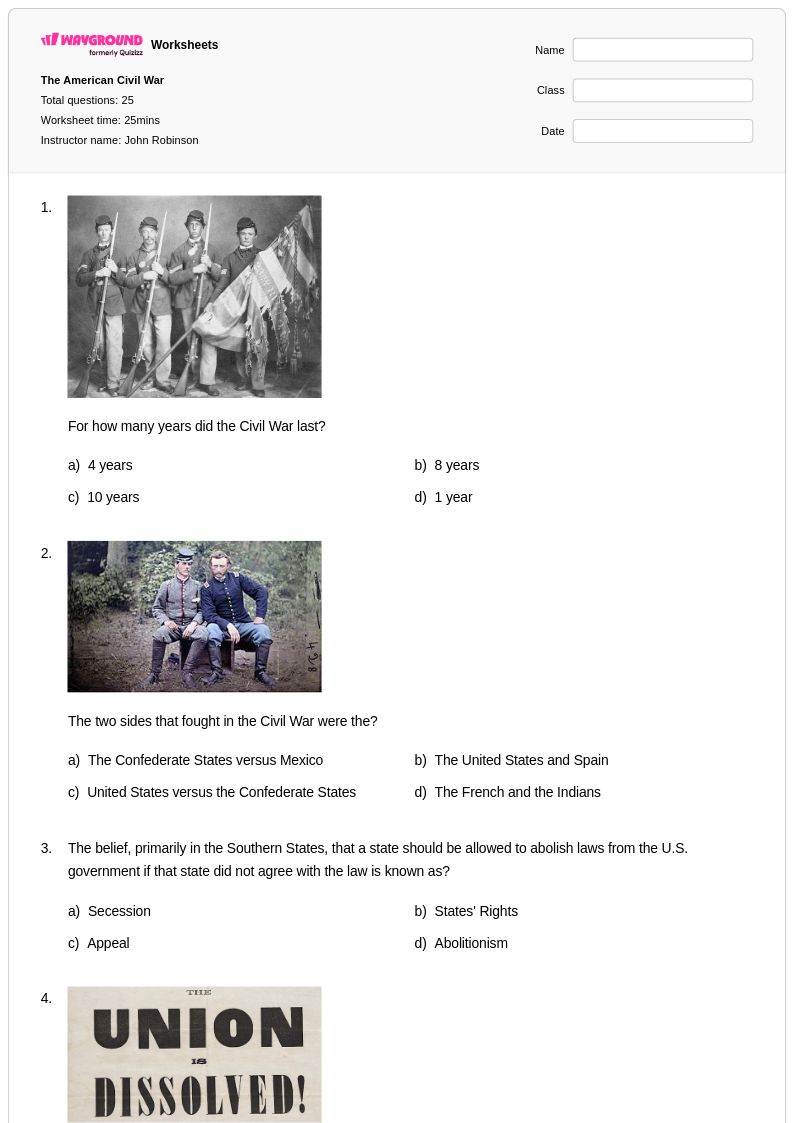
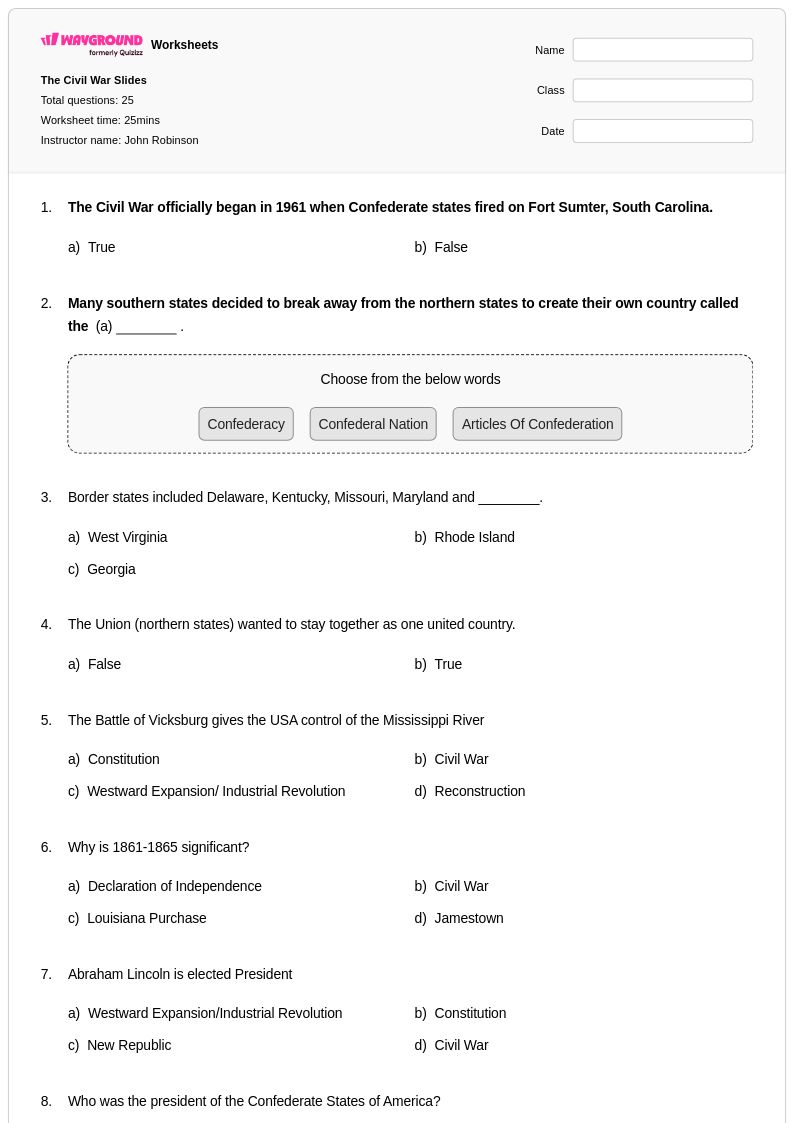
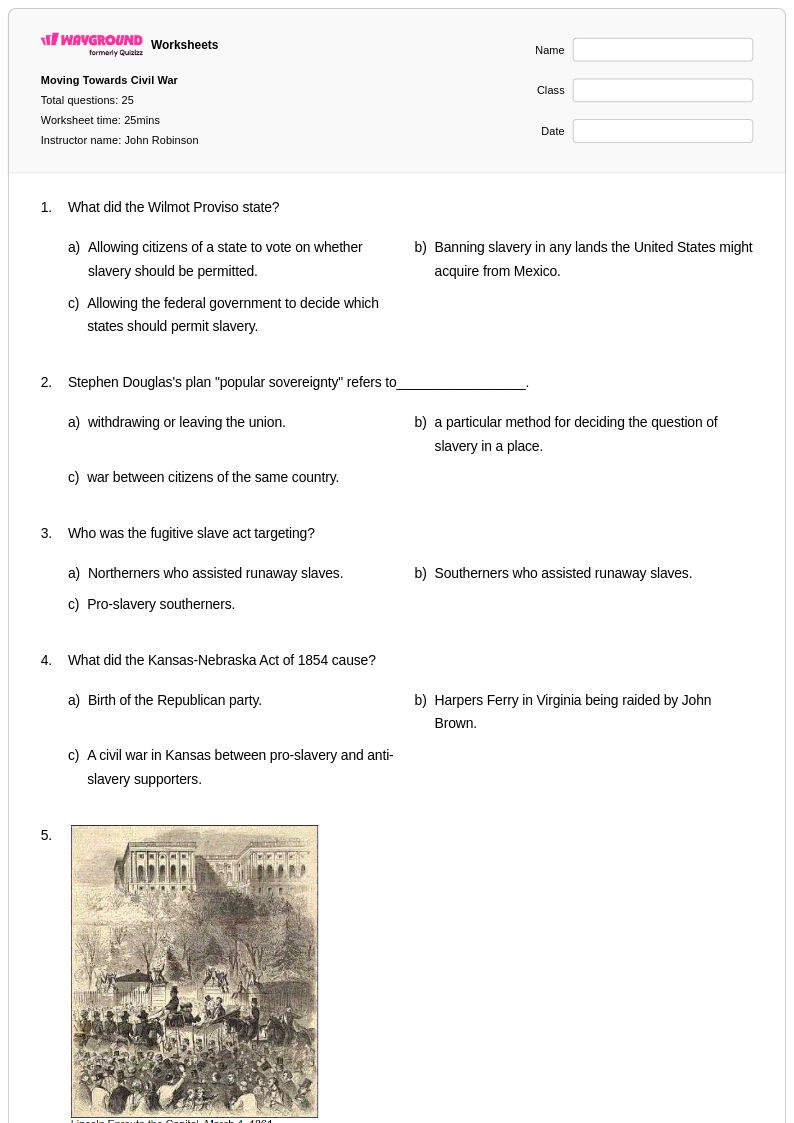
Class 12 Civil War worksheets from Wayground offer comprehensive printables and practice problems that help students master key battles, causes, and consequences of America's defining conflict, complete with answer keys and free PDF downloads.
Explore printable Civil War worksheets for Class 12
Civil War worksheets for Class 12 students available through Wayground (formerly Quizizz) provide comprehensive resources for exploring this pivotal period in American history. These expertly crafted materials help students develop critical analysis skills as they examine the complex causes, key battles, political decisions, and lasting consequences of the conflict between 1861-1865. Students engage with primary source documents, analyze military strategies, evaluate the roles of prominent figures like Lincoln, Grant, and Lee, and assess the war's impact on slavery, economics, and national unity. Each worksheet collection includes detailed answer keys and is available as free printable pdf downloads, making them accessible for both classroom instruction and independent practice. The practice problems range from document-based questions to comparative analysis exercises that strengthen students' ability to synthesize historical evidence and construct well-supported arguments about this transformative era.
Wayground (formerly Quizizz) empowers educators with millions of teacher-created Civil War resources that streamline lesson planning and enhance student learning outcomes. The platform's robust search and filtering capabilities allow teachers to quickly locate materials aligned with state and national social studies standards, while built-in differentiation tools enable customization based on individual student needs and learning objectives. These Class 12 Civil War worksheets are available in both printable pdf format and interactive digital versions, providing flexibility for traditional classroom settings, remote learning environments, and blended instruction models. Teachers utilize these comprehensive collections for targeted skill practice, remediation support for struggling learners, and enrichment opportunities for advanced students, ensuring that all Class 12 students develop the historical thinking skills necessary for success in advanced coursework and civic engagement.
FAQs
How do I teach the Civil War to middle or high school students?
Teaching the Civil War effectively means organizing instruction around the three core phases: causes (sectionalism, slavery, states' rights, economic divides), the war itself (key battles, military leadership, turning points), and consequences (Emancipation Proclamation, Reconstruction, lasting social change). Grounding lessons in primary sources — letters, speeches, photographs, and official documents — helps students move beyond memorization toward genuine historical analysis. Structured cause-and-effect activities and timeline construction are particularly effective for building chronological understanding and analytical thinking.
What exercises help students practice analyzing Civil War causes and consequences?
Cause-and-effect graphic organizers are among the most effective tools for helping students trace how sectional tensions escalated into armed conflict and how the war's outcome reshaped American society. Primary source document analysis — such as Lincoln's Gettysburg Address, the Emancipation Proclamation, or Confederate secession declarations — pushes students to evaluate evidence and draw reasoned conclusions. Combining these with timeline construction exercises builds both chronological literacy and the ability to see connections across events.
What are the most common misconceptions students have about the Civil War?
One of the most persistent misconceptions is that the Civil War was primarily fought over states' rights in a general sense, when in fact the central right in dispute was the preservation of slavery. Students also frequently conflate the Emancipation Proclamation with the abolition of slavery nationwide, not realizing it applied only to Confederate-held states and was a wartime measure. A third common error is viewing the war as a series of isolated battles rather than understanding how military strategy, political decisions, and economic pressures interacted throughout the conflict.
How can I use Civil War worksheets to support students with different learning needs?
Civil War worksheets on Wayground can be used alongside the platform's built-in accommodation tools to support diverse learners. Teachers can enable Read Aloud for students who need audio support when working through primary source documents or complex comprehension questions, and Reduced Answer Choices can lower cognitive load for students who struggle with multiple-choice formats. Extended time settings can be applied to individual students without disrupting the rest of the class, and all accommodation preferences are saved for reuse across future sessions.
How do I use Civil War worksheets from Wayground in my classroom?
Civil War worksheets on Wayground are available as printable PDFs for traditional classroom use and in digital formats for technology-integrated environments, including the option to host them as a quiz directly on Wayground. Each worksheet includes a complete answer key, which reduces grading time and allows for faster feedback cycles. Teachers can use them for direct instruction support, independent practice, formative assessment, or review before tests.
How do I differentiate Civil War instruction for advanced versus struggling students?
For struggling students, focus on scaffolded materials that build comprehension before analysis — vocabulary support, guided reading questions, and structured timelines help establish the foundational knowledge they need. Advanced students benefit from essay prompts that require synthesizing evidence across multiple sources, such as comparing Union and Confederate motivations or evaluating the long-term effectiveness of Reconstruction policies. Wayground's customization features allow teachers to modify content complexity within the same worksheet set, so both groups can work with Civil War material at an appropriately challenging level.