Free Printable Color Mixing Worksheets for Class 1
Explore Class 1 color mixing worksheets and free printables that help young students discover how primary colors combine to create new colors through hands-on science practice problems with answer keys.
Explore printable Color Mixing worksheets for Class 1
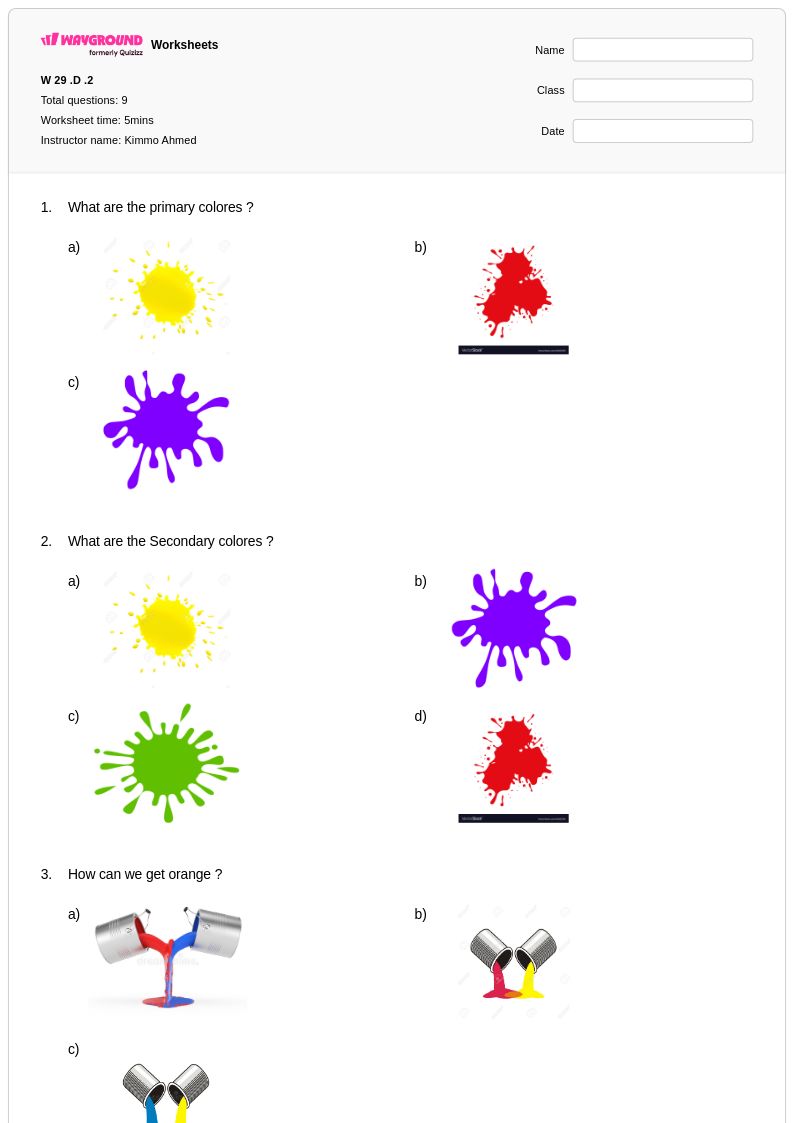
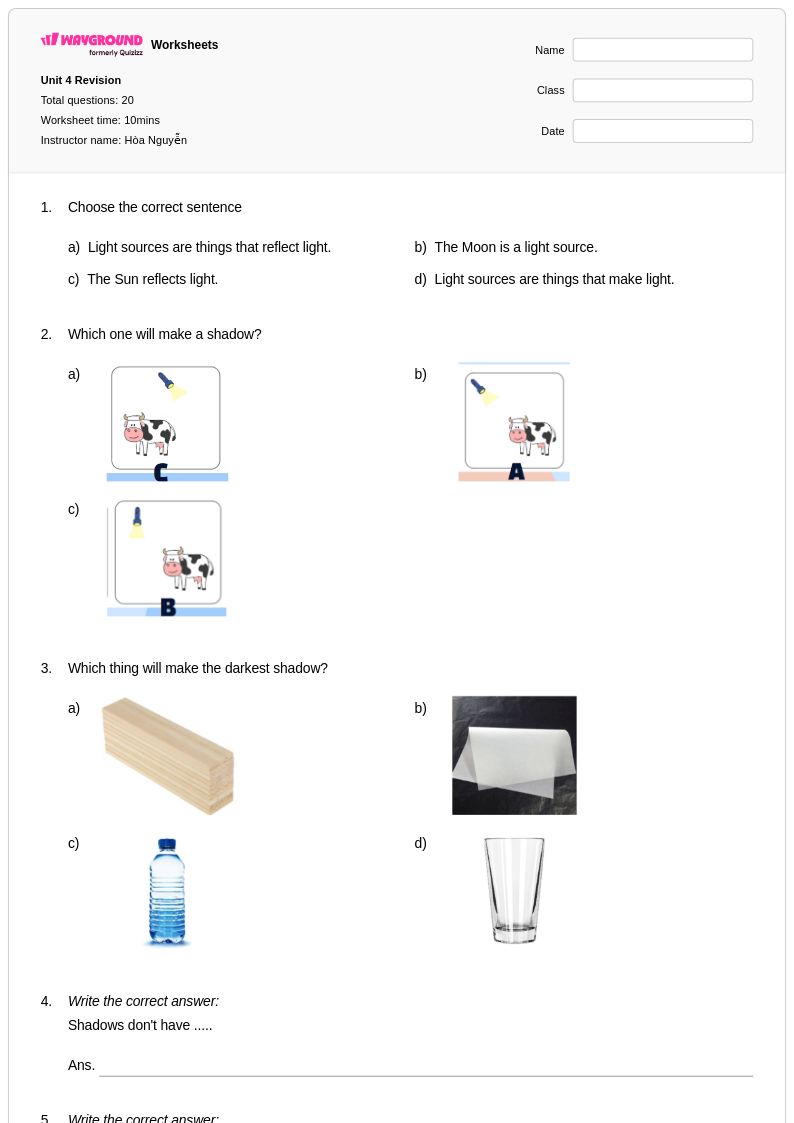
Color mixing worksheets for Class 1 students available through Wayground (formerly Quizizz) introduce young learners to fundamental concepts in physics through hands-on exploration of how different colors combine to create new hues. These educational resources strengthen critical observation skills, scientific reasoning, and understanding of light and color theory at an age-appropriate level. The comprehensive collection includes free printables that guide students through systematic color mixing experiments, practice problems that reinforce learning outcomes, and engaging activities with complete answer keys that support both independent work and teacher-led instruction. Each worksheet is designed as a convenient pdf download, making them easily accessible for classroom use, homework assignments, or supplemental learning activities that build foundational physics concepts through visual and tactile experiences.
Wayground (formerly Quizizz) empowers educators with millions of teacher-created resources specifically designed for Class 1 color mixing instruction, featuring robust search and filtering capabilities that help locate materials perfectly suited to individual classroom needs. The platform's standards alignment ensures these physics worksheets meet curriculum requirements while offering differentiation tools that accommodate diverse learning styles and ability levels within the same grade. Teachers benefit from flexible customization options that allow modification of existing materials, plus seamless availability in both printable and digital pdf formats for versatile classroom implementation. These comprehensive features streamline lesson planning while providing targeted resources for remediation support, enrichment opportunities, and systematic skill practice that helps young students develop a solid foundation in scientific observation and color theory principles.
FAQs
How do I teach color mixing to students in a science class?
Start by distinguishing between additive color mixing (light) and subtractive color mixing (pigments), since students frequently confuse the two systems. For additive mixing, use examples like stage lighting or screens where red, green, and blue light combine to produce white. For subtractive mixing, connect pigment theory to real-world materials like paint and ink, where cyan, magenta, and yellow are the true primaries. Hands-on observation activities, such as mixing colored cellophane sheets under a flashlight or blending watercolors, help students internalize the difference before moving to more abstract worksheet practice.
What exercises help students practice primary, secondary, and tertiary color relationships?
Color wheel completion activities are highly effective because they require students to apply both primary and secondary color mixing rules simultaneously rather than recall them in isolation. Color prediction exercises, where students are given two input colors and must identify the result, build procedural fluency with both pigment and light mixing. Worksheets that ask students to work backwards from a mixed color to its components deepen conceptual understanding and are particularly useful for reinforcing tertiary color relationships.
What mistakes do students commonly make when learning color mixing?
The most persistent misconception is applying pigment color rules (red, yellow, blue as primaries) to light, where the primaries are actually red, green, and blue. Students also frequently assume that mixing all colors of light produces black rather than white, which is the opposite of what happens with pigments. Another common error is treating secondary colors as arbitrary rather than understanding that they are predictable results of specific wavelength combinations. Addressing these misconceptions explicitly before worksheet practice prevents students from reinforcing incorrect models.
How does color mixing connect to the electromagnetic spectrum and light wavelengths?
Color perception is directly tied to wavelength: the human eye contains cone cells sensitive to roughly red (long wavelength), green (medium), and blue (short wavelength) light. Additive color mixing works because combining light of different wavelengths stimulates these cones in different proportions, producing the perception of a new color. Teaching this connection helps students understand why additive and subtractive mixing follow different rules, grounding color theory in physics rather than treating it as purely an art concept.
How do I use Wayground's color mixing worksheets in my classroom?
Wayground's color mixing worksheets are available as printable PDFs for traditional classroom use and in digital formats for technology-integrated environments, including the option to host them as a quiz directly on the Wayground platform. Answer keys are included with each worksheet, reducing teacher prep time for grading and self-checking activities. The digital format allows teachers to apply accommodations for individual students, such as read aloud support, extended time, or reduced answer choices, directly through the platform's student settings.
How do I differentiate color mixing instruction for students at different skill levels?
For students who need additional support, begin with concrete pigment mixing (paint or food coloring) before introducing abstract diagrams or light-based examples, since tactile experience builds the mental model faster. More advanced students can be challenged to explain the physics of why additive and subtractive systems behave differently or to predict the results of three-color mixing scenarios. On Wayground, teachers can apply individual accommodations such as reduced answer choices or read aloud settings to specific students without affecting the rest of the class, making it straightforward to run differentiated digital practice within a single session.