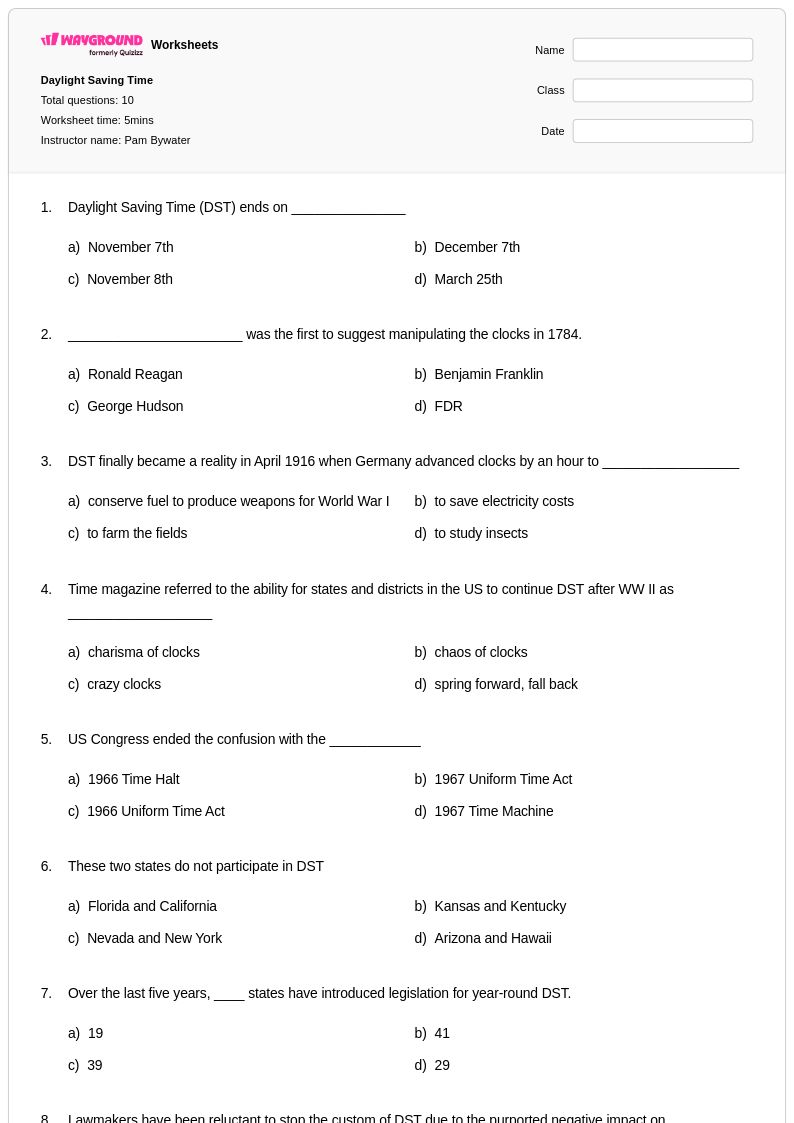
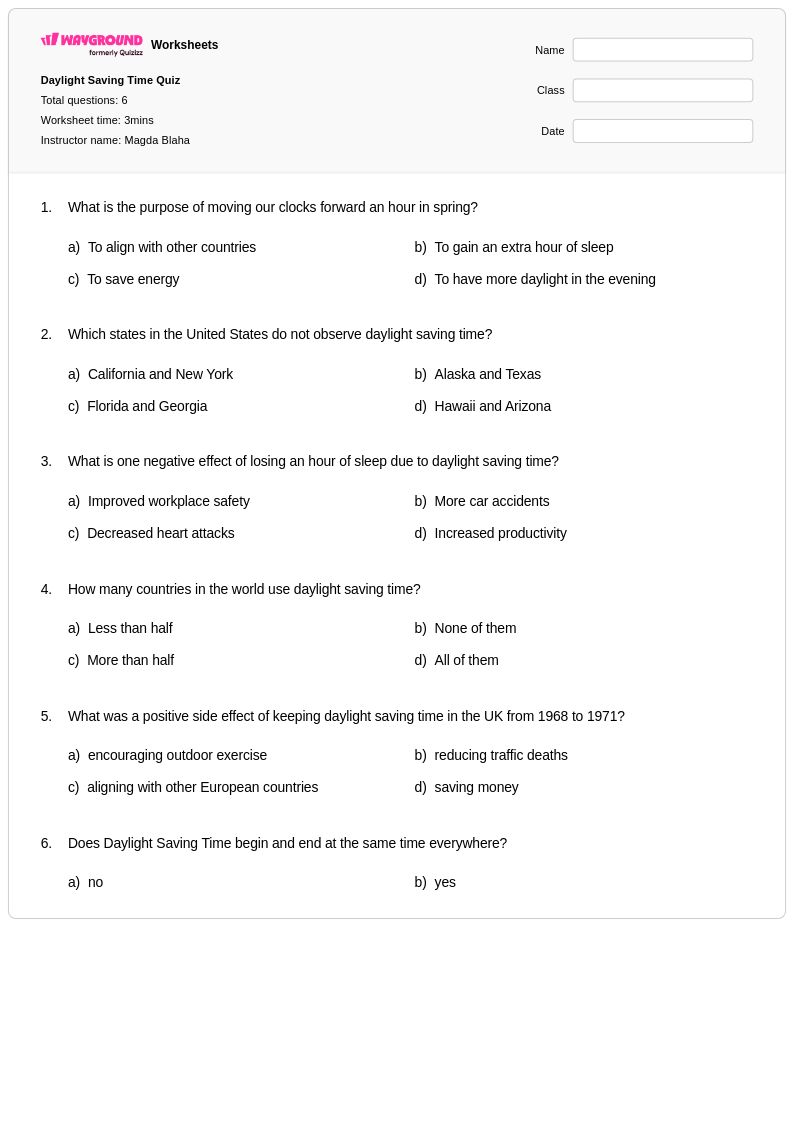
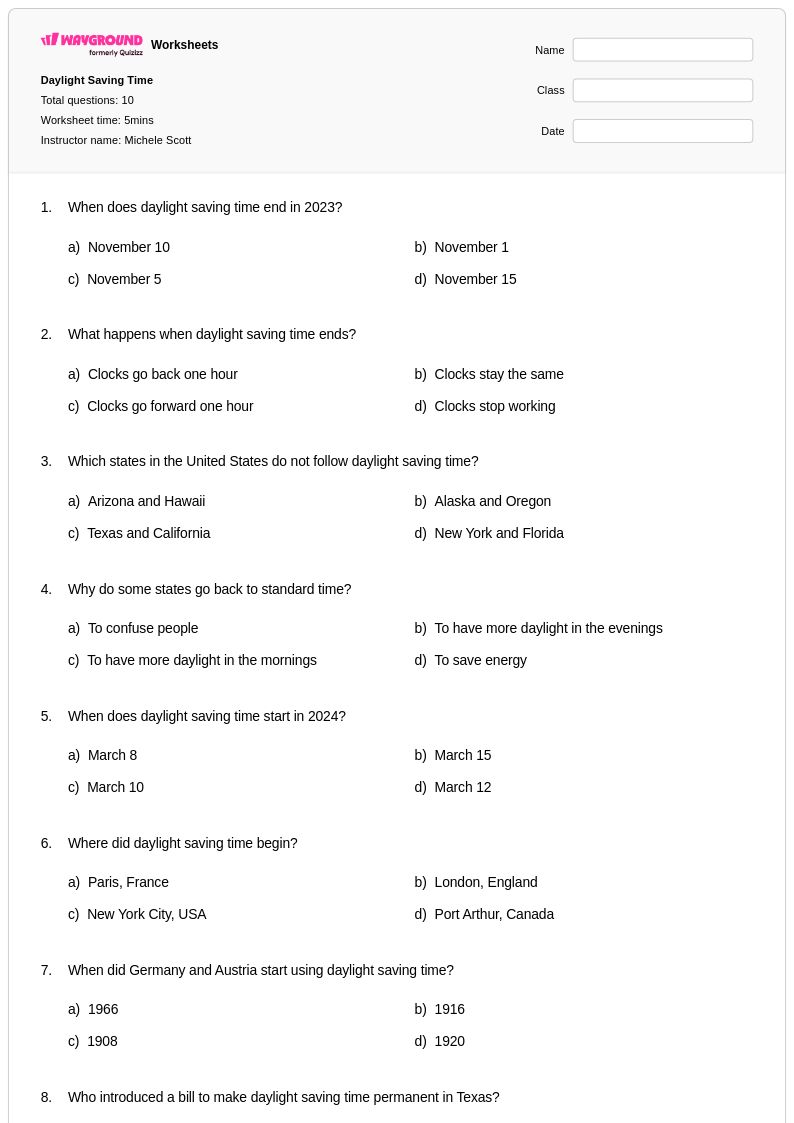
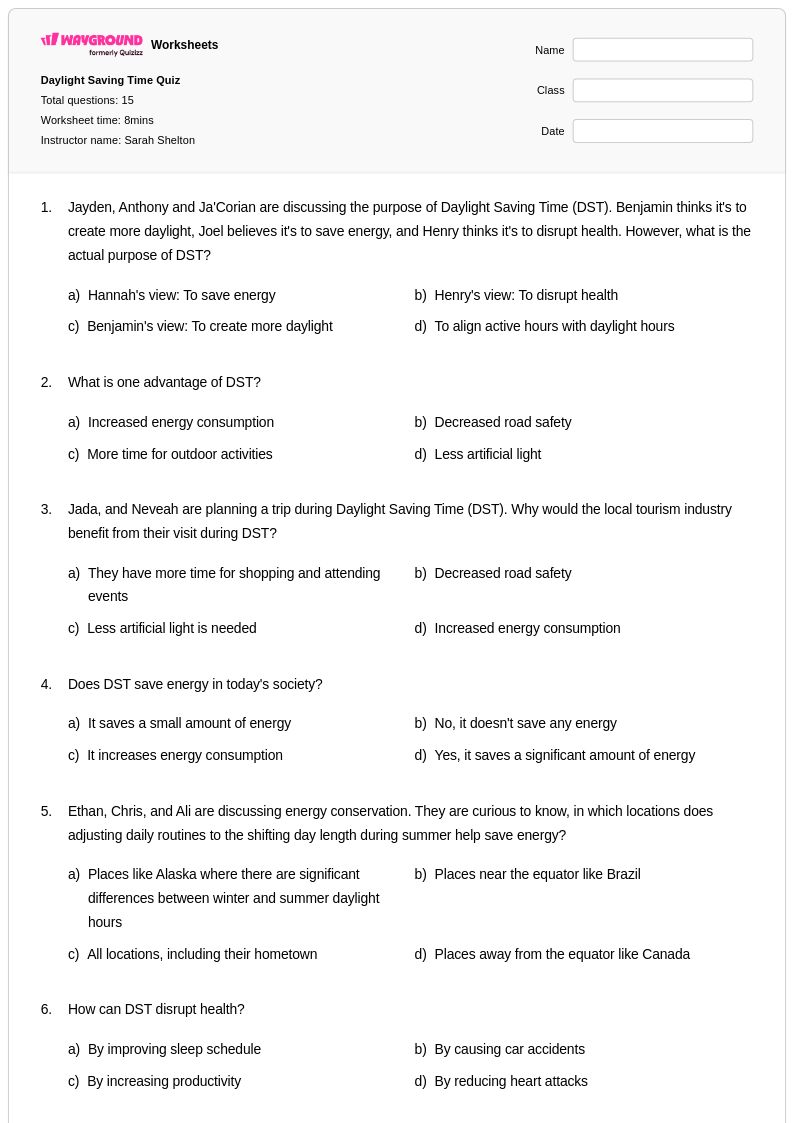
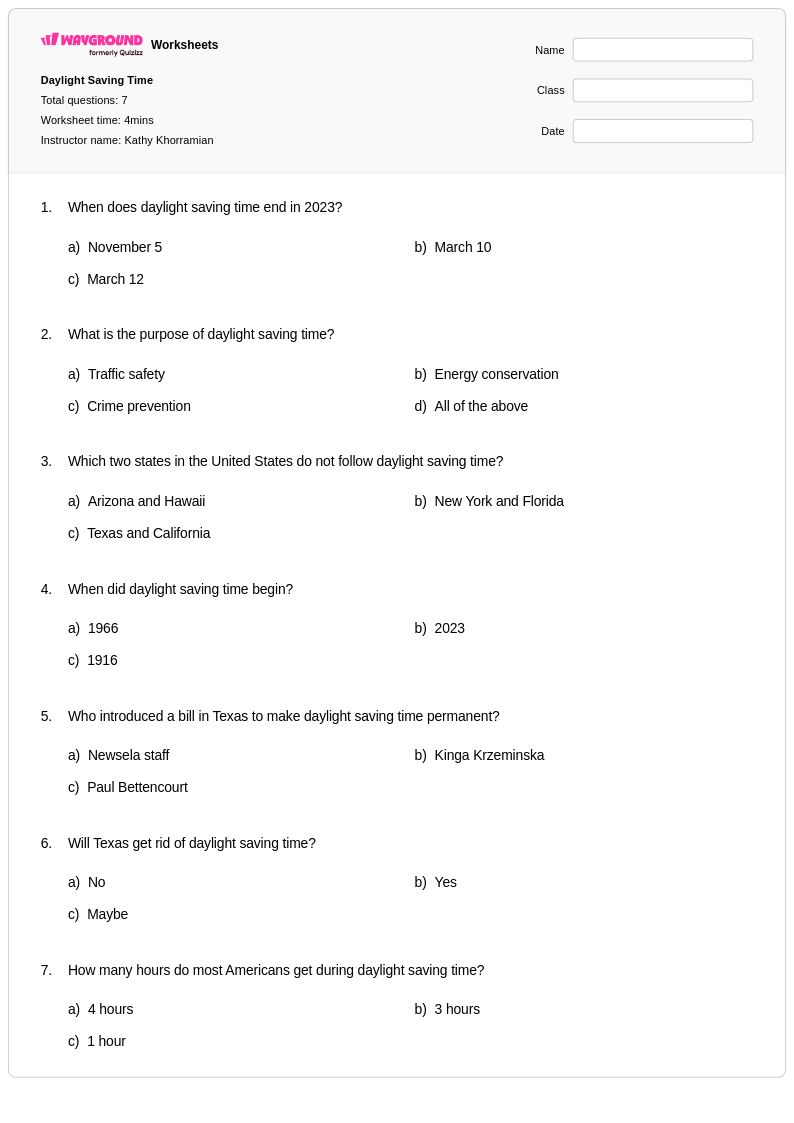
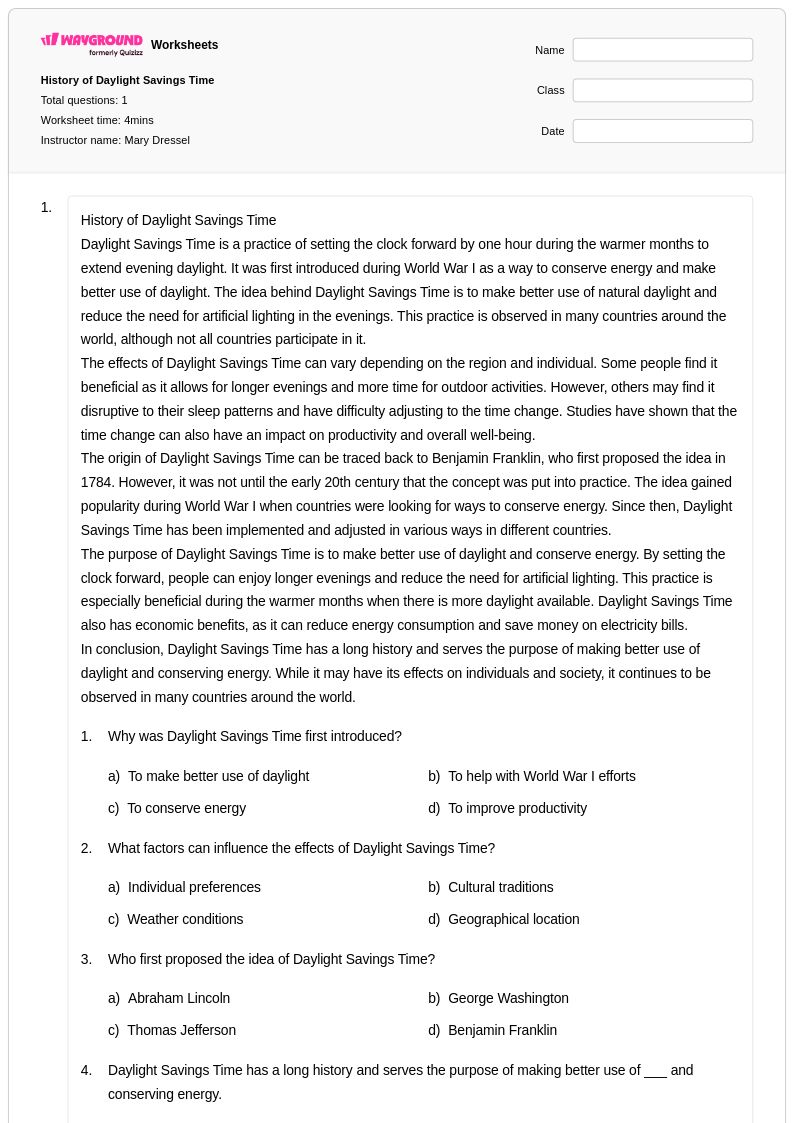
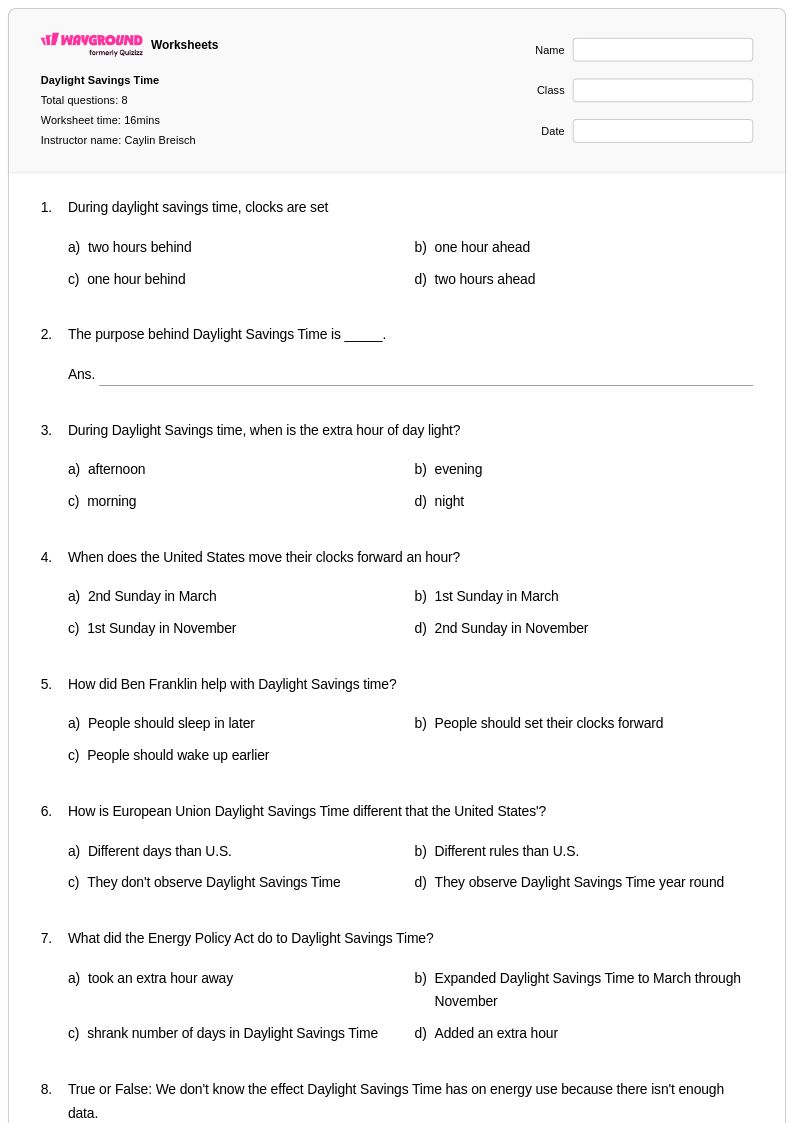
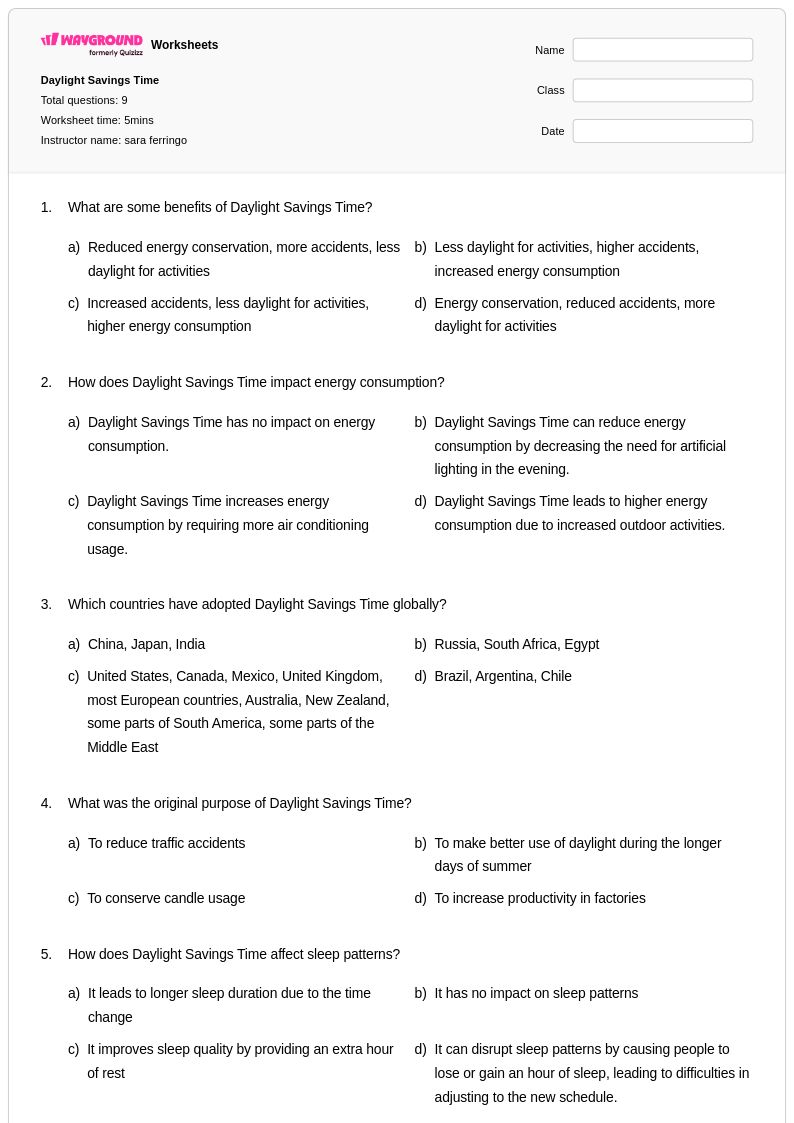
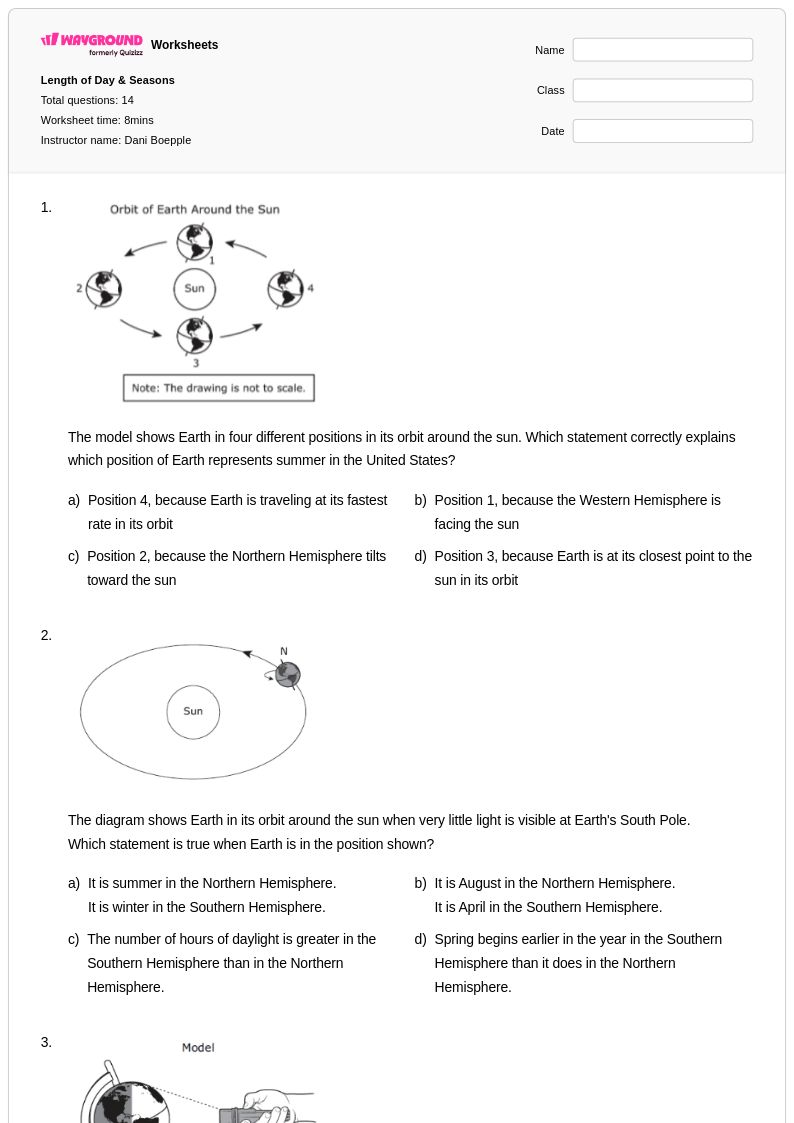
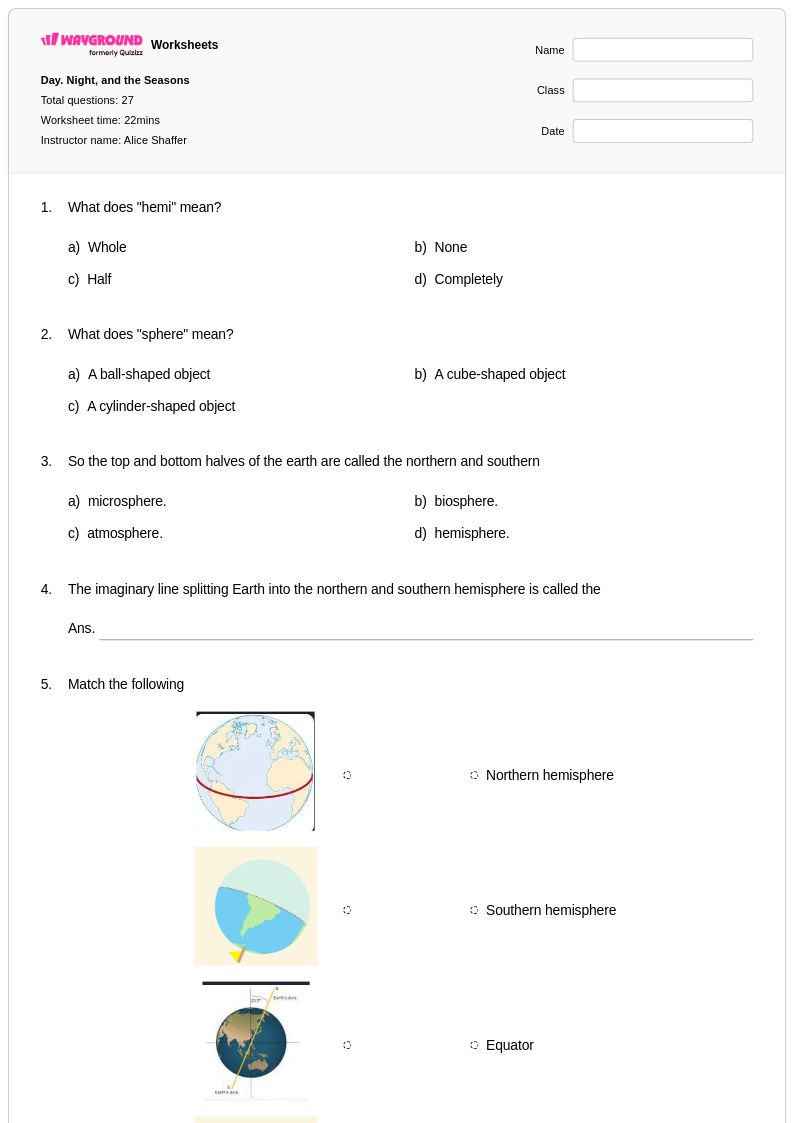
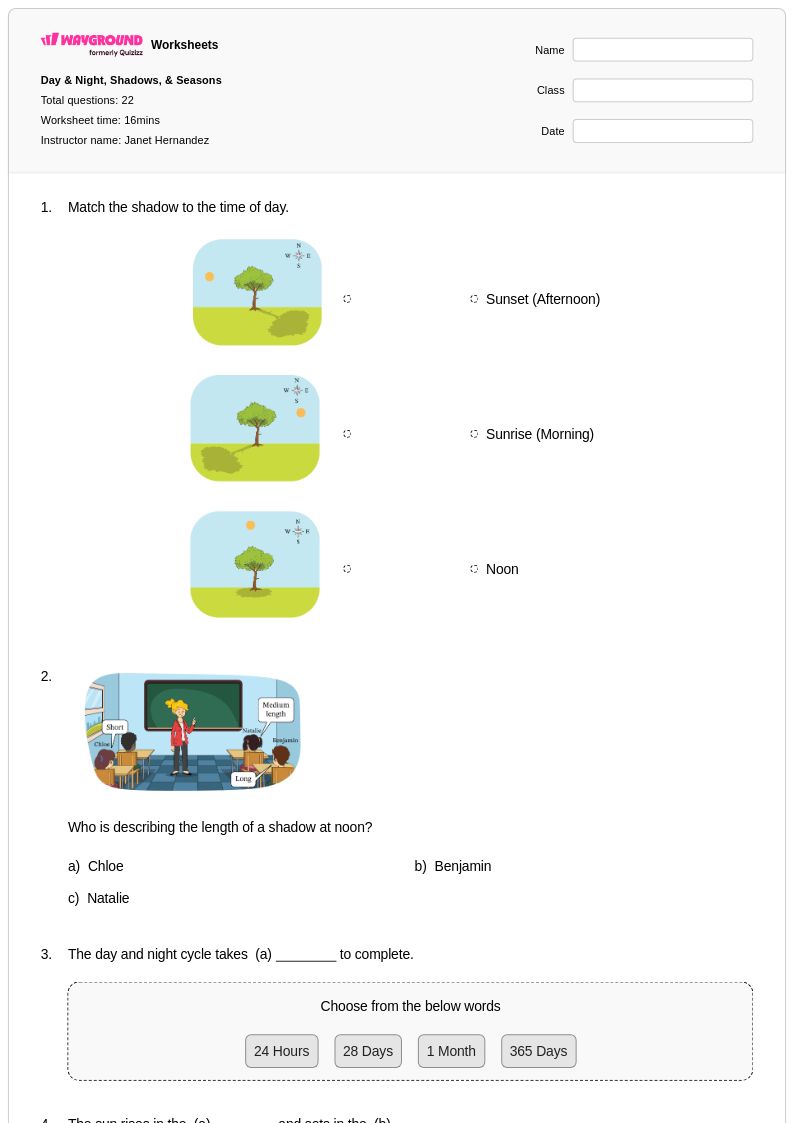
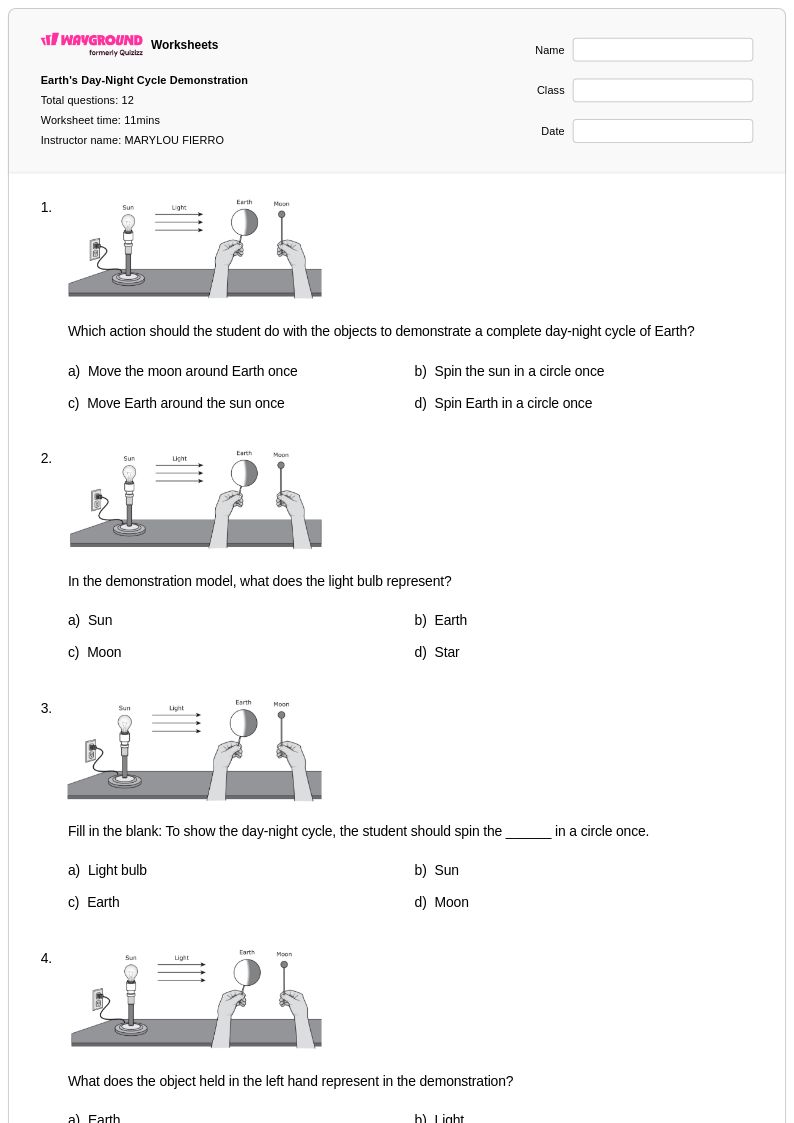
Explore free Daylight Saving Time worksheets and printables from Wayground that help students understand this Earth & Space Science concept through engaging practice problems and comprehensive answer keys.
Daylight Saving Time worksheets available through Wayground (formerly Quizizz) provide students with comprehensive practice materials that explore this fascinating intersection of astronomy, geography, and human timekeeping systems. These educational resources strengthen critical thinking skills as students examine why societies adjust their clocks, analyze the relationship between Earth's rotation and solar time, and investigate how daylight patterns change throughout the year at different latitudes. The worksheets feature engaging practice problems that challenge students to calculate time zone differences during standard and daylight saving periods, interpret data about sunrise and sunset times, and evaluate the historical and contemporary impacts of this time adjustment system. Each worksheet collection includes detailed answer keys and is available as free printables in convenient pdf format, allowing educators to seamlessly integrate these materials into their Earth and space science curriculum.
Wayground (formerly Quizizz) supports educators with an extensive collection of teacher-created Daylight Saving Time resources, drawing from millions of carefully curated materials that address diverse learning needs and instructional approaches. The platform's robust search and filtering capabilities enable teachers to quickly locate worksheets that align with specific learning standards while offering differentiation tools that accommodate varying student readiness levels and learning preferences. These flexible customization features allow educators to modify content, adjust difficulty levels, and personalize practice problems to match their classroom objectives, whether for initial skill introduction, targeted remediation, or advanced enrichment activities. Available in both printable and digital formats including downloadable pdf versions, these comprehensive worksheet collections streamline lesson planning while providing teachers with reliable, standards-aligned resources for reinforcing students' understanding of time systems, seasonal patterns, and the scientific principles underlying our modern approach to timekeeping.
FAQs
How do I teach Daylight Saving Time to students?
Start by grounding students in Earth's rotation and its relationship to solar time, then explain why daylight hours shift across seasons depending on latitude. From there, introduce Daylight Saving Time as a human system designed to align waking hours with available sunlight. Using real sunrise and sunset data and time zone maps helps students connect the abstract concept to observable, everyday experience.
What exercises help students practice understanding Daylight Saving Time?
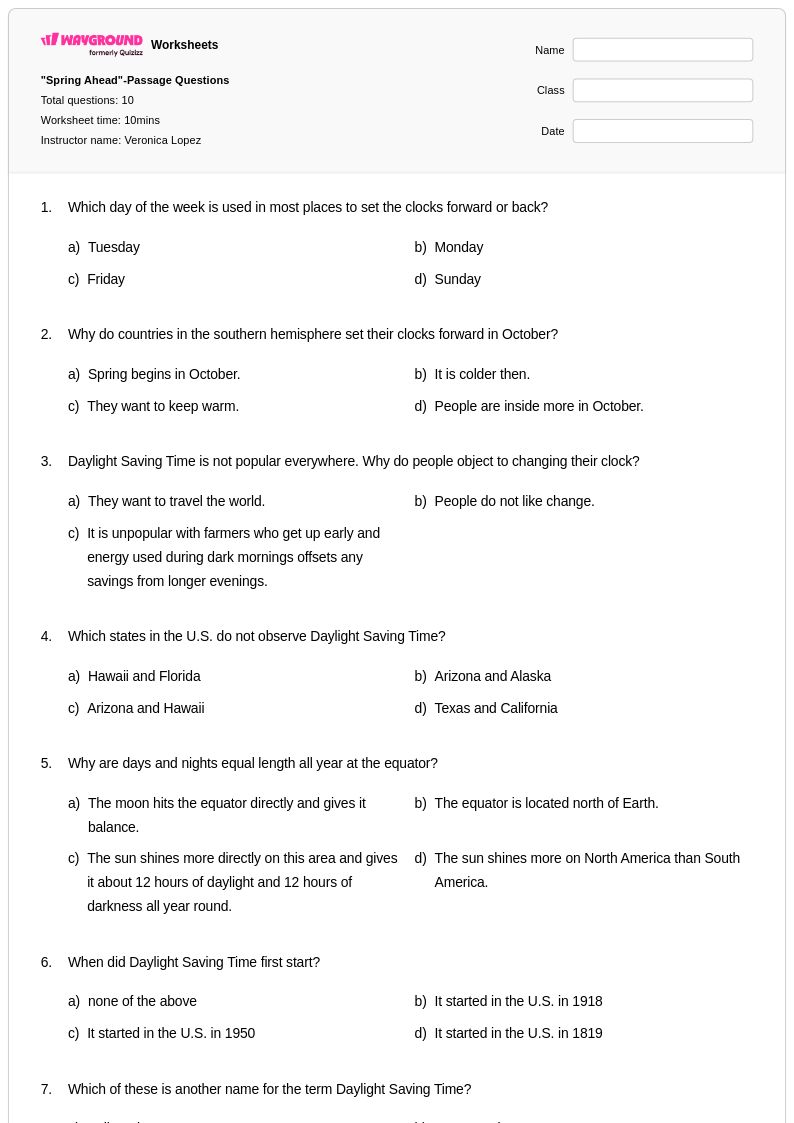
Effective practice involves calculating time differences between locations during both standard and daylight saving periods, interpreting sunrise and sunset data tables, and comparing daylight hours across different latitudes and seasons. Problems that ask students to convert times across time zones before and after the clock change are especially useful for building precision and reinforcing the real-world mechanics of the system.
What misconceptions do students commonly have about Daylight Saving Time?
A common misconception is that Daylight Saving Time creates more daylight, when in fact it only shifts when that daylight occurs relative to the clock. Students also often confuse the reason for seasonal daylight changes, attributing them to Daylight Saving Time rather than Earth's axial tilt and orbit. Clarifying that DST is a policy decision layered on top of natural astronomical patterns helps students separate the science from the human system.
How can I use Daylight Saving Time worksheets in my classroom?
Daylight Saving Time worksheets from Wayground are available as printable PDFs for traditional classroom use and in digital formats for technology-integrated environments, including the option to host them as a quiz directly on Wayground. This flexibility makes them suitable for in-class assignments, homework, or self-paced digital practice. Each worksheet includes a complete answer key, so teachers can use them for independent work, partner review, or guided instruction without additional prep.
How does Daylight Saving Time connect to Earth and Space Science standards?
Daylight Saving Time sits at the intersection of astronomy, geography, and human systems, making it a relevant application topic within Earth and Space Science units covering Earth's rotation, time zones, and seasonal patterns. It gives teachers a real-world context for students to apply knowledge about solar time, latitude, and daylight variation rather than treating these as purely abstract concepts.
How do I differentiate Daylight Saving Time instruction for students at different readiness levels?
For students who need additional support, reduce the complexity of time zone calculations and focus first on interpreting single-location sunrise and sunset data before introducing multi-zone comparisons. More advanced students can analyze historical and geographic differences in DST adoption or evaluate arguments for and against the policy. On Wayground, teachers can apply accommodations such as reduced answer choices or read-aloud support to individual students without disrupting the rest of the class.