Free Printable Earthquakes and Volcanoes Worksheets for Class 9
Discover free Class 9 earthquakes and volcanoes worksheets and printables from Wayground that help students master seismic activity, tectonic processes, and volcanic formations through engaging practice problems with complete answer keys.
Explore printable Earthquakes and Volcanoes worksheets for Class 9
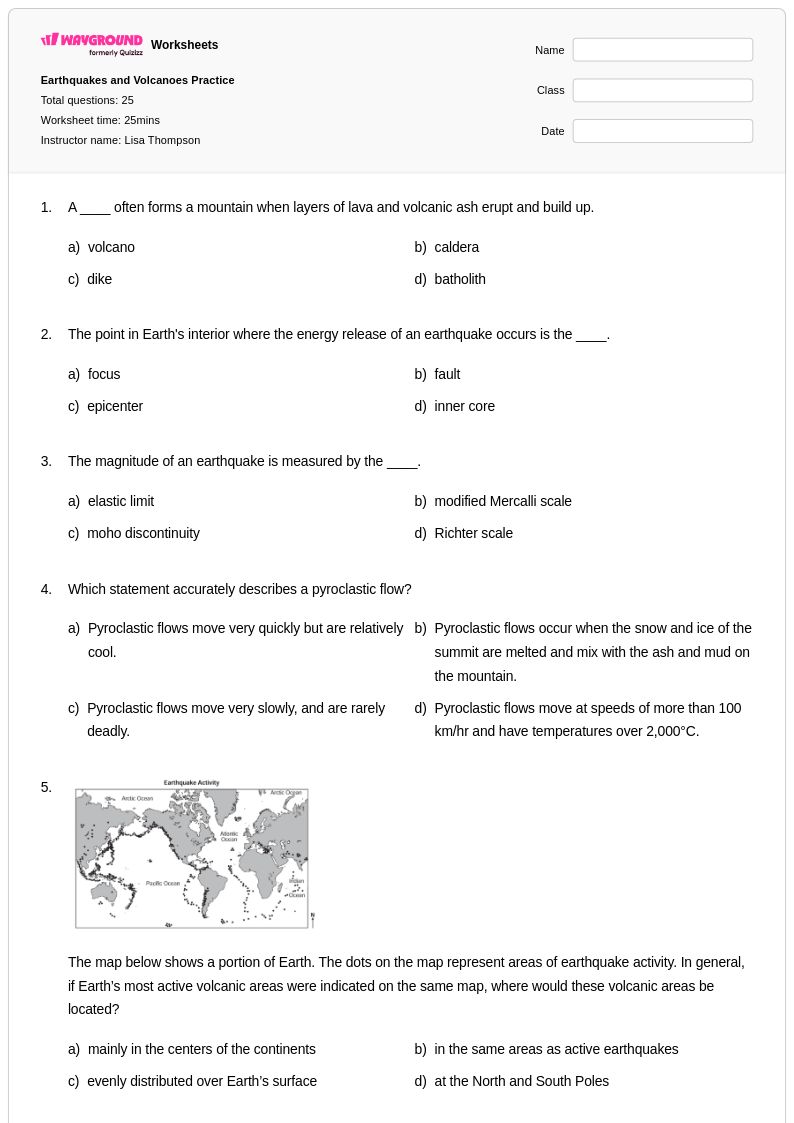
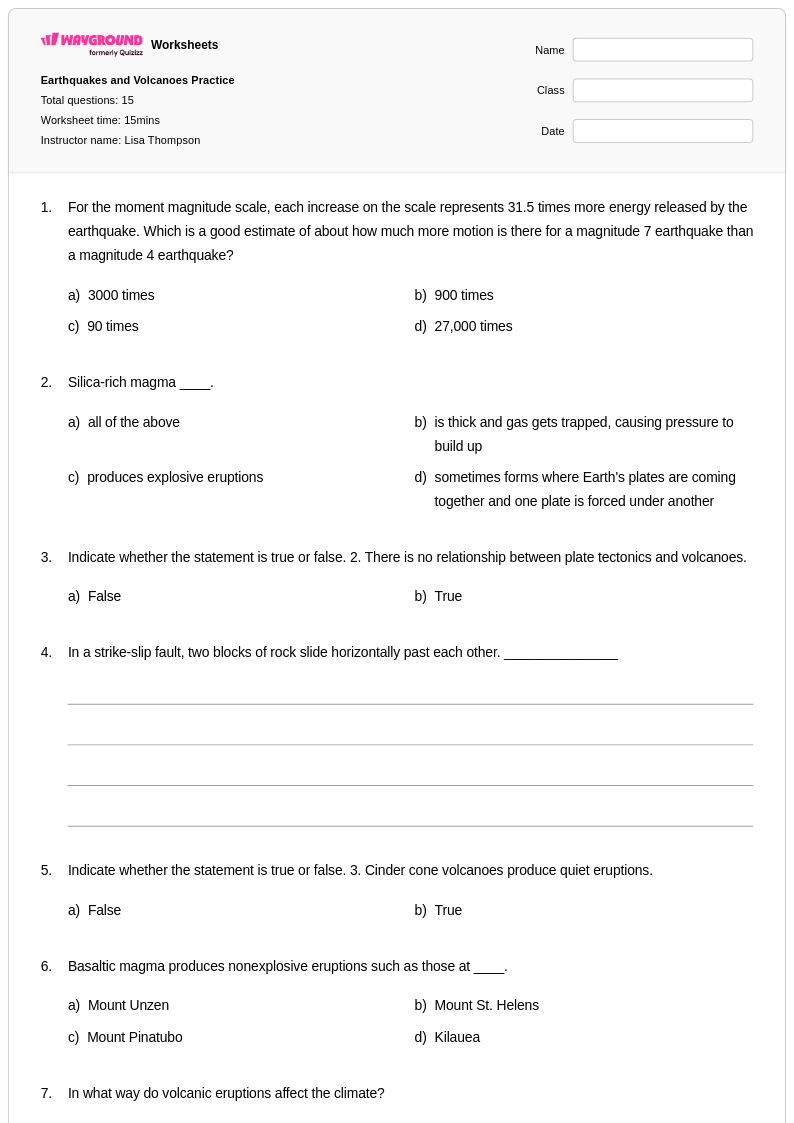
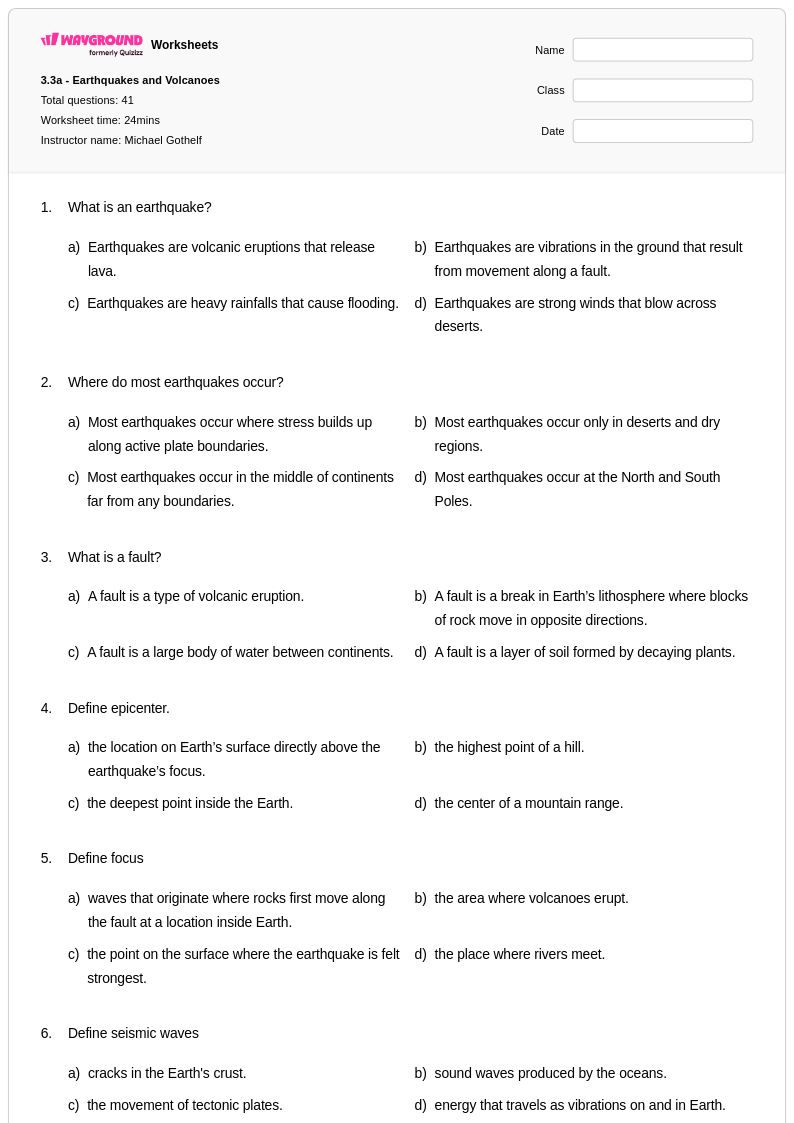
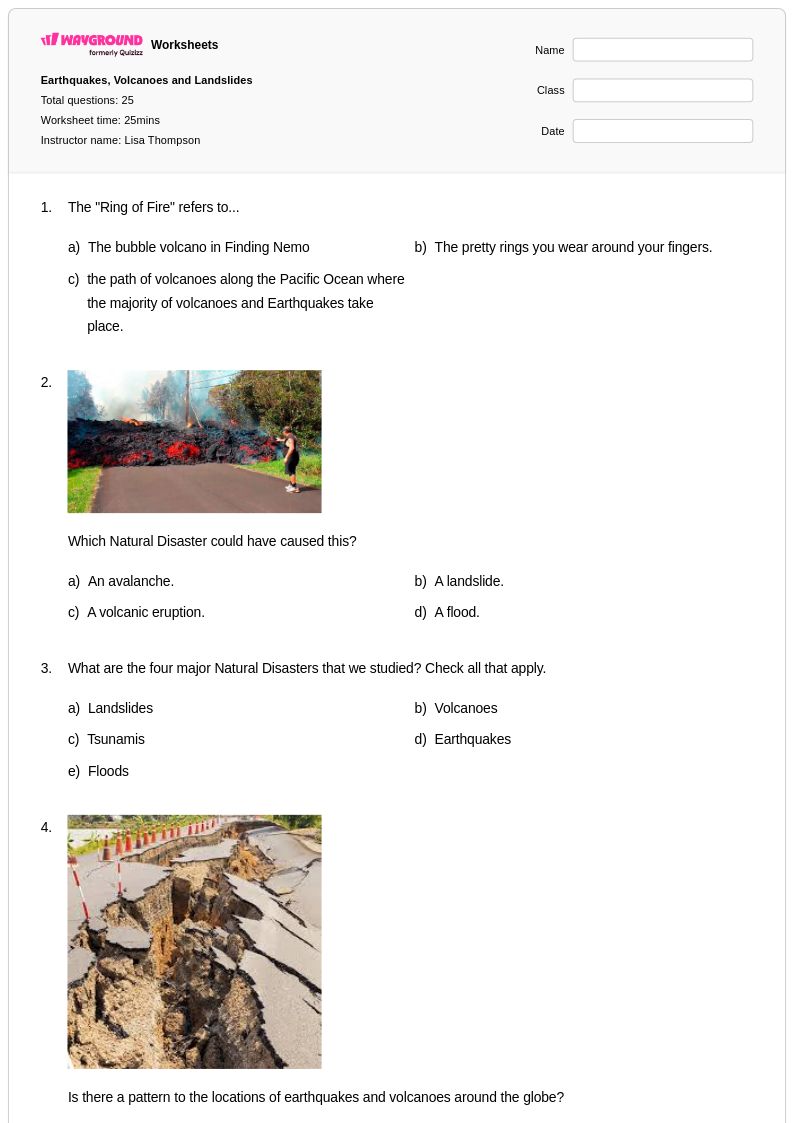
Class 9 earthquakes and volcanoes worksheets through Wayground (formerly Quizizz) provide comprehensive educational resources that help students master the fundamental concepts of seismic activity and volcanic processes. These expertly designed worksheets strengthen critical thinking skills as students analyze tectonic plate movements, interpret seismograph data, examine volcanic eruption patterns, and evaluate the geological factors that contribute to natural disasters. The collection includes practice problems that challenge students to apply scientific principles while working with real-world scenarios, from calculating earthquake magnitudes using the Richter scale to identifying different types of volcanic formations. Each worksheet comes with a detailed answer key to support both independent study and classroom instruction, and the materials are available as free printables in convenient pdf format for easy distribution and accessibility.
Wayground's extensive platform supports science educators with millions of teacher-created resources specifically focused on earthquakes and volcanoes content, featuring robust search and filtering capabilities that allow instructors to quickly locate materials aligned with their curriculum standards and learning objectives. The platform's differentiation tools enable teachers to customize worksheets based on individual student needs, whether for remediation support or enrichment challenges, while maintaining the academic rigor appropriate for Class 9 Earth and Space Science coursework. These versatile resources are available in both printable and digital formats, including downloadable pdf versions, making them ideal for various classroom settings and teaching approaches. Teachers can seamlessly integrate these materials into their lesson planning for skill practice sessions, formative assessments, or homework assignments, ensuring students develop a thorough understanding of geological processes and their impact on Earth's surface.
FAQs
How do I teach earthquakes and volcanoes in a way students actually understand?
Start by grounding instruction in plate tectonics — students need to understand that most earthquakes and volcanic eruptions occur at plate boundaries before they can make sense of specific events. Use real seismograph data and maps of the Ring of Fire to connect abstract theory to observable patterns. Case studies of well-known events like the 1980 Mount St. Helens eruption or the 2011 Tōhoku earthquake help students see how geological forces play out in practice.
What practice exercises help students understand earthquake magnitude and seismic waves?
Worksheets that ask students to interpret seismograph readings and compare P-wave and S-wave arrival times are especially effective for building conceptual understanding of how earthquakes are detected and measured. Practice problems involving the Richter and moment magnitude scales help students grasp the logarithmic nature of earthquake intensity, which is a concept many find counterintuitive. Pairing these exercises with labeled diagrams of Earth's interior reinforces why seismic wave behavior differs across layers.
What common mistakes do students make when learning about volcanoes and plate tectonics?
A frequent misconception is that all volcanoes sit at convergent plate boundaries — students often overlook hot spot volcanism, which explains islands like Hawaii that form far from any plate edge. Students also tend to conflate lava type with eruption style without understanding that silica content drives viscosity and explosive potential. Another common error is assuming earthquakes and volcanic eruptions are random rather than systematically tied to tectonic plate interactions.
How do I use Wayground's earthquakes and volcanoes worksheets in my classroom?
Wayground's earthquakes and volcanoes worksheets are available as printable PDFs for traditional classroom use and in digital formats for technology-integrated environments, accommodating different teaching setups and student preferences. Teachers can also host worksheets directly as a quiz on Wayground, enabling real-time student responses and instant feedback. Each worksheet includes a complete answer key, making them practical for independent practice, small group work, or formative assessment.
How can I differentiate earthquakes and volcanoes instruction for students with varying skill levels?
For students who need additional support, Wayground offers built-in accommodation tools including reduced answer choices to lower cognitive load, read aloud functionality for students who benefit from audio support, and extended time settings configurable per student. These accommodations can be applied to individual students while the rest of the class receives standard settings, and they carry over to future sessions without requiring repeated setup. More advanced students can be directed toward open-ended analysis tasks, such as evaluating volcanic hazard risk or comparing seismic activity across different tectonic settings.
What's the best way to assess whether students understand the relationship between Earth's internal structure and surface geological events?
Effective assessment tasks require students to explain causal connections — for example, why convection currents in the mantle drive plate movement, or why subducting oceanic plates generate both deep-focus earthquakes and arc volcanism. Short-answer and labeling questions on cross-section diagrams of Earth's layers are particularly revealing because they expose whether students understand mechanism, not just vocabulary. Look for whether students can transfer their understanding to unfamiliar scenarios, such as predicting earthquake risk in a region based on a map of plate boundaries.